
Where taking the first steps is a dream
- World Cerebral Palsy Day today

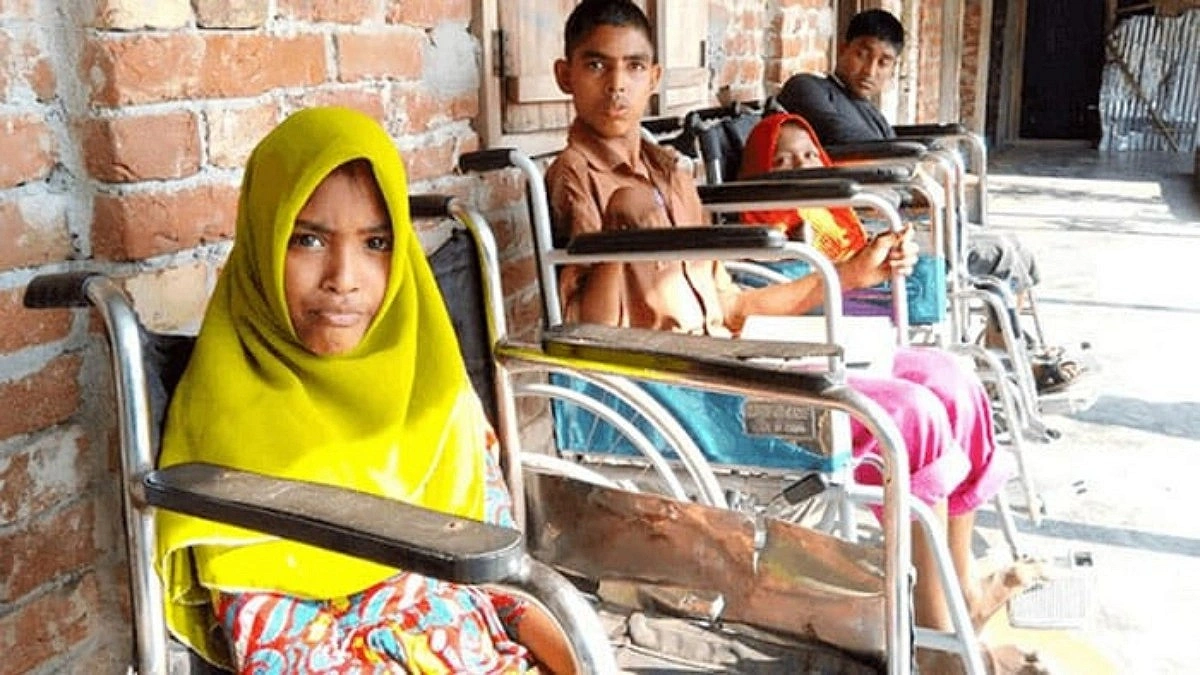
Photo: Agamir Somoy
When a child lets go of their mother's hand and stands for the first time, it is difficult to put the joy of that moment into words. Even if the child takes a few steps and falls, the family celebrates. But not every child's journey of growing up is the same. For some, standing on their own feet, saying a word or eating with a spoon can become a matter of waiting for a long time.
The journey of children with cerebral palsy is much like this. Some cannot sit properly while others cannot walk. Some have difficulty controlling the movement of their hands and feet. Others may face problems with speaking, eating, seeing, hearing or learning. However, cerebral palsy does not mean that all doors of possibility are closed for a child.
Today, October 6, is World Cerebral Palsy Day. The day is being observed in different countries around the world to highlight the rights, needs and social inclusion of nearly 50 million people living with the condition. Various organizations in Bangladesh are also holding awareness programs. The day is not only an opportunity to raise awareness about a condition but also to change society's attitude toward children and adults with cerebral palsy.
Experts say cerebral palsy can occur due to abnormalities or damage to the developing brain of a child. The risk may increase if the brain is damaged before birth, during birth or shortly after birth. Premature birth or low birth weight, lack of oxygen during birth, bleeding in the brain and some infections can also increase the risk. However, in many children the specific cause of cerebral palsy cannot be identified.
Dr. Md. Barul Alam, joint director and professor at the National Institute of Neurosciences and Hospital, said the main characteristic of cerebral palsy is difficulty controlling movement and posture. Some people develop stiff muscles while others experience uncontrolled movements. Some have problems with balance and coordination. Its effects are not limited to walking or movement. Problems can also occur with speaking, swallowing, eating, seeing, hearing or learning.
Waiting for the Child to "Get Better With Age" Can Be Dangerous
Families need to be alert if a child cannot hold their head up, sit, crawl or attempt to stand according to their age or uses one side of the body more than the other. However, many families consider these signs a delay in normal development and continue to wait. Some think the child will get better with age.
Experts say such waiting can result in valuable time being lost. The first few years of a child's life are extremely important for brain development and learning. If a problem is identified early and necessary therapy and support are started, there is an opportunity to improve the child's ability to perform daily activities.
Treatment for cerebral palsy does not mean medication alone. There is no single treatment that can completely cure every child. The main goals of treatment are to improve the child's abilities, reduce pain and complications and help the child become as independent as possible.
This may require physical therapy, therapy to improve daily living skills, speech and language therapy, nutritional management and medication when necessary. Various assistive devices including wheelchairs may also be needed. Some children may require vision and hearing tests or measures to control seizures. In some cases, surgery on the bones and joints may also be necessary.
However, starting treatment is not the end of the journey for many families. Rather, it marks the beginning of another long struggle. In Bangladesh, a large portion of specialized treatment and rehabilitation services is concentrated in the capital and a few major cities. As a result, families at the district and upazila levels have to travel to Dhaka repeatedly for treatment and therapy.
In addition to the cost of regular therapy, families also have to bear transportation, accommodation and food expenses as well as the cost of parents' lost working hours. For low and middle income families, meeting these costs can often be difficult. As a result, although many families start therapy initially, they are forced to stop after several months or years.
Dr. ASM Mahmuduzzaman Shoeb, associate professor of the Department of Pediatrics at Shaheed Suhrawardy Medical College Hospital, said cerebral palsy is primarily a matter of long term management. The idea that all problems will disappear after a few weeks or months of therapy is not realistic.
The type and goals of therapy may also change depending on the child's age and physical condition. He said increasing the number of hospitals or therapy centers alone would not be enough. Families also need to be trained so they can provide opportunities for regular exercises at home. In particular, integrated services for physical therapy, daily living skills and speech therapy need to be ensured at the district level.
Caring for a child with cerebral palsy does not only change the child's life. It also changes the lives of the entire family. Ishrat Jahan, the mother of Raktim, a pseudonym, said the mother bears much of the responsibility for everything from feeding and bathing the child to dressing the child and taking them to regular therapy sessions. She also had to leave her job to care for her child.
For many mothers like her, caring for and treating their child becomes a full time responsibility. As a result, family income decreases while treatment costs continue to rise.
There is another invisible burden as well: society's attitude. Many people look at children with cerebral palsy with pity. Some keep them socially isolated while others believe these children will not be able to achieve anything in the future. Such attitudes create barriers to a child's confidence and development. Opportunities for education, sports and social interaction become limited. Their chances of joining the workforce in the future can also be reduced.
Experts say children with cerebral palsy need the combined support of their families, society and the state alongside medical treatment. In addition to ensuring early diagnosis, accessible treatment and long term rehabilitation services, services need to be expanded at the district level.
Families also need to understand that a child may not be able to walk or speak like others but still has the ability to learn, love, dream and do things in their own way. A child may not be able to walk. That can be a challenge in the child's life. But it is not a reason to take away the child's right to dream.
