
Dengue infections continue to rise despite repeated government initiatives

Graphics: Agamir Somoy
Liton Das, an expatriate Bangladeshi, lost his eight-year-old daughter Oishi Das to dengue. In Panchagarh, a couple named Babul Haque and Nazmin Akter, lost both their sons within just 21 days.
Amid such tragedies, the government has taken one initiative after another to control dengue infections. These include restructuring the national committee and forming a high-level task force. At other times, it has launched special mosquito control drives and conducted mobile court operations. Most recently, it launched a three-month nationwide cleanliness and public awareness campaign. However, despite all these initiatives, dengue infections continue to rise and deaths show no signs of stopping.
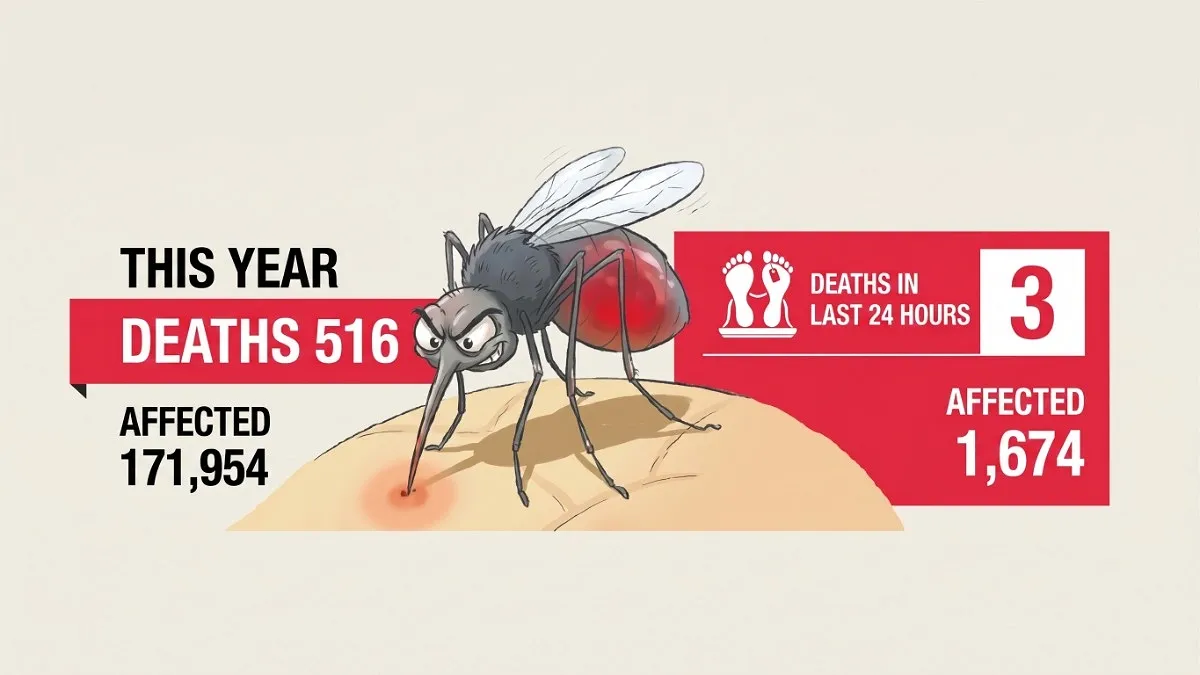
As of November 21, a total of 171,954 people had been hospitalized with dengue across the country. The disease has claimed 516 lives. Of them, three died in the past 24 hours, while 1,674 people were infected during the same period. All figures are from the Directorate General of Health Services (DGHS).
Eight-year-old Oishi Das from Chattogram died of dengue on October 29. The third-grade student had suffered from fever for only four days, accompanied by vomiting. After learning about his daughter’s illness, her father Liton Das immediately boarded a flight. However, before he could reach Bangladesh, he received the news of her death.
The number of dengue infections this year is almost double that of the same period last year. The death toll is also significantly higher. In 2025, 88,893 people had been hospitalized with dengue and 353 had died by the same date.
Mushtaq Husain, former principal scientific officer of the Institute of Epidemiology, Disease Control and Research (IEDCR) and a public health expert, believes the government’s approach to controlling dengue is neither appropriate nor scientifically sound.
The public health expert told Agamir Somoy, “Intensive activities must be carried out to identify and destroy mosquito breeding sites through targeted searches. At the same time, mosquito control drives must be launched wherever dengue patients are found. These activities must be conducted under the supervision of entomologists. Unless these measures are implemented in an integrated manner, the dengue situation cannot be brought under control. People will continue to die.”
During the first five months of this year, only five people died of dengue. The government had considered the risks associated with the monsoon season when planning its prevention efforts.
At a meeting of the national committee under the Ministry of Local Government, Rural Development and Cooperatives in June, a decision was made to form a task force under the supervision of State Minister for Local Government Mir Shahe Alam. The task force was formed on June 23. Its primary responsibilities include monitoring field activities, coordinating among different agencies and taking emergency measures.
On June 15, the National Committee for Prevention of Dengue and Other Mosquito-Borne Diseases was reconstituted. The committee was formed with representatives from city corporations, various ministries, government agencies and experts. Its responsibilities included providing policy guidance, monitoring ongoing activities and coordinating among the relevant agencies.
During the final week of June, the task force also conducted special operations in Dhaka. After finding Aedes mosquito larvae at two under-construction buildings in Jigatala, it fined the building owners Tk 100,000. It also instructed authorities to remove stagnant water and waste from government residential buildings and areas adjacent to water bodies.
Despite these two initiatives, dengue infections and deaths continued to increase. One person died of dengue in May, while the number rose to 13 in June.
Public health expert Mushtaq Husain said dengue patients must be admitted to secondary-level hospitals for treatment to prevent deaths. At the same time, free NS1 testing must be made available at the community level wherever patients are identified. People must also be informed that the danger begins after the fever subsides in dengue patients.
The dengue situation became alarming in September. Nearly 150 people died from the mosquito-borne disease that month.
The couple from Panchagarh, Babul Haque and Nazmin Akter, lost their two sons within just 21 days. Their younger son, 16-year-old Intisar Hasan Yas, died on September 21, while their elder son, 24-year-old Nazmul Hasan Ifti, died on October 12. The family spent nearly Tk 900,000 on the treatment of the two brothers. However, the expenditure could not save their lives.
“The approach being used to control dengue is neither appropriate nor scientifically sound.” Mushtaq Husain, Public Health Expert
Although the government announced several additional measures at the beginning of September, these included special cleanliness drives every Saturday, identifying Aedes mosquito breeding sites in homes and institutions through mobile courts, and setting up dengue corners at upazila health complexes.
Other measures included keeping field hospitals ready and providing specialized training to nearly 300 doctors to treat dengue patients. The government also announced that dengue tests would be available free of charge at public hospitals and directed private hospitals to reserve 10 percent of their beds free of charge.
Prime Minister Tarique Rahman inaugurated the three-month nationwide programme titled “Dengue Prevention and Cleanliness Campaign 2026” at the South Plaza of the Jatiya Sangsad Bhaban on September 12. The campaign is scheduled to continue until December 12.
Despite these measures, the dengue situation deteriorated further in October. The highest number of infections and deaths was recorded that month. The situation did not improve in November either.
Calling for evidence-based mosquito control measures, Kabirul Bashar, an entomologist and professor of the Department of Zoology at Jahangirnagar University, told Agamir Somoy, “The places where Aedes mosquito larvae breed must be identified and necessary measures taken. However, Aedes mosquitoes do not actually breed in many of the places where mosquito control programmes are conducted.”
The failure to improve the dengue situation despite repeated initiatives has raised questions about their effectiveness.
As of September 8, this year, 45,475 people had been hospitalized with dengue across the country, while 130 had died. During the following 74 days, up to November 21, another 126,479 patients were hospitalized and 386 people died. A significant proportion of both infections and deaths were recorded in Dhaka.
Brigadier General Imrul Kayes Chowdhury, Chief Health Officer of Dhaka North City Corporation, acknowledged that the dengue situation had not improved.
He told Agamir Somoy, “The density of Aedes larvae is measured every week, and the findings indicate that the dengue situation is improving. However, it cannot yet be described as ‘well controlled.’ The number of patients may decline toward the end of November.”
However, Dr. Jahane Ferdous Binte Rahman, Chief Health Officer of Dhaka South City Corporation, claimed that the number of dengue patients was declining.
She said, “Insecticides are applied after three stages of testing. There are no questions about the quality. The crash programme is ongoing. The number of mosquitoes is decreasing.”
