
Is this what human life is!

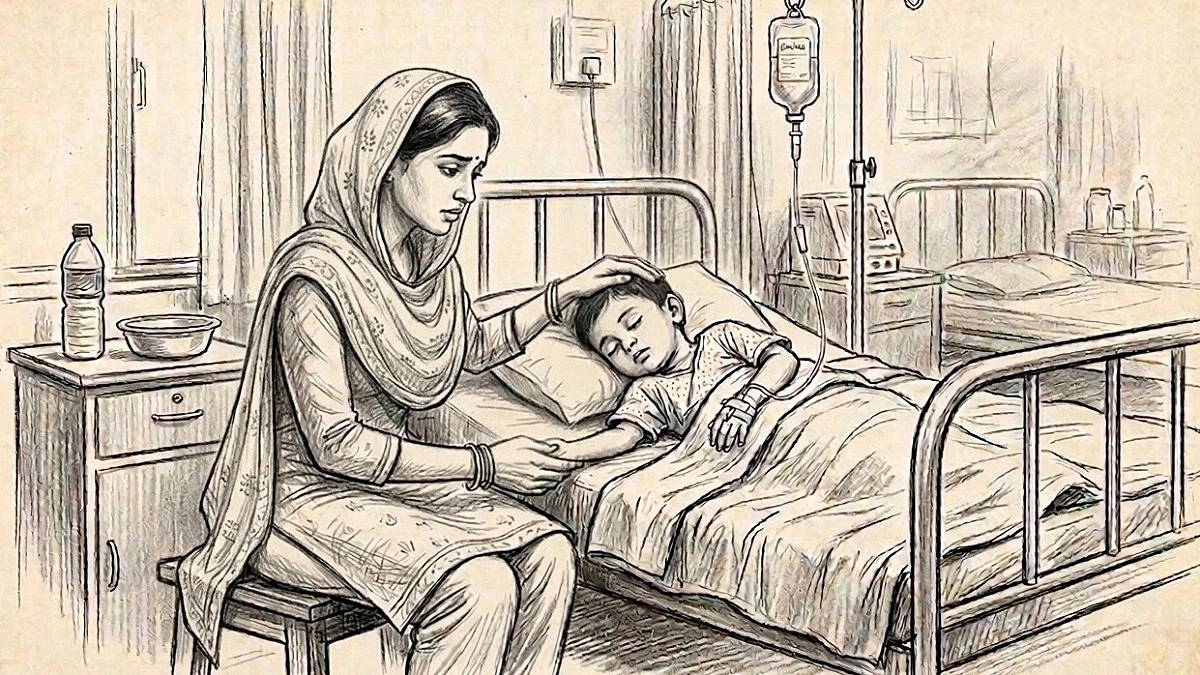
Graphics: Agamir Somoy
Samia is muttering something under her breath. She is restless, tossing slightly and groaning in pain.
Even her mother could barely hear her. Leaning down to listen closely, the faint cry became clear. Samia was whimpering—water, I want water.
Oxygen tubes were in Samia's nose; a saline needle was stuck in her hand as the drip continued. A small handmade quilt—perhaps stitched by her grandmother through sleepless nights—covered her. The two-and-a-half-year-old girl had no way to move. It seemed she didn’t even want to move. Her only desire was a little water.
Realizing what she wanted, Samia’s mother desperately asked everyone around, "My child wants water, can I give her some? Can I give her water?"
A nurse came and tried to help her drink. Samia’s father was running around frantically. A doctor rushed in and said she must be moved to the ICU; she needed high-flow oxygen. The ICU was right next to the ward, but it felt a million miles away because there were no vacant beds.
Samia’s relatives did not lose hope. A bed was about to become available. The screams of another child’s parents could be heard nearby. That child had likely left their ICU bed—and this world—leaving it behind for Samia. Samia’s relatives gathered anxiously at the ICU door, trying to see if that bed could be secured for her.
On one side, the parents of the child who left the world in silent protest were screaming in grief; on the other, a flicker of relief appeared in the eyes of Samia’s father—finally, a bed was found. The mother picked Samia up, trying to feed her a little water while crying out, "My baby wants to drink water!"
This melodramatic description might remind you of the plague in France or a scene from the recent COVID-19 pandemic. But surprisingly, this has become a daily reality for the past few months at the Bangladesh Shishu Hospital and Institute in Shyamoli, due to an outbreak of measles.
This scene is not unique to the children's hospital. According to official government figures, at least in hundreds of hospitals across 58 districts in Bangladesh are currently fighting for their lives against measles and related respiratory complications. Among them, nearly 450 little angels have already left this world, leaving us with their silent curse. You can be certain that the number of children not included in official records is several times higher. Measles, once considered a mild disease over the past few decades, is now threatening to wipe out the future generation of Bangladesh.
Hundreds of children are going through this process every day. Some are gasping for lack of oxygen, while others are restless with severe respiratory distress. Some are pleading, "I want water, I want water."
Morning light had not yet reached the beds of the Children's Hospital. Even before dawn, all the children in Ward 2—the specialized measles ward—were awake. In truth, they hadn't slept all night. Some struggled with breathing, some with body aches, and others with an insatiable thirst. On some beds, exhausted mothers had fallen asleep, while their children tried to pull the oxygen tubes from their noses.
Most of these children are under two years old. There are even infants only three or four months old. They cannot fathom why they are being held captive by these machines, saline drips, and oxygen tubes.
Take Yasmin, for example, whose parents and grandparents brought her all the way from Faridpur. For two months now, everyone has been running from pillar to post for her. Yasmin had measles; it cleared up about two months ago. At least, there are no more rashes on her body. But Yasmin cannot breathe properly. She suffers from constant respiratory distress; without oxygen, she suffocates. She has been placed in the HDU (High Dependency Unit), kept on high-flow oxygen.
The family is simply waiting for the day Yasmin can return to a general bed. They cannot even wrap their minds around when they might take her home. Their only thought is for the child to get out of the HDU. The value of life has far surpassed the definition of health. Let the child stay in the hospital, let him be confined—as long as he stays alive.
Jahangir, a garment worker from Dhamrai, has been rushing to the hospital doors for exactly three months to keep his son alive. For two and a half months, Jahangir has been stationed in front of the ICU of this measles ward. He has lost his job; his wife’s jewelry and their small piece of land have all been sold. He has already spent Tk 693,000. He can no longer even afford to stay at the low-cost boarding houses opposite the hospital.
Jahangir’s wife spends twenty-four hours a day in the HDU holding the child. Jahangir and his brother spend the entire day sitting or standing on this side of the glass door. If a nurse hands them a prescription, they rush to get the medicine or saline. The rest of the time, they pray. At night, they try to sleep on a mat in the hospital’s open courtyard. Sleep doesn't come; they return to the door—just in case the boy needs medicine.
The Children's Hospital has officially designated one ward specifically for measles. It isn't enough. Ward 9 has also been handed over to children suffering from measles. A security guard standing at the door with a look of total exhaustion says, "Sir, even this won't be enough. I think the dengue ward will be needed too. It’s unbearable to listen to anymore."
Who can bear it? These children, untouched by the sins, injustices, and complexities of this world—how can any human witness their struggle? Nafisa’s great-grandmother cried out, "Are we even human? Can a human being endure the suffering of these little ones?"
Nafisa, from Madaripur, was born under a lucky star. Her mother’s grandmother is a strong woman, as fit as someone much younger. Everyone used to joke that Nafisa and her great-grandmother would go on outings together. But before Nafisa could even learn to walk, she became tethered to an oxygen pipe.
While patients from the Madaripur and Faridpur regions seemed most numerous, having settled at the Children's Hospital after moving through various other facilities, many have also come from Savar and Dhamrai. Even Sharif has come here all the way from Kurigram. What a stroke of luck Sharif had! He came for surgery on a broken leg but contracted measles here and is now suffering from respiratory distress. A few children aged 12 or 13, like Sharif, were also seen. Their families admitted with terrible regret that they had never vaccinated them.
Most of the children are not yet old enough to receive the vaccine. Since the disease has spread through an unvaccinated generation in society, the infants who haven't reached the age for vaccination are suffering the most. Those who were supposed to protect them—the two-year-olds—are the ones infected due to the lack of vaccines.
Why was there a shortage of vaccines?
After sitting in front of the ICU for two months, Jahangir’s frustration boiled over. "Don't you understand? Don't you get why there was a shortage? I went to the vaccination center eight times. I got all the other vaccines, but they didn't give the measles vaccine. They didn't give Vitamin A. Don't you people understand anything? Or are you just putting on a show of crying?"
No. These tears truly feel tragically theatrical now. It seems another bed is about to become vacant in the ICU. Heart-wrenching screams can be heard, and doctors are seen running in helpless desperation. Our theatrical tears and the empty rhetoric of seminars are of no use here.
Debabrata Mukhopadhyay, Author and Journalist
