
Patient-bought medicines funneled from hospital back to pharmacies

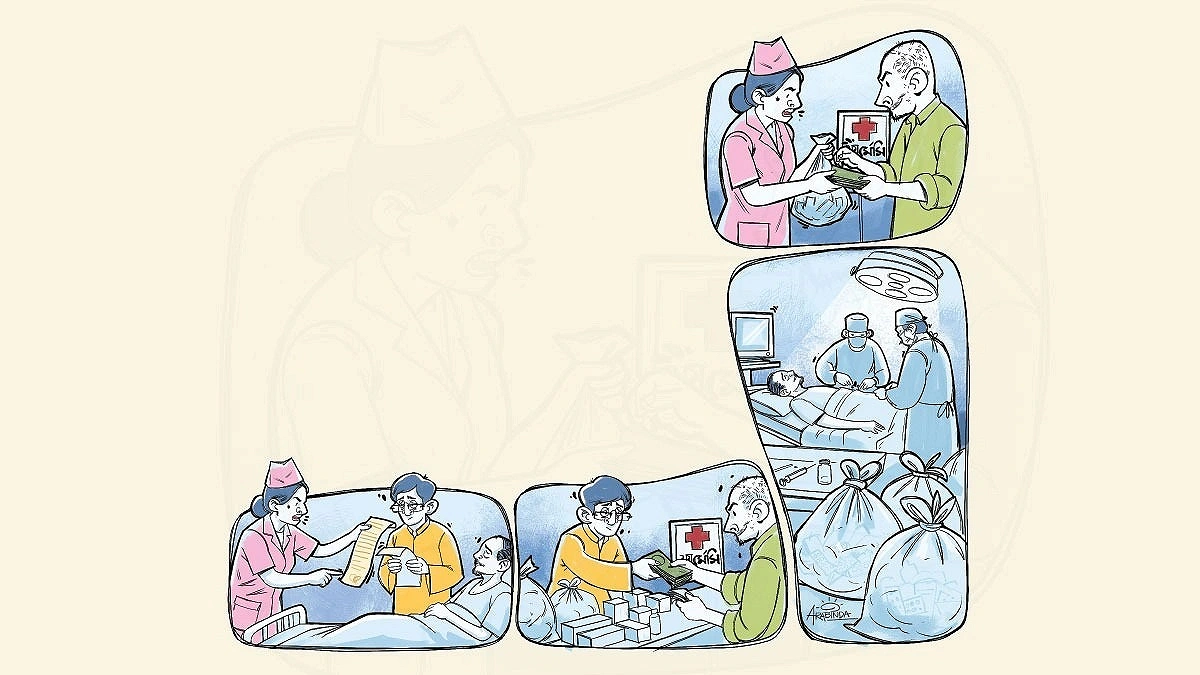
Graphics: Agamir Somoy
An investigation conducted by Agamir Somoy at the National Institute of Cardiovascular Diseases and Hospital in Dhaka uncovered footage and video evidence showing medicines purchased by patients’ relatives being carried out of the hospital.
In some instances, through nurses, and in others through ward boys and other staff, these medicines reach outside pharmacies, with scenes of receiving cash in exchange captured on the reporter’s camera.
These details were gathered by tracking the purchasing and supply process of medicines by relatives across various departments of the hospital from 15 August to 21 September. On 16 September at 3 pm, ward boy Babul Mulla entered Room 244 of Cardiac Cath Lab-1 carrying two strips of tablets.
Shortly after, he changed his attire and exited with a black bag, crossed the hospital’s main gate, went to Bismillah Pharmacy in front, left the medicine bag there, and departed. On 17 September at 7:30 pm, nurse Anjuman Ara emerged from the Cath Lab, went to Antora Pharmacy in the hospital’s administrative building, and handed over some medicines along with a slip of paper.
Moments later, a handful of cash was passed to her from inside the pharmacy, which she tucked into her bag before returning to the Cath Lab.
Around 8:30 pm, three more nurses exited the Cath Lab. One of them, nurse Saleha, held three bags and walked south past the main gate toward Suhrawardy Medical College Hospital. About 200 meters away, she handed the bags to a person who then departed on a rickshaw toward Mohammadpur.
The reporter trailed the rickshaw for about 15 minutes until it pulled up in front of Rajbari Tailors at House 4/8 on Mohammadpur Kachabazar Road. The building guard, Majed Mia, revealed that the rickshaw driver regularly delivers medicine bags there to a person named Ruhul on the second floor, who allegedly supplies medicines to various pharmacies.
When questioned regarding the allegations, Saleha admitted to the reporter that she had been delivering medicines to Ruhul and had been engaged in the activity for a few days.
Similar allegations surfaced at Cath Lab-2. On 8 September at 9:20 pm, nurses Saifunnahar and Tonni were seen stepping out of the Cath Lab carrying two bags. Exiting through the main hospital gate, they walked north toward the Kidney Hospital.
After Saifunnahar made a phone call, a man came out, crossed the road with them, and took a bag of medicines. The man then entered Anurag Pharmacy on the opposite side of the street. Shortly afterward, pharmacy worker Rasel handed a handful of cash to Saifunnahar. Later, hospital worker Shanta also visited the pharmacy and received money as well.
Denying the allegations, Saifunnahar claimed she did not sell hospital medicines, maintaining that she went to the pharmacy to return unused medication belonging to her sick husband. However, when informed of the video footage in the reporter’s possession, she offered a compromise.
Allegations of selling medication were also raised against Cath Lab-2 nurse Fatema, who, when contacted via mobile phone, remarked, “Do whatever you have to do,” before hanging up. Meanwhile, Hajera Begum came to the hospital from Alamdanga, Chuadanga with her elder sister, having spent 17 days visiting to get a stent placed in her sister’s heart. Her sister was scheduled for surgery on 16 September at 3:40 pm.
According to Hajera Begum, during pre-surgery preparations, the nurse and ward boy attempted to insert an intravenous cannula or needle into the patient’s hand, causing blood to spurt out. At that point, relatives were made to purchase several medicines and medical supplies from outside, which were never used.
Hajera questioned why relatives were forced to buy items from outside if the required medicines and supplies were supposed to be available at the hospital, and where those unused medicines went after being purchased.
Similarly, Morium Akter brought her mother, Khaleda Begum, from Narayanganj to the hospital for cardiac issues, where she was admitted to non-paying Bed 12 of Ward 18.
According to Morium, when her mother was taken to the CCU to remove a CVP line, on-duty ward boy Ehsan wrote down three medical supplies on a piece of paper, including extra gloves, and instructed relatives to purchase them from outside.
Morium alleged that despite purchasing and delivering them, the items were never utilized - an incident witnessed by the reporter posing as a patient’s relative. She noted that despite the urgency placed on buying the items, they went unused and their whereabouts remain unknown, adding that Ehsan became aggressive when confronted about the matter.
On condition of anonymity, an SDU department ward boy disclosed that relatives are instructed to purchase micropore tape and heparin injections for CVP removal. He explained that a single heparin injection can serve five patients and one roll of micropore tape can serve 10 patients, yet every patient is instructed to buy them individually.
The ward boy identified Hossain as the mastermind behind this practice in the SDU department, claiming that extra micropore and heparin collected from patients are later resold to Dhaka Pharmacy - meaning extra supplies bought from pharmacies return to those exact same pharmacies with staff assistance.
At the hospital, several medicines and medical supplies are supposed to be provided free of charge during surgeries and procedures, including Hartsol 1000 ml injection, saline, surgical gloves, disposable caps, micropore, papaverine injection, normal saline infusion, and surgical blades.
However, allegations indicate that relatives are forced to buy these items from outside despite their free hospital availability. Similar allegations exist in the Vascular Department, where Giasuddin of the emergency department allegedly takes prescription slips from doctors, goes to Antora Pharmacy inside the hospital, and collects a commission, with ward boy Miraj allegedly involved as well.
In the fifth-floor Vascular Department, in-charge Rehan Jannat provides a list of required medicines the day before surgery. Relatives allege the list contains 10-12 medicines that should be supplied by the hospital, yet they are forced to buy them externally.
Patients’ relatives alleged that once purchased and handed over, staff retain those medicines and conduct surgeries using government-supplied medicines instead, later selling the patient-bought medicines to Dhaka Pharmacy. Ward boys Jalal and Meem face allegations of smuggling these medicines out of the operation theater.
On 15 September, Ansar members detained ward boy Meem in the Vascular Department with a bag full of medicines, but he was seen back on duty the very next day. When asked why Meem was released, Ansar Commander Aminul Islam said he was released into the custody of hospital authorities.
Beyond smuggling medicines outside, allegations also involve forcing relatives to buy the same medicines several times. On 12 August, Nahida Begum from Pabna submitted a written complaint saying before taking her husband, Paran, into the operation theater (OT), she was forced to buy the same type of medicine twice, costing her Tk 12,080.
She claimed that even a month after filing the complaint, no resolution had been provided and she was never questioned further.
Addressing these allegations, National Institute of Cardiovascular Diseases and Hospital Deputy Director Muneer Ahmed Khan said, “We are not sitting here to harbor thieves and robbers. If anyone commits a crime, they will be punished.”
Denying knowledge of Meem being caught with medicines, he added, “However, an investigation report regarding Nahida’s complaint has been submitted.”
When approached for comment, hospital Director Abdul Wadud Chowdhury remarked, “I am leaving now, I cannot talk,” before walking away - a move hospital sources described as his typical strategy for evading media inquiries.
