
C-section business: Tk 50,000 agreement, Tk 150,000 bill
- 309 pieces of medicine and medical supplies cost Tk 25,000
- Bill reached Tk 31,000 in 12 hours and Tk 150,000 in two days
- Blood crossmatching alone cost Tk 4,000 per person
- 71.3 percent of babies in Bangladesh are being delivered by C-section

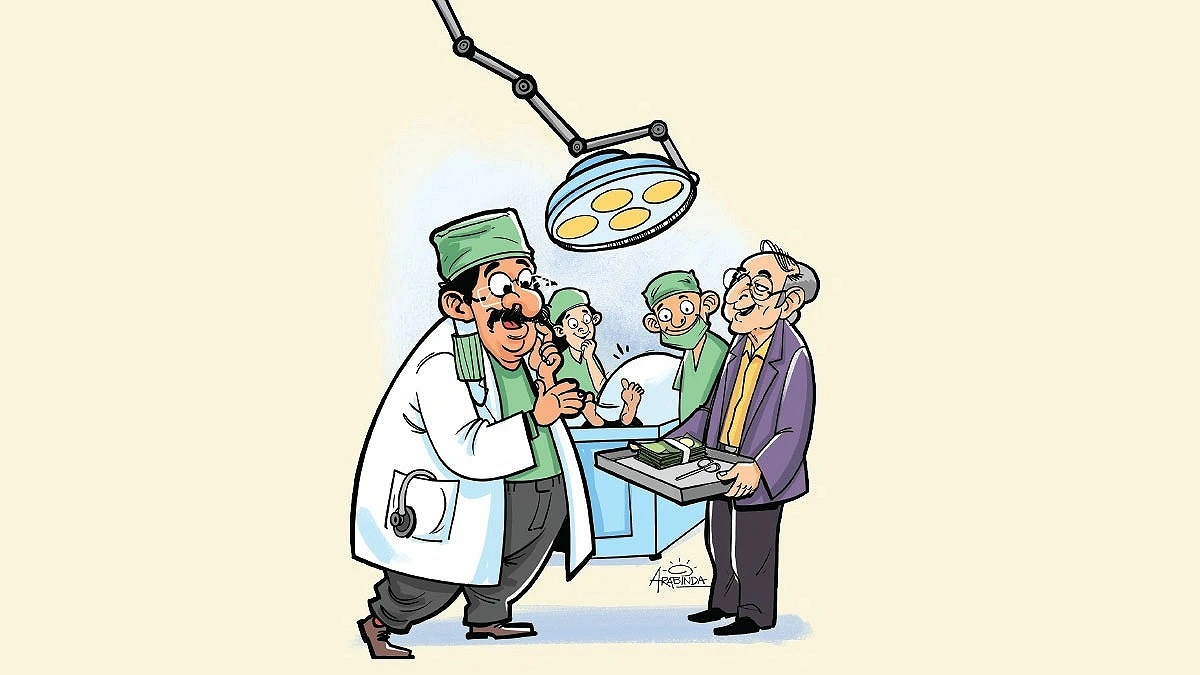
Graphics: Agamir Somoy
Sonia Akter was admitted to Grace Hospital Limited in Dhanmondi, hoping to deliver her baby naturally. An agreement was reached with physician Sanjukta Saha for a delivery at Tk 50,000. The agreed amount included Tk 30,000 for the physician’s fee and Tk 20,000 for hospital expenses. However, after the baby was born, the family was handed a bill for Tk 150,393. Unable to pay the full amount, the patient and her relatives faced difficulties when trying to leave the hospital.
An investigation by Agamir Somoy into Sonia’s medical bill, her family’s allegations and the hospital authorities’ statements has raised several questions. How did a bill exceed Tk 150,000 after an agreement for Tk 50,000? Why was Tk 25,127 charged for 309 medicines and medical supplies used during the surgery? Why were two different amounts recorded for pathology tests and blood related expenses?
The family said they received no satisfactory explanations for these questions. They also alleged that Sonia was taken to the hospital for a natural delivery but underwent a C-section instead. Following the surgery, she developed an abdominal infection and is currently receiving treatment at Dhaka Paramount Specialized Hospital in Shonir Akhra. According to her relatives, her condition is critical.
Tk 50,000 agreement, Tk 150,393 bill
Sonia was admitted to Room 504 at Grace Hospital. She alleged that although she went to the hospital hoping for a natural delivery, the situation later led to surgery. She also alleged that medication was administered to reduce her pain and that the amniotic sac was ruptured to drain the fluid.
Sonia’s elder sister Yasmin Akter Popy said, “We had an agreement for Tk 50,000, but after the procedure was completed, we were handed a bill for a much larger amount. We were not properly informed about the delivery process. A patient who was in a condition to deliver naturally was taken for a C-section to charge a higher bill.”
According to Sonia’s bill, the total expenses amounted to Tk 150,393. The breakdown included Tk 50,000 for physician Sanjukta Saha’s fee, Tk 25,127 for medicines and medical supplies, Tk 1,900 in service charges, Tk 3,000 in postoperative charges, Tk 5,000 for the operating theater and Tk 1,750 in operating theater service charges.
There were also discrepancies in the pathology expenses. One document listed Tk 8,100 while another analysis form recorded Tk 8,410. The reason for the two different amounts under the same category was unclear.
The family claimed that they had paid Tk 92,000. They faced difficulties when attempting to leave the hospital over the outstanding amount. They questioned how so many additional expenses had been added beyond the agreed Tk 50,000.
309 items of medicine and medical supplies cost Tk 25,000
Another questionable part of Sonia’s bill concerned medicines and medical supplies. A total of Tk 25,127 was charged for 309 items. Her relatives alleged that the hospital pharmacy did not adequately inform them about which medicines were being prescribed, how much was being used or how much each item cost.
Sonia’s husband Kamruzzaman Akand said a medicine for which the hospital pharmacy charged Tk 1,350 was available at an outside pharmacy for Tk 1,150. He alleged that they were not given information about the medicines and were simply handed a list and told to pay the bill.
Questions over blood related expenses
Sonia’s relatives also raised objections over blood related expenses. They alleged that two bags of blood had been arranged but only one was used. The other bag was not returned to them and they were not clearly informed about what happened to it.
The bill listed Tk 8,410 for blood collection and supply related expenses. The family claimed that several thousand taka had been charged for crossmatching alone. According to them, the same service costs about Tk 1,200 at other hospitals.
Shahriar, an administrative officer at the hospital, said they used high quality blood bags and that this increased the cost. Ripon, the official responsible for preparing bills, said relatives could take any unused blood with them if they wished.
However, the family wants a detailed breakdown showing how much was charged for blood testing, crossmatching, storage and supply.
Infection after surgery, Sonia in critical condition
Sonia’s relatives said her physical condition deteriorated after the C-section at Grace Hospital. She is currently receiving treatment at Dhaka Paramount Specialized Hospital.
According to Dr. M. G. Ferdous, a postgraduate trainee physician at the hospital, Sonia developed abdominal swelling, pain throughout her abdomen and a fever. He said an infection inside the abdomen could lead to serious complications such as peritonitis and sepsis. Possible causes include the entry of germs during or after surgery or an infection at the surgical wound. However, identifying the specific cause of the infection requires medical records, test results and a clinical assessment.
Sonia’s relatives alleged that the infection following the surgery had put her life at risk. However, a direct link between the infection and the treatment provided at Grace Hospital cannot be established without an independent medical assessment.
Similar allegations from other patients
Besides Sonia’s case, other patients and their relatives have also raised complaints against Grace Hospital over billing and medical services. They alleged that although one set of expenses was quoted before admission, much larger bills were presented after childbirth.
Monika Manzur Rakhi’s bill also showed substantial expenses. According to the documents, Tk 18,146 was charged for 270 medicines, Tk 2,550 in service charges and Tk 54,500 in physician related service charges. Her relatives alleged that the final bill did not match the expenses quoted before admission.
Bill reached Tk 31,000 in 12 hours, reduced to Tk 25,000 after objection
Complaints have also been raised about the bill for the labor room numbered 508 at the hospital. Relatives of one patient claimed that the initial bill was Tk 31,000. After they objected, it was reduced to Tk 25,000. They questioned why the higher amount had been charged initially and why it was reduced only after they raised objections.
The relatives also raised concerns about the baby’s weight. They claimed that an ultrasound conducted before arriving at the hospital showed the baby weighed 3.2 kilograms. The hospital later reported the weight as 2.8 kilograms. They alleged that a nurse named Sharmin acknowledged the possibility of an error.
Nurunnabi, who came from Kishoreganj, alleged that he had agreed to pay Tk 50,000 but was later presented with a bill for Tk 71,000. Expressing anger, Nurunnabi said, “I will not pay even one taka more than this amount. I was brought here under an agreement. If I had needed a C-section, I could have had it done in my local area, where it costs Tk 15,000 to Tk 20,000. Why should I pay so much after coming here?”
Abdus Salam, who came from Narayanganj, also expressed concern about the bill after childbirth. He fears that he may have to pay a large amount once he receives the final bill after treatment.
Patients’ relatives alleged that although they were reassured about expenses before admission, additional charges were subsequently added under different categories. They also claimed that additional tests or medical services were provided in some cases without their consent.
Hospital fails to provide satisfactory explanations
Shahriar, the hospital’s administrative officer, said the accounting for medicines was related to the respective consultant. Asked about the 309 items listed on the bill, he said the quantities could vary. He said the hospital wanted to provide services to patients but that he would be held accountable if the bill was reduced.
Regarding the allegation that the hospital had agreed to charge Tk 50,000, Shahriar said the hospital had done what it could and that the rest was up to the patient’s relatives.
However, no specific explanations were provided when the hospital was asked for details about medicine prices, the quantities of medical supplies used, the two different pathology charges and the breakdown of blood related expenses. The officials concerned said the expenses were listed on the bill.
Physician Sanjukta Saha has reportedly faced controversy in the past as well. In 2023, she came under scrutiny over allegations of negligence following a patient’s death and the use of a fake professor’s title.
Responding to the current allegations, Sanjukta Saha said, “I did not practice medicine through bullying. If you had a problem, you should have told me earlier.”
However, no detailed response was obtained from her regarding the decision to perform surgery on Sonia, the physician’s fee and other expenses beyond the agreed amount, or the allegations of infection following the operation.
Research shows rising C-section rates and financial pressure
As the rate of C-section deliveries rises in Bangladesh, families are also facing increasing financial hardship in meeting childbirth expenses. Several studies published in 2026 have highlighted this situation.
A study titled From Medical Necessity to Private-Sector Dominance: A Two-Decade Evolution of Cesarean Section Determinants in Bangladesh (2004-2022) was published in the journal Scientific Reports on May 9.
Analyzing data from 26,845 women included in the Bangladesh Demographic and Health Survey, the study found that the C-section rate in Bangladesh rose from 6.8 percent in 2004 to 2007 to 39 percent in 2018 to 2022. Among deliveries at private facilities, the rate increased from about 55 percent to 84 percent.
Another study found that the C-section rate among deliveries at health care facilities rose from 58.5 percent in 2014 to 69.4 percent in 2022. During the same period, the proportion of families forced to take loans or sell assets to cover childbirth expenses increased from 10.8 percent to 21.3 percent.
In 2022, about 85 percent of all C-sections were performed at private hospitals. The C-section rate at private facilities was 6.7 times that at public facilities. The likelihood of experiencing financial hardship was 4.15 times higher for C-section deliveries than for natural deliveries.
Another study titled Other Factors Associated With Cesarean Section for First Births in Bangladesh Using Demographic Health Survey Data 2022 was published in the journal Discover Public Health on August 28.
An analysis of data from 1,371 women who delivered their first child at health care facilities found that 71.3 percent gave birth by C-section. The rate of C-section deliveries for first births at private facilities was 8.14 times that at public facilities.
The studies recommended stronger oversight of private hospitals, reducing unnecessary C-sections, providing financial protection to families facing childbirth expenses and conducting clinical audits of surgical procedures. They also emphasized expanding midwife led maternity care.
Call for safe childbirth services
Dr. Mohammad Mushtaq Hossain, former principal scientific officer at the Institute of Epidemiology, Disease Control and Research (IEDCR), said that although the rate of institutional deliveries has increased in Bangladesh, maternal mortality has not declined as expected.
He alleged that some private hospitals were commercially exploiting efforts to ensure safe childbirth by performing unnecessary C-sections to generate additional profits. This can lead to surgical complications, failure to control excessive bleeding and breathing difficulties in newborns.
He said that expanding essential maternal and child health services free of charge through government initiatives down to the upazila level could help reduce unnecessary C-sections and lower maternal and child mortality.
