


Shortage of Padma Hilsa in markets, traders admit the truth

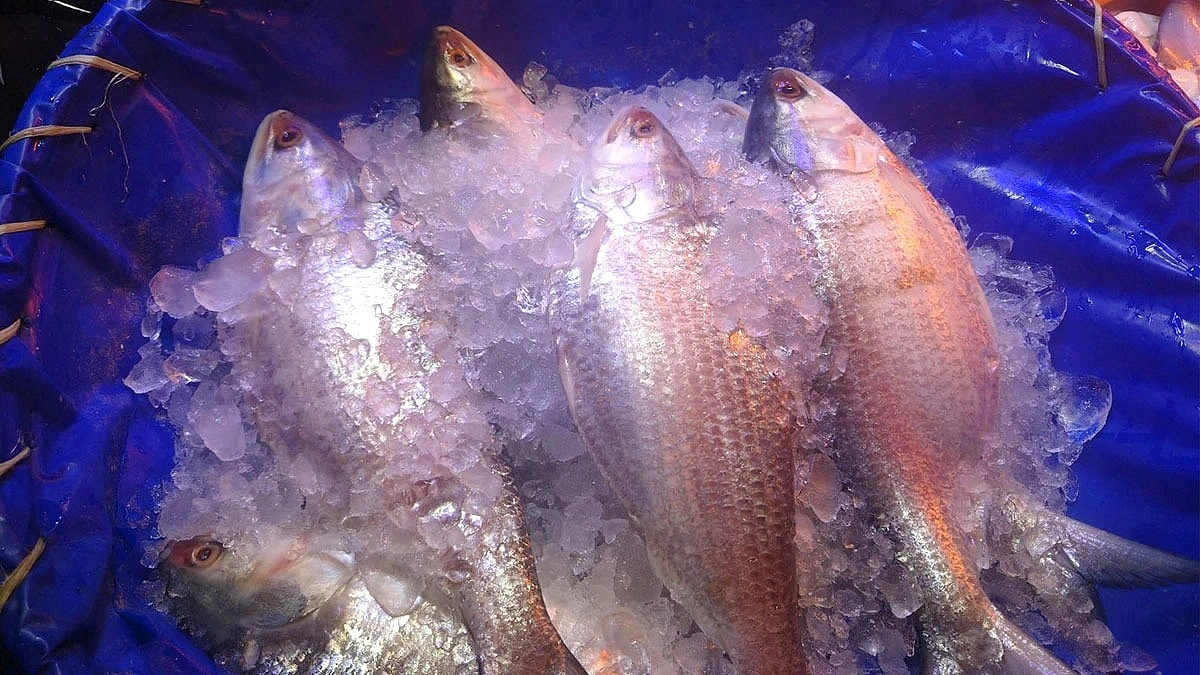
Photo: Agamir Somoy
Various sizes of hilsa are displayed on ice at fish stalls in the market. The fish arranged in rows at the wholesale markets also differ in shape. Some have a typical shape while others are relatively more elongated. Despite the abundance of hilsa in the market, however, the sought after ‘Padma hilsa’ is not available.
A visit to Karwan Bazar, one of the capital’s major wholesale and retail markets, on Thursday found that buyers were searching for Padma hilsa but could not find it. They were forced to return home after buying fish from other regions.
Conversations with traders there revealed that most of the hilsa currently available in the market comes from the Chandpur estuary, the Meghna River and the Barishal region.
Karwan Bazar hilsa trader Md. Ainal Mia said, “Real Padma hilsa has not been coming to the market for a long time. Whatever supply of Padma hilsa there is gets sold out as soon as it reaches the Chandpur fish landing station. It does not reach the Dhaka market. Although many sellers try to pass off other fish as Padma hilsa, that is not true. We do not lie to customers. Whenever they ask, we tell them the truth.”
However, ordinary buyers expressed frustration over the high price of hilsa in the market. Government employee Md. Ahsan Habib, who came to buy fish, said, “At this time in previous years, hilsa prices were relatively affordable. But this year the prices are sky high. Even after paying a high price, I cannot find Padma hilsa. I was forced to buy Barishal hilsa at a higher price.”
A visit to the market found that hilsa weighing around 1 kilogram to 1.5 kilograms was selling for Tk 3,000 per kilogram. Hilsa weighing 1,200 grams was selling for Tk 2,700. Fish weighing 1 kilogram was selling for Tk 2,600 and 800 gram hilsa was selling for Tk 2,400. In addition, 700 gram hilsa was selling for Tk 2,200. Fish weighing 500 grams was selling for Tk 1,800. Hilsa weighing 300 grams was selling for Tk 1,600. Fish weighing between 200 and 250 grams was selling for Tk 1,400 per kilogram.
Most Hilsa in the Market Comes from Barishal
Trader Nabi Hossain of the Chandpur Borostation fish landing station explained why Padma hilsa is not reaching the Dhaka market. He said it is possible to send fish to Dhaka only when there is an adequate supply at the landing station. But the catch in the Padma River near Chandpur is currently very low. As a result, the available fish is sold out to meet demand in local markets and online orders. He also said Chandpur and Padma hilsa generally costs somewhat more because it is considered tastier and more desirable than hilsa from the southern region or the sea.
Haji Mohammad Shabe Barat Sarker, general secretary of the Chandpur Fish Traders Cooperative Association, told Agamir Somoy that when the supply is good, 10 to 15 maunds of fish are sent from Chandpur to different parts of the country every day. However, shipments to other parts of the country have decreased significantly because of the current shortage.
Meanwhile, the fisheries department has identified various natural and human made causes behind the decline in hilsa supply in the river. The fish are changing their normal migration routes because of the formation of submerged sandbars in the river, navigability problems, water pollution caused by industrial waste and rising water temperatures due to climate change.
A five-member expert team has been working in Chandpur since Monday to investigate the main reasons behind the hilsa shortage and declining supply. The investigation is being conducted under the leadership of Dr. Anisur Rahman, former chief scientific officer of the Bangladesh Fisheries Research Institute and current hilsa researcher.
According to researcher Dr. Anisur Rahman, preliminary observations show that there are smaller hilsa than large hilsa in the river. However, before reaching a final conclusion, the overall river environment, water flow, fish migration routes and natural changes will be scientifically analyzed. After the research is completed, a report containing detailed information and data will be submitted to the Department of Fisheries.
Chandpur correspondent Shariful Islam contributed information to this report.

