
Risky journeys on rough waters in trawlers

Graphics: Agamir Somoy
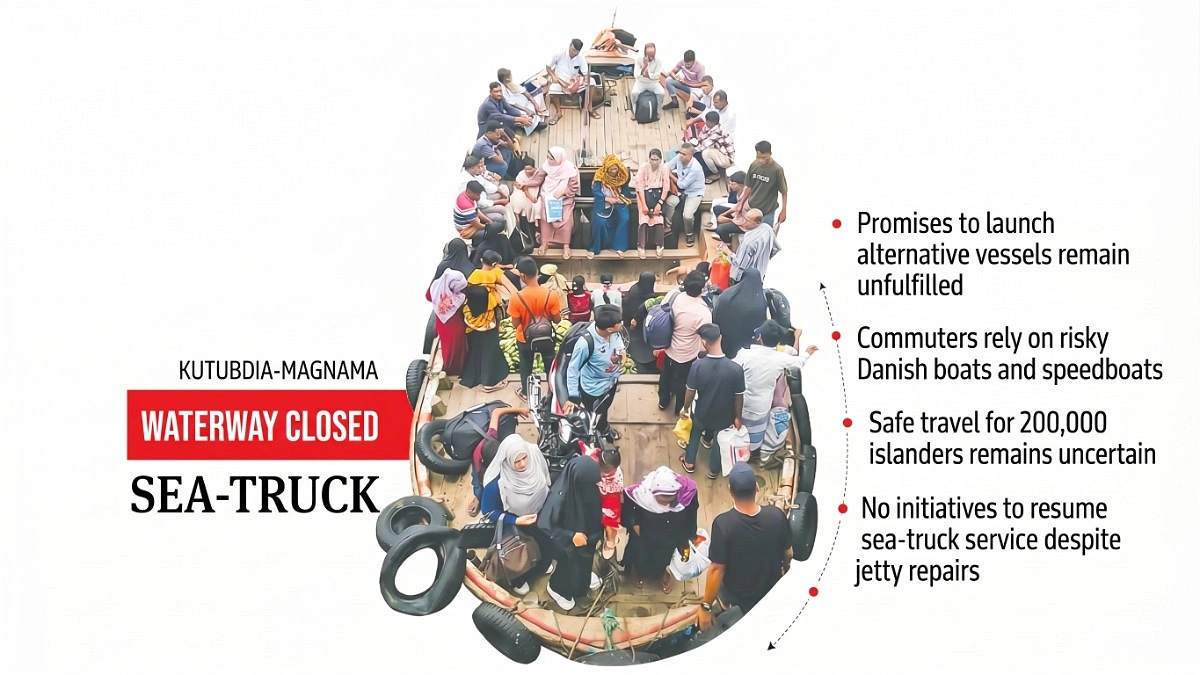
Some are traveling for medical treatment, others to their workplaces and some to earn a living. However, residents of Kutubdia Island in Cox’s Bazar have to cross a rough channel of the Bay of Bengal to reach the mainland. The sea truck ST Nijhum Dwip was introduced to provide safe transportation. It has been out of service for more than four months. Although authorities promised to provide an alternative vessel, the commitment has not been fulfilled. As a result, nearly 200,000 island residents are risking their lives by traveling in old wooden Danish boats, locally known as trawlers, and speedboats. Their suffering and uncertainty are particularly severe when they need to travel to the mainland for emergency medical treatment.
Local residents alleged that the sea truck service was introduced to ease the difficulties of people who had long depended on small boats and trawlers. However, the initiative to ensure safe transportation effectively came to a halt when the vessel was relocated elsewhere within just a few months.
According to local sources, controversy arose over an initiative to move the ST Nijhum Dwip to the Hatiya route. Local residents claimed that the move was initiated in response to a request from Hatiya lawmaker Hannan Masud. The authorities concerned described the matter as a misunderstanding. They also promised to provide an alternative sea truck for the Kutubdia to Magnama route. However, that promise has yet to be fulfilled.
The Bangladesh Inland Water Transport Authority (BIWTA) completed repairs to the pontoon at Baraghop Jetty a long time ago. However, the Bangladesh Inland Water Transport Corporation (BIWTC) has taken no visible initiative to resume sea truck operations. More than two months have passed since authorities said the ST Jabbar would replace the ST Nijhum Dwip, but the vessel has yet to reach Kutubdia.
Nurul Islam, the leaseholder of Magnama Ghat, claimed that the ST Nijhum Dwip was relatively large and therefore more expensive to operate. Since passenger numbers were low, the vessel was relocated to reduce operating costs, with a smaller sea truck promised as a replacement.
According to him, the jetty pontoon was damaged when it was struck by the sea truck. Authorities later promised to build a new dock, arrange facilities for passengers to board and disembark, and provide an alternative vessel within a short period. However, the commitment has not been fulfilled despite the passage of considerable time. No specific timeline has been given for the arrival of the new sea truck.
Ashraf Mia, manager of the Kutubdia Channel Station, said, “The sea truck at Magnama Ghat has been taken to Sandwip on the instructions of the higher authorities.” However, he said he had no confirmed information about the launch of a new sea truck service on the Kutubdia to Magnama route.
Uncertainty over the resumption of the service has also fueled anger among local residents. Engineer Robiul Hossain, a resident of Kutubdia, believes that regular sea truck services must be introduced as soon as possible to ensure safe and normal transportation for island residents. He said the necessary vessels must be allocated for this purpose.
Another local resident, Shahidul Islam, has also demanded the immediate allocation of a suitable sea truck and the introduction of regular services. He also called on the authorities concerned to provide a clear explanation for relocating the vessel and delaying the alternative arrangement.
Former Kutubdia Upazila Parishad Vice Chairman Akbar Khan said, “It is as if Kutubdia has no guardian. Even when we receive something, we ultimately fail to hold on to it.”
In this situation, the administration has promised to resolve the problem. Kutubdia Upazila Nirbahi Officer (UNO) Md. Mizanur Rahman said, “A meeting will be held with the leaseholder soon to discuss whether passenger transportation by sea truck can be resumed as an alternative arrangement using the temporarily repaired jetty.”
Cox’s Bazar District Council Administrator Nurul Bashar Chowdhury also said efforts were underway to resolve the problem quickly.
However, island residents remain unconvinced by these assurances. Crossing the rough channel has become particularly risky for critically ill patients, elderly people, women and children. They are also concerned about whether a safe vessel will be available when they need to travel to the mainland for emergency medical treatment.
