
Children’s climate risk report and save the children data
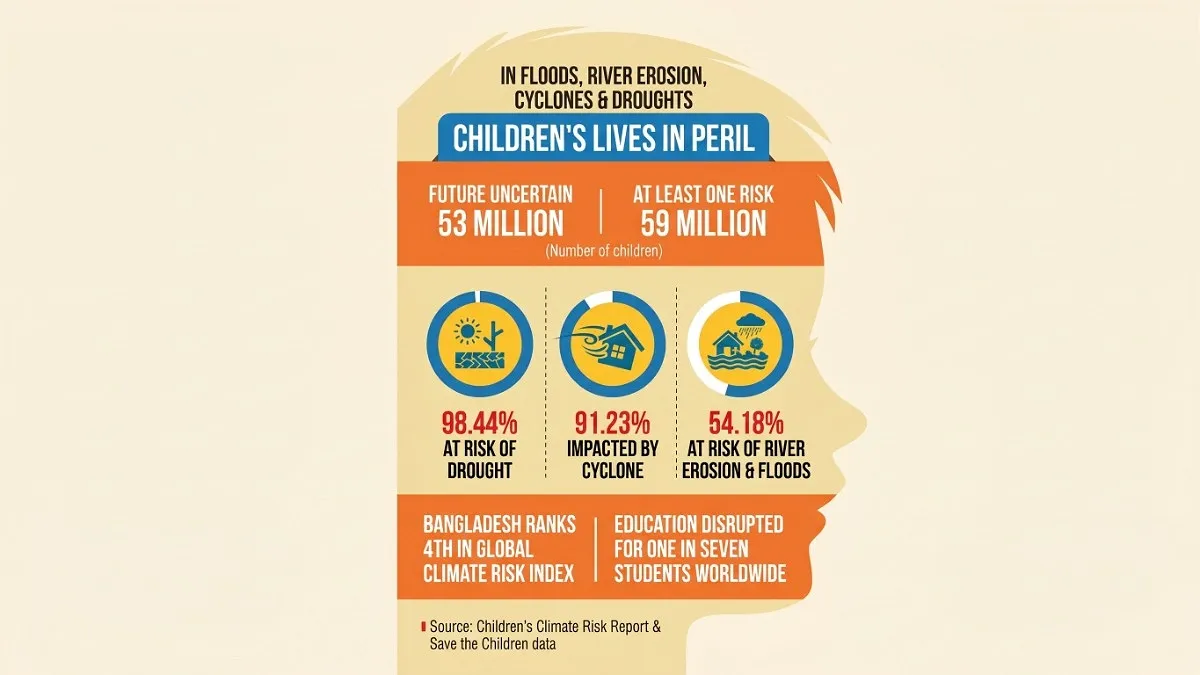
Future uncertain for 53 million children

Graphics: Agamir Somoy
“Children are born today into the light of this world, and we want a beautiful garden for them. Children are born today amid their mothers’ smiles, and we want to see those smiles forever.”
The lyrics paint a picture of a bright future for children and a beautiful world for generations to come. However, the children who will shape the world of tomorrow are now among those most at risk across the globe.
Recently published data from UNICEF’s Children’s Climate Risk Report and Save the Children have highlighted concerns about the uncertain future of millions of children facing the impacts of climate change. Extreme heat, floods, cyclones and river erosion are disrupting children’s health, education and normal development.
According to the UN agency, disasters such as floods, river erosion, cyclones and droughts are increasingly putting the lives of around 59 million children in Bangladesh at risk. These children are exposed to at least one of the aforementioned hazards. Meanwhile, approximately 53 million of them, or nearly 90 percent, face at least three types of climate risks simultaneously.
A survey conducted by Save the Children in Bangladesh found that almost all participating children (96 percent) had experienced at least one disaster over the past two years. In addition, 49 percent of school-going children had missed school over the past year due to disasters or weather-related events. Furthermore, 80 percent of children had fallen ill following disasters or heatwaves, while 53 percent faced difficulties accessing safe drinking water.
The findings of the two organizations are reflected in the experiences of 16-year-old Jerin from Madarganj in Jamalpur. During the monsoon, rising water levels in the Jamuna River flood Jerin’s village. Tube wells and toilets go underwater, creating a shortage of safe drinking water and increasing the risk of waterborne diseases.
Although families can take shelter in evacuation centers or on higher ground, new challenges emerge for girls like her. Safe toilets and bathing facilities are often unavailable. The situation becomes even more difficult if they menstruate during this period.
However, after joining a disaster preparedness project, Jerin learned about water purification, hygiene practices and early flood warnings. She now tries to raise awareness among her family members and neighbors as well. UNICEF’s Children’s Climate Risk Report describes Jerin’s experience as a reflection of the realities faced by children exposed to climate risks in Bangladesh.
Jerin is not alone. The lives of millions of children across the country are now uncertain due to the impacts of climate change. For children, this is not merely an environmental crisis. It is a daily struggle for survival and a disruption to their everyday lives.
According to the Children’s Climate Risk Report 2026, 98.44 percent of children in Bangladesh are exposed to drought risks, 91.23 percent to cyclones, 82.87 percent to extreme temperatures and 54.18 percent to riverine floods.
Drought has emerged as the most widespread climate threat to children in Bangladesh. The report says approximately 57.9 million children in the country, representing 98.44 percent of the total, are at risk of drought. Of them, 54 million face agricultural drought risks and 53 million are exposed to meteorological drought risks.
In addition, approximately 54 million children (91.23 percent) are at risk from tropical storms. Around 32 million children (54.18 percent) face the risk of riverine flooding.
Data from the Bangladesh Bureau of Statistics (BBS) also support UNICEF’s findings. According to BBS data, more than 15,000 people lose their homes and become displaced due to river erosion every year on average.
Meanwhile, more than 17.7 million people were affected by floods and cyclones between 2021 and 2025. Of them, approximately 16.9 million were affected by floods and around 874,000 by cyclones.
These climate changes are also affecting children’s health. Changes in temperature and rainfall patterns are creating favorable conditions for mosquito breeding and the spread of diseases. Diseases such as dengue and chikungunya are on the rise, claiming thousands of lives every year.
Children’s education disrupted
Two UNICEF reports titled “Learning Interrupted” have highlighted how climate change disrupted education systems worldwide in 2024 and 2025.
The first report, published on January 24, 2025, said climate-related disasters disrupted the education of at least 242 million students across 85 countries and territories in 2024.
In Bangladesh, approximately 35 million children were affected. School closures caused by extreme heat, Cyclone Remal and floods kept many students away from classrooms for extended periods.
Bangladesh’s global position
Bangladesh is among the countries most severely affected by climate change.
According to UNICEF’s report, Bangladesh ranks fourth on the global climate hazard index with a score of 9.38 out of 10.
Meanwhile, according to the Climate Risk Index (CRI) 2026 published by Germany-based research organization Germanwatch, Bangladesh ranks 13th globally in terms of losses and damage caused by extreme weather events between 1995 and 2024.
Save the children concerned
From October 9 to 17, 172 child researchers from the National Children’s Task Force (NCTF) interviewed 1,375 children aged 10 to 17 from climate-vulnerable areas in 38 districts.
The survey found that climate change has already become part of the everyday reality of childhood in the surveyed areas.
Almost all participating children (96 percent) reported experiencing at least one disaster over the past two years. Extreme heat was the most common experience, reported by 55 percent of the children, followed by floods at 42 percent.
Over the past year, 49 percent of school-going children had missed school due to disasters or weather-related events. Following disasters or heatwaves, 80 percent of children had fallen ill, while 53 percent faced difficulties accessing safe drinking water.
Save the Children in Bangladesh Country Director Suman Sengupta said, “Children in Bangladesh are in no way responsible for creating this crisis, yet they are suffering the most. The survey has highlighted their specific needs. It is our responsibility to ensure that these needs are addressed and their problems are resolved.”
State Minister for Health and Family Welfare MA Muhith recently said, “It is essential to ensure that accurate health information reaches schools during heatwaves. Even if permanent doctors are unavailable, schools can be visited by mobile healthcare teams or visiting nurses and doctors.”
He emphasized the importance of early warnings and timely preparedness. He also called for research into health risks in flood-affected areas.
Public health expert Mushtaq Hossain said, “Changes in temperature and rainfall affect the mosquito life cycle and create conditions favorable for disease transmission. However, besides climate change, unplanned urbanization, stagnant water, inadequate waste management and weak mosquito control measures also contribute to the spread of dengue.”
He said disruptions to crop production caused by floods and droughts resulting from climate change could create shortages of nutritious food for children. This could increase the risks of malnutrition, stunting, weight loss and weakened immunity.
Therefore, ensuring safe drinking water, hygienic food, adequate water intake and prompt medical treatment is essential to protect children from climate risks, he added.
The crisis facing children has also been discussed at the ongoing COP31 conference in Antalya, Türkiye.
Only 2.4 percent of global climate financing is allocated to child-sensitive activities. The benefits of this funding are not reaching children and marginalized communities adequately.
Against this backdrop, policymakers, climate finance officials and civil society representatives have called for dedicated funding for children and guaranteed access to financial resources through national and international climate funds.
