
Second Padma Bridge project to start while BNP is in power
- Feasibility study underway
- Lender being sought simultaneously
- China has shown interest in financing

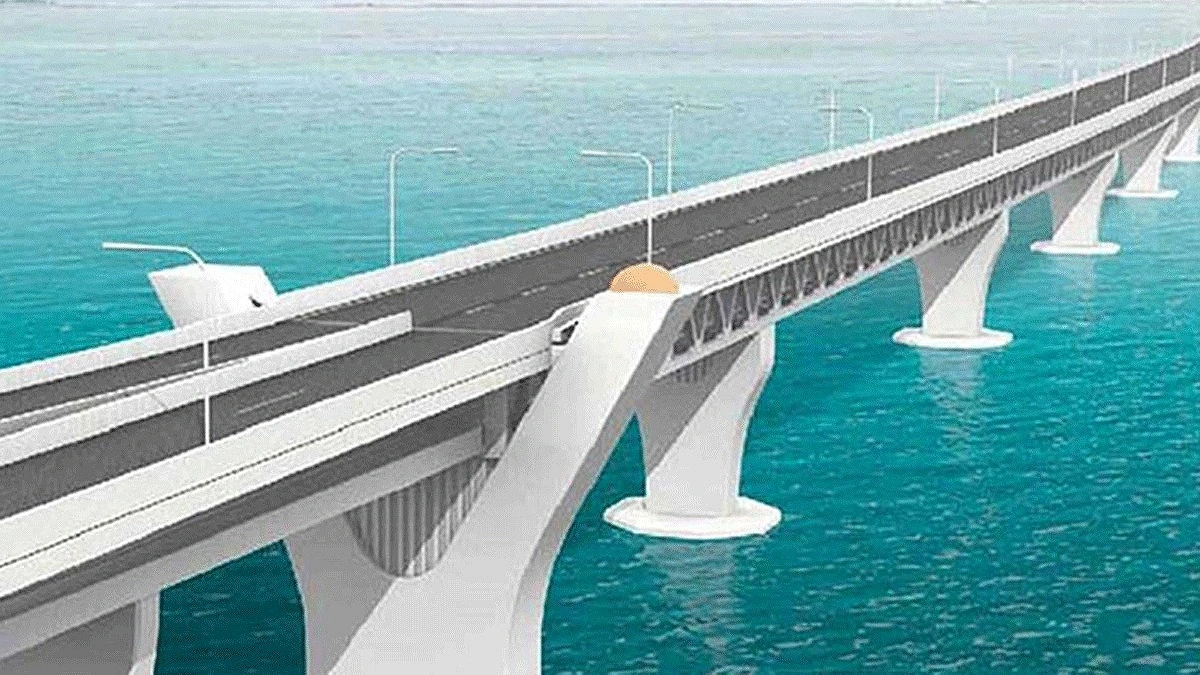
Representational image.
The government plans to build another bridge over the Padma River. Construction is expected to begin before the next national parliamentary election. The BNP-led government has already begun taking various initiatives to implement the plan. With this objective, the Bangladesh Bridge Authority (BBA) is conducting a feasibility study. Work is also under way to determine the alignment, explore potential sources of financing and complete other preparatory activities. Even before the feasibility study is completed, discussions have begun with various countries and lending agencies regarding financing. The BBA said China has already expressed interest in investing in the project.
A feasibility study conducted by the Japan International Cooperation Agency (JICA) in 2003-05 to determine the site for the Padma Bridge considered four possible routes. One of them was from Mawa in Munshiganj to Janjira in Shariatpur, where the Padma Bridge has already been built. Based on information from the previous study, feasibility assessments for the second Padma Bridge are now being conducted on the remaining routes. A new option has also been added: the Daulatdia-Paturia section, connecting Rajbari and Manikganj. Tk 4.5 crore has been allocated in the 2026-27 fiscal year for the feasibility study of the second Padma Bridge.
Asked whether construction of the second Padma Bridge could begin during the current government's term, Bridge Division Secretary Mohammad Abdur Rouf told Agamir Shomoy, “The government is giving the project importance as part of its political commitment. That is why the work is being expedited. It will be possible to begin construction of the second Padma Bridge before the next parliamentary election.”
“The most time-consuming part is usually securing loans, which can take three to six years. However, given the pace at which the work is progressing, it will be possible to complete the necessary processes within three years,” he added.
A feasibility study is normally conducted before a major infrastructure project is undertaken. The study determines whether the project is viable and assesses its potential economic and social benefits. If the feasibility study establishes the project's justification, a Preliminary Development Project Proposal (PDPP) is prepared. It outlines the estimated cost, timeline and other aspects of the project. Sources of financing are then explored. In the case of foreign loans, the Economic Relations Division (ERD) holds discussions with lending agencies. Once financing is secured, a Development Project Proposal (DPP) is prepared and submitted to the Executive Committee of the National Economic Council (ECNEC) for approval. After approval, detailed design work, the appointment of consultants and contractors, land acquisition and other activities are completed before the main construction begins.
Officials of the Bridge Division said it normally takes five to seven years to complete the entire process for a project of this kind. In the case of the second Padma Bridge, however, discussions on potential financing have begun while the feasibility study is still under way. As a result, efforts are being made to advance some of the processes simultaneously rather than following the conventional sequence.
The roots of the second Padma Bridge plan, however, go back much further. JICA's 2003-05 study considered four possible routes across the Padma River: Paturia in Manikganj to Goalanda in Rajbari; Dohar in Dhaka to Charbhadrasan in Faridpur; Mawa in Munshiganj to Janjira in Shariatpur; and Chandpur to Vedarganj in Shariatpur. Considering the river's characteristics, future traffic, road connectivity, engineering feasibility, economic benefits, and environmental and social impacts, the Paturia-Goalanda and Mawa-Janjira routes were selected for further detailed study. Ultimately, the existing Padma Bridge was built along the Mawa-Janjira route.
The second Padma Bridge has returned to the spotlight through the BNP's election manifesto. The issue has continued to be discussed in political circles after the government was formed. Questions such as which route the bridge will follow, what its design will be, whether Pabna can be connected through the bridge and whether it will include a railway line are also under consideration.
However, officials concerned at the Bangladesh Bridge Authority (BBA) said the final alignment and other aspects of the project will depend not only on the findings of the feasibility study but also on policy decisions. Speaking on condition of anonymity, a BBA official told Agamir Shomoy that although everything is supposed to depend on the feasibility study, there is a risk that political considerations may influence major infrastructure projects. Therefore, the final decision on which route the bridge will follow and whether it will include a railway line may also depend on political decisions.
According to BBA information, at least three types of alignments are being discussed for the second Padma Bridge. One concept involves a Y-shaped bridge with three endpoints in Manikganj, Rajbari and Pabna. Under this concept, the bridge could be around 12 kilometres long. Another proposal involves connecting the three districts through an inverted “seven”-shaped alignment. Meanwhile, if the bridge between Paturia and Daulatdia can be kept within five kilometres, the project cost could be reduced.
Another BBA official said preparations for the second Padma Bridge are indeed being advanced by the government, but the project is not yet at a stage where the main construction work can begin. Projects such as the metro rail, monorail and Bhola Bridge are also currently among the government's priorities. In his view, from the perspective of actual need, a second Jamuna Bridge is more necessary than a second Padma Bridge. However, if all preparations are kept ready, inaugurating construction of the second Padma Bridge before the election could yield political benefits.
Transport expert and Bangladesh University of Engineering and Technology (BUET) Professor Shamsul Hoque said, “Large projects are essentially political decisions. The Awami League also undertook many politically driven projects. Because of inadequate planning, their full benefits are not being realised. To obtain the benefits of a major road or bridge, the surrounding roads must also be developed appropriately. Otherwise, the speed of the Mawa Expressway will come to a halt at the Hanif Flyover. I hope the current government will not undertake major projects simply for political reasons.”
An earlier study of the Daulatdia-Paturia route estimated the possible length of the bridge at 4.8 kilometres. Its width was estimated at 18.1 metres, while the connecting roads on the two sides were projected to total around 15.5 kilometres. River training works were expected to extend for around 18-20 kilometres on the two sides. The estimated project cost in that study was Tk 12,750 crore.
Regarding the feasibility of a second Padma Bridge, international river expert Professor Ainun Nishat said, “The river's behaviour needs to be studied. Thinking about building another bridge without monitoring the impact of the existing bridge would be wrong. Before building another bridge, we must first ensure that it will not lead to the destruction of the Padma. Under normal circumstances, I do not see scope for building another bridge over the Padma.”
Meanwhile, the Ministry of Railways has recommended including a railway connection in the feasibility study for the proposed second Padma Bridge in the Paturia-Daulatdia area. The ministry conveyed its opinion to the Bridge Division in a letter.
Afzal Hossain, director general of Bangladesh Railway, told Agamir Somoy that whenever the Padma is bridged again, the ministry wants a railway line to be included. This would allow the railway network to be expanded further in the future. The current government is also taking initiatives to expand railway lines. In this regard, a railway connection on the second Padma Bridge would be important.
The first major bridge over the Padma River was the Lalon Shah Bridge. The 1.8-kilometre bridge was inaugurated on May 18, 2004. Later, the Padma Bridge, built between Mawa in Munshiganj and Janjira in Shariatpur, was inaugurated on June 25, 2022.
If a second Padma Bridge is built, road connectivity with Dhaka could become easier and travel distances could be reduced for parts of the southwestern region, including Meherpur, Chuadanga, Kushtia, Jhenaidah, Magura, Rajbari, Faridpur, Gopalganj and Narail, as well as Jessore. If a railway line is added to the bridge, it could also create an opportunity to expand rail connectivity with the southwestern region.
