
Potential for employment of two lakh people in Bangladesh through Japanese investment
- Matarbari to become an industrial and energy hub
- Initiatives to expedite the implementation of an economic partnership agreement
- New agreements in defense and agriculture

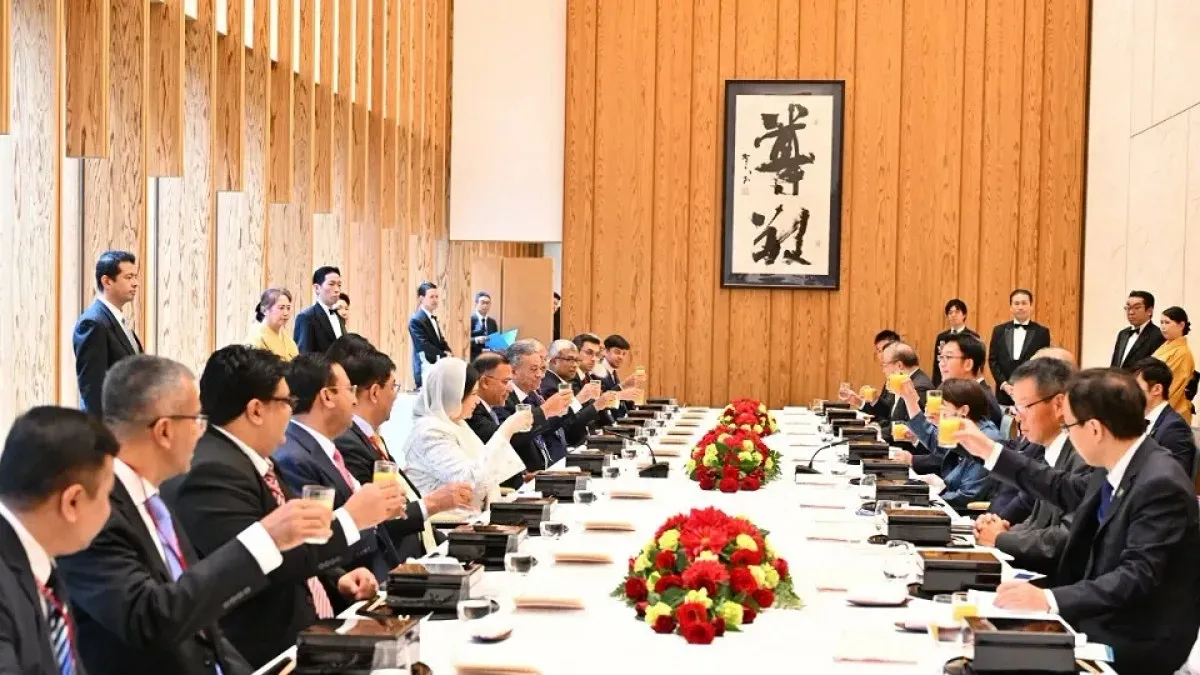
Prime Minister Tarique Rahman leads a bilateral meeting in Tokyo on Tuesday. Photo: Prime Minister's Office
The two countries see the potential for up to one trillion yen in Japanese private investment in Bangladesh over the next five years. Bangladesh's Prime Minister Tarique Rahman and Japan's Prime Minister Sanaye Takaichi have agreed to strengthen economic cooperation with the aim of creating two lakh jobs in Bangladesh through this investment. In the joint statement of the two countries, special importance has been given to investment, trade, energy security, infrastructure, agriculture, information technology, and defense cooperation.
These matters came up in the joint statement published after the bilateral summit meeting of the two Prime Ministers on Tuesday (October 27) in Tokyo. In it, the commitment to elevate Bangladesh-Japan relations to a broader and more effective partnership was reaffirmed.
The joint statement said the two countries' special economic cooperation initiative "Big-B for Shared Prosperity" will be further expanded. Under it, the two Prime Ministers agreed to build an integrated hub for deep seaport, energy, industry, and cargo transport centered on the Matarbari-Maheshkhali region. Alongside this, it was said that preparations for the rapid launch of the third terminal of Hazrat Shahjalal International Airport in Dhaka and cooperation in advancing the development of Dhaka's public transport system will be taken forward.
Important cooperation in energy security also came up. Prime Minister Tarique Rahman thanked Japan for 50 billion yen in emergency loan assistance under Japan's "Power Asia" initiative to ensure economic stability and energy supply. A decision was made to increase cooperation in reducing the gap between energy demand and supply and in expanding renewable energy.
The two countries welcomed the signing of a memorandum of understanding on economic relations to improve the investment environment. This understanding was reached between Japan's Ministry of Economy, Trade and Industry and the Economic Relations Division of Bangladesh's Ministry of Finance. In addition, the signing of two memoranda of understanding between Japan's Ministry of Agriculture, Forestry and Fisheries and the concerned ministries of Bangladesh to increase cooperation in the food, agriculture, fisheries, and livestock sectors was welcomed.
An expression of interest was signed between the two countries to tackle the environment and climate change. Its goal is to increase cooperation in low-carbon emission-based development, improving energy efficiency, and expanding renewable energy.
The two Prime Ministers emphasized the rapid implementation of the Bangladesh-Japan Economic Partnership Agreement to expand trade. Through this agreement, alongside increasing trade and investment, cooperation is expected in addressing Bangladesh's transitional economic challenges as it graduates from the list of least developed countries.
Defense and security cooperation also received importance at the meeting. The two leaders welcomed the signing and coming into effect of the agreement on the transfer of defense equipment and technology. The joint statement also mentioned the provision of a patrol vessel under Japan's development assistance and five patrol boats under the security assistance program to strengthen Bangladesh's coastal security.
