'We will start and complete Padma-Teesta barrage works quickly', says PM
- 4 million farmers to receive cards, granting access to 10 types of benefits
- Number of beds at Upazila Health Complexes to be doubled
- Plans to revive closed industrial units
- Initiative to plant 250 million trees over the next five years

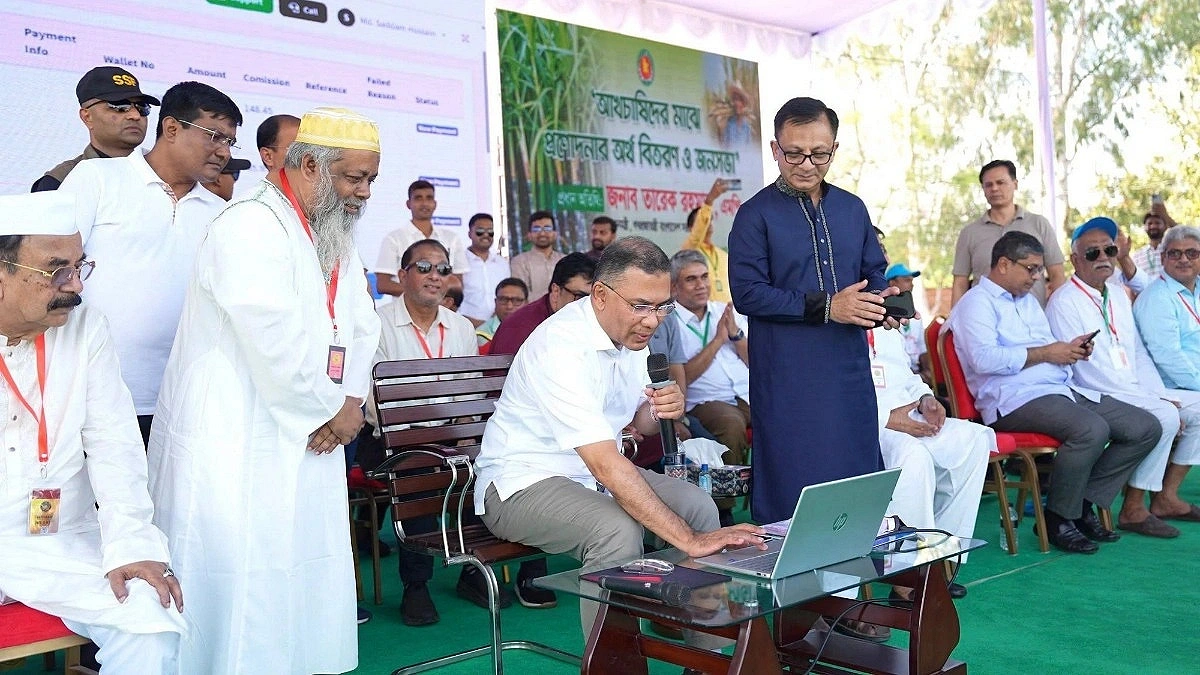
Prime Minister Tareque Rahman is disbursing 120 million taka in incentives to sugarcane farmers' accounts by pressing a button on a laptop. PMO.
Prime Minister and BNP Chairperson Tarique Rahman has announced that work on constructing barrages on the Padma and Teesta rivers will be started and completed quickly. He said necessary steps will be taken to secure the country's people's rightful share of water. These two projects will play an important role in increasing agricultural production, expanding irrigation facilities, and eliminating water crises.
At the same time, he announced plans to excavate 20,000 kilometers of canals in the next five years, deliver farmer cards to 40 lakh farmers, double the number of beds in upazila health complexes, and reopen closed mills and factories.
The Prime Minister cited these issues in his speech as chief guest at an incentive distribution ceremony for sugarcane farmers and a public rally at the historic Madrasa Ground in Rajshahi on Tuesday (October 20) afternoon.
Tarique Rahman said, "The Padma and Teesta are two major rivers of the country. The government has decided to construct barrages on these rivers. Through this, efforts will be made to increase agricultural production alongside tackling water crises."
Highlighting information about the declining water flow in the Padma River, he said people in the Rajshahi region have long felt its scarcity. Water security is essential for the development of agriculture and people's livelihoods in this region. Discussions will be held with relevant parties to secure the country's people's rightful share of water. If necessary, the government will go as far as needed to secure rights.
According to the Prime Minister, if the Padma barrage is constructed, people in about 14 districts, including Rajshahi and surrounding areas, will benefit.
Describing agriculture as the foundation of the country's economy, he said, "If farmers survive, agriculture will survive; if agriculture survives, the country will survive."
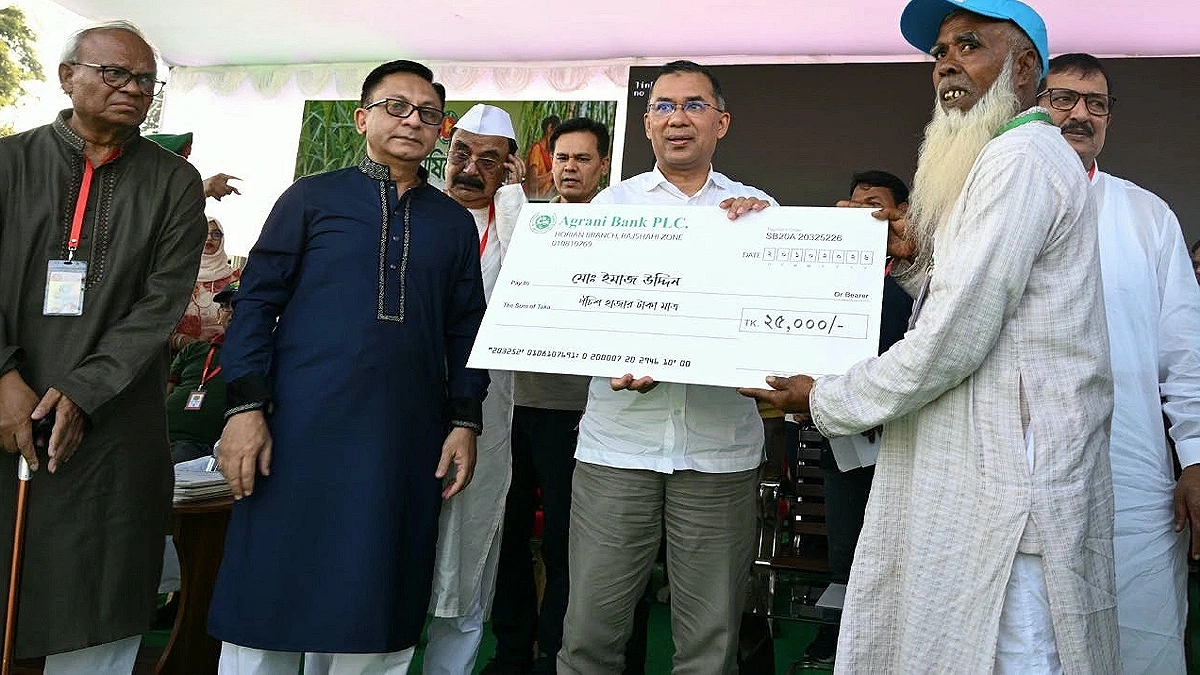
Tarique Rahman said the incentive arrangement for sugarcane farmers has been made from this belief. An initiative has been taken to deliver this assistance to about 39,000 sugarcane farmers so that the pressure of sugarcane cultivation costs is somewhat reduced in the next season.
The Prime Minister is handing an incentive check to a farmer. PMO.
Noting that BNP had promised to stand by farmers before the election, he said, "Within seven days of forming the government, the promise to waive agricultural loans up to Tk one lakh along with interest has been implemented. About 13 lakh farmers across the country have benefited from this."
Work is underway to prepare lists of landless, marginal, small, medium, and large farmers. After this process is completed, farmer cards will be distributed in phases, the head of government said.
"Through the farmer card, farmers will receive assistance with necessary fertilizer, seeds, and pesticides for their produced crops. Even if they produce two or three crops a year, the government will try to reduce their hardship by providing inputs for at least one crop. This card will also offer facilities for crop insurance and bank loans," Tarique Rahman added.
Emphasizing the importance of giving farmers access to information technology, Tarique Rahman said weather information can be known on mobile phones through the farmer card. If farmers can know whether it will rain the next day, they can make advance decisions about tasks such as sowing seeds or applying fertilizer. There are plans to include about 10 types of facilities on this card.
The Prime Minister also highlighted the canal excavation and river restoration program to eliminate the water crisis for agriculture. He said, "The canal excavation program began during the time of martyred President Ziaur Rahman. Initiatives were also taken then for the development of the Barind region. In continuation of that, the government has again started excavating canals and rivers to increase irrigation facilities for farmers and reduce the water hardship of village people."
A target has been set to excavate 20,000 kilometers of canals in the next five years, Tarique Rahman said, claiming that about 800 kilometers of canal excavation work has been completed in the past eight months. If the program is implemented, farmers will get irrigation water. At the same time, he expressed hope that in areas of the northern region, including Rajshahi, where the groundwater level has fallen, the water crisis will decrease and groundwater recharge will be helped.
Speaking about plans to bring healthcare to people's doorsteps, the Prime Minister said, "In the next five years, the number of beds in every upazila health complex in the country will be raised from 50 to 100. As a result, rural people will not have to go to distant district towns or metropolitan cities for treatment of common illnesses. Although seriously ill patients may need to go to larger hospitals, the government aims to ensure primary and general treatment at the upazila level."
He also said separate bed arrangements will be made for children and women in upazila hospitals. Alongside this, there are plans for dialysis facilities for kidney patients. Through these initiatives, the government wants to bring healthcare services closer to ordinary people.
Referring to local leaders' demands regarding Rajshahi's healthcare system, Tarique Rahman said, "A demand has been made to increase the number of beds in a medical facility here from 1,300 to 2,500." He responded positively to the matter.
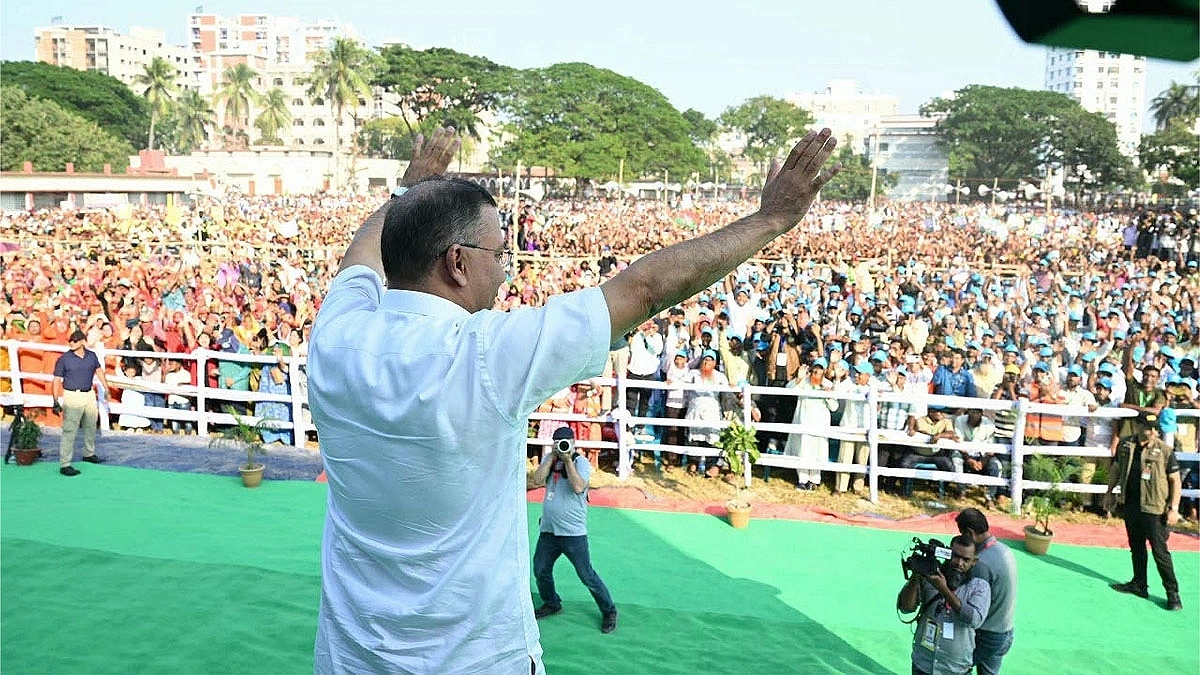
PM Tarique Rahman is waving hands to greet the ordinary people and party activists who arrived at the rally venue. PMO.
Highlighting initiatives to reduce treatment costs, the Prime Minister said, "Taxes on medicines used in dialysis for kidney patients have been reduced."
According to him, dialysis previously cost about Tk 1,200 to Tk 1,500. Now it has come down to about Tk 700 to Tk 800.
He said taxes have also been reduced on some equipment used in the treatment of heart disease. As a result, the cost of some medical equipment that previously cost about Tk 1 lakh 20 thousand to Tk 1 lakh 30 thousand has come down to Tk 60 thousand to Tk 65 thousand, the Prime Minister claimed.
Emphasizing the reopening of closed mills and factories to increase employment, Tarique Rahman said, "Many workers have become unemployed because industrial factories in various areas of the country, including Rajshahi, have closed. The government is discussing with domestic entrepreneurs to reopen these factories. At the same time, foreign investors are being encouraged to invest in Bangladesh. The goal is to increase production and create employment opportunities for workers."
The Prime Minister said initiatives have already been taken to reopen six closed mills and factories in the country. There are plans to reopen about 46 more closed factories between January and December 2027. If these factories are reopened, workers' employment will increase. At the same time, he expressed hope that opportunities will be created to export domestically produced goods abroad.
However, the PM alleged that some political parties and groups are trying to create instability to obstruct the government's programs. He said, "The government wants to ensure stability and security in the country. Making farmers self-reliant, creating employment for workers, reopening closed industries, and reducing unemployment are the government's goals. But some political parties are trying to slow down these initiatives by creating chaos on the streets."
The Prime Minister claimed that intelligence information shows funding from the fugitive autocratic force is behind labor unrest in several industrial factories. He alleged that attempts are being made to create instability inside the country by supplying money from abroad to a certain group. However, he did not provide detailed information about specific individuals, organizations, or incidents in support of the allegation.
Speaking about environmental protection and greening, the Prime Minister said BNP has taken a program to plant 25 crore trees in the next five years. Trees will provide fruit and shade for people, maintain environmental balance, and help reduce temperatures. He also mentioned that in the past, under the leadership of former mayor Mizanur Rahman Minu, extensive tree-planting initiatives were taken in Rajshahi city.
Regarding women's education and economic empowerment, Tarique Rahman said, "During former Prime Minister Begum Khaleda Zia's time, girls were given the opportunity to study free of charge up to the intermediate level. The current government has decided to expand free education for girls up to the honors level. There are also plans to provide scholarships to female students who achieve good results."
Remembering the martyrs of the 2024 mass uprising, the Prime Minister said, "BNP embraces both the history of the Liberation War and the 2024 mass uprising."
He mentioned the construction of a memorial at Osmani Udyan in Dhaka in memory of the martyrs of the mass uprising. He also said initiatives have been taken to provide employment to family members of the martyrs and assistance for the treatment of injured July fighters.
Tarique Rahman alleged that although some political parties were invited to an event organized to pay tribute to the martyrs of the July mass uprising, they did not send representatives. In his view, it is important for political statements and actual behavior to match.
Emphasizing stability, employment, and democratic rights in the country, the Prime Minister said the people of Bangladesh want political rights and a peaceful environment along with economic rights. No one from abroad will come and develop the country. The people of the country themselves must build the country through labor and hard work.
The rally was presided over by BNP Acting Secretary General Advocate Ruhul Kabir Rizvi. Among others, Land Minister Mizanur Rahman, Cultural Affairs Minister Nitai Roy Chowdhury, BNP Standing Committee member Gayeshwar Chandra Roy, Advisor to the BNP Chairperson Major General (retd.) Sharif Uddin, Dhaka District BNP President Nipun Roy Chowdhury, Member of Parliament for Rajshahi-5 (Puthia-Durgapur) constituency Professor Nazrul Islam Mondal, Member of Parliament for Rajshahi-6 (Bagha-Charghat) constituency Abu Sayeed Chand, Member of Parliament for Rajshahi-3 constituency Advocate Shafiqul Haque Milon, and MP Abdul Muktadir spoke at the event.
Earlier, at around 3 pm on Tuesday, the Prime Minister landed at Hazrat Shah Makhdum Airport in Rajshahi on a military aircraft. From there, he went directly to the public rally at the Madrasa Ground. He reached there at 3:20 pm. After staying for a while at the Circuit House, he is scheduled to visit the Dharmasabha puja mandap in Rajshahi city on the occasion of the Sharadiya Durga Puja.
After completing his programs in Rajshahi, the Prime Minister is scheduled to leave for Chattogram. There, he is scheduled to visit the puja mandap at JM Sen Hall in Rahmatganj and return to Dhaka at night. During his one-day visit, the Prime Minister is visiting puja mandaps in three divisions and exchanging greetings with followers of the Sanatan religion.