Gazipur factories reopen as workers return after month of unrest

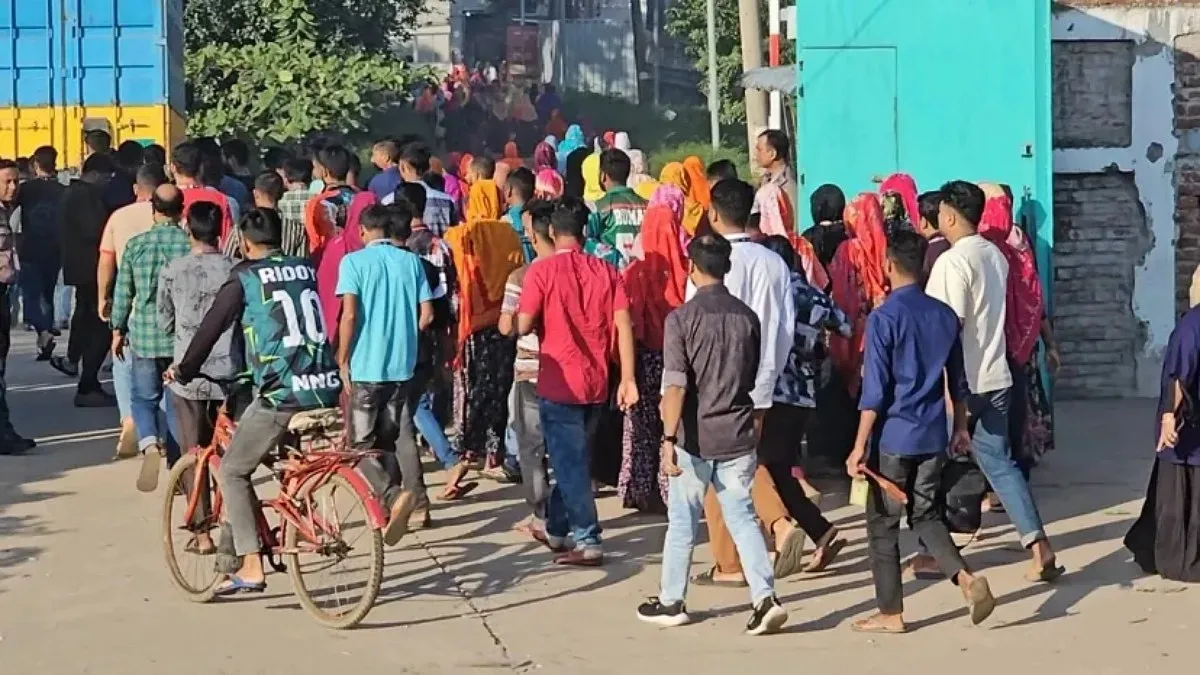
Photo: Agamir Somoy
After a month of continuous labor unrest and clashes, factories of Gazipur have resumed their production activity as workers joined their duties on Saturday morning.
However, 35 factories that were declared closed for an indefinite period have not reopened yet.
Gazipur Industrial Police Superintendent of Police (SP) Mohammad Amjad Hossain confirmed the matter.
From 8 am, workers were seen returning to work in the industrial zones adjacent to the Dhaka-Tangail and Dhaka-Mymensingh highways. Worker attendance in factories across areas including Bhogra Bypass, Naojor, Konabari, Sofipur, Palli Bidyut, Chandra, Salna, Rajendrapur, Banglabazar, Bhabanipur, Hotapara, Memberbari, Bagher Bazar, Gorgoria Masterbari, Shirirchala, and Beraiderchala is largely returning to normal.
To maintain a normal situation in the Gazipur industrial zone, 17 executive magistrates, 17 platoons of Border Guard Bangladesh (BGB), Industrial Police, District Police, Gazipur Metropolitan Police, SRB, and Ansar members are performing their duties.
Law enforcement agencies were seen maintaining a vigilant stance at key points across the industrial zone.
Earlier, on 27 October, workers at a garment factory in the Mouchak area of Kaliakair initiated a work stoppage demanding a minimum wage of Tk 30,000. Later, they blocked the Dhaka-Tangail Highway and protested by burning bamboo and wood on the road.
Gradually, the movement spread to various areas including Palli Bidyut Intersection, Sofipur, Konabari, and Kaliakair, before spreading across various areas of Gazipur Metropolitan City.
During this time, incidents of road and highway blockades, factory work stoppages, and clashes with police occurred. That movement started from Mirpur, Dhaka and spread across the country, including Savar, Ashulia, and Narayanganj.
Amid worker unrest, the government formed a six-member Minimum Wage Board on 1 November, comprising representatives from both factory owners and workers. At the board’s fourth meeting on 24 November, the minimum wage for readymade garment workers was fixed at Tk 17,000, raised from Tk 12,500. The new wage structure is scheduled to take effect from 1 December.
However, as this decision fell short compared to the workers’ demand for a Tk 30,000 wage, dissatisfaction persisted. Even after the announcement of the new wage structure, incidents of unrest and clashes occurred at various factories. To control the situation, several factories declared holidays, while some factories were kept closed for an indefinite period.
Most recently, a week and a half ago, clashes with workers occurred in Gazipur Sadar and Sreepur Upazilas.
Meanwhile, labor unrest has also impacted international purchase orders for the country’s readymade garment industry. A report by news agency Reuters, citing three garment factory owners, said in the first 18 days of November, garment purchase orders worth around $254 million were shifted from Bangladesh to other countries.
In Bangladeshi currency, this amount stands around Tk 3,184 crore. A major portion of these orders went to India, alongside an observed trend of shifting purchase orders to Vietnam, Cambodia, and Indonesia.
According to estimates by the Bangladesh Garment Manufacturers and Exporters Association (BGMEA), the amount of production loss due to worker protests exceeds $400 million. More than 80 percent of the country’s export earnings come from the readymade garment sector.
As a result, long-term instability in this sector could also impact the country’s overall economy.