
RAB to be Abolished, PPF to be Introduced

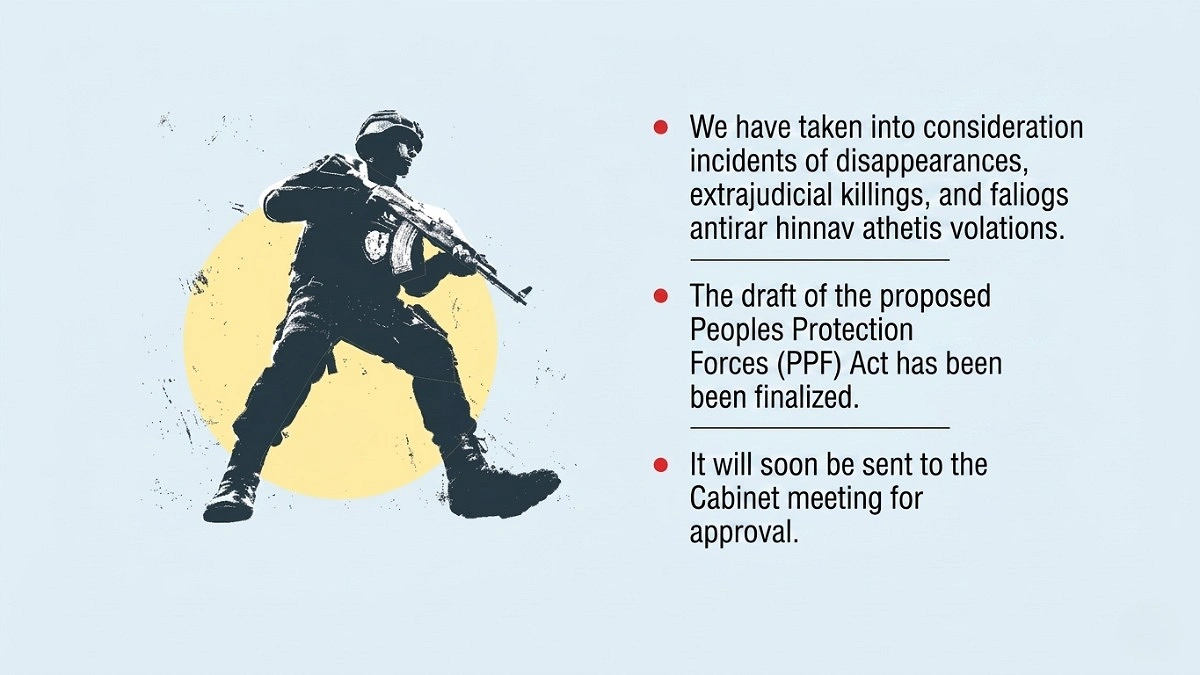
Graphics: Agamir Somoy generated by AI
The elite force Rapid Action Battalion (RAB) is set to be dissolved by the government, citing allegations of enforced disappearances, extrajudicial killings, and other human rights violations. In its place, a new specialised police force called the “People’s Protection Forces (PPF)” will be formed. The draft law for this has already been finalised by the Ministry of Home Affairs and vetted by the Ministry of Law. It will soon be placed before the cabinet for approval, according to policy-level government sources.
During the 22nd anniversary of RAB on 18 May, Home Minister Salahuddin Ahmed had hinted at its possible dissolution, saying the government was working to form a modern and professional elite force while upholding human rights and public expectations.
According to the Home Ministry, the proposed law will be titled the “People’s Protection Forces Act 2026.” The draft states that the reorganisation is intended to strengthen internal security and take strict action against terrorism, drug trafficking, illegal arms, and explosives, while improving overall law and order.
The new force will be formed in a similar structure to RAB, with personnel drawn from various security agencies. It will be led by a Director General (DG), who must be a police officer and will operate under the Inspector General of Police (IGP) while executing government directives.
The draft also states that members of the force will be subject to disciplinary action under their respective parent organisations if they commit any offence. They will have powers equivalent to a police officer-in-charge (OC) regarding search, arrest, and detention. Any arrest or seizure must be promptly reported to the nearest police station with a brief report, a rule that exists in the current RAB law but is reportedly not properly enforced.
The proposed law outlines eight key functions for the new force, including maintaining internal security, intelligence gathering, combating terrorism, recovering illegal arms, explosives and drugs, assisting other law enforcement agencies, and carrying out investigations or duties assigned by the government or courts.
It also includes provisions allowing detention under 17 specific grounds, with a requirement to inform higher authorities and provide written reasons for arrest.
All assets, liabilities, and personnel of RAB will automatically be transferred to the new PPF. Existing RAB officers and staff will become members of the new force.
Former member of the Commission of Inquiry on Enforced Disappearances, Nur Khan Liton, told Agamir Somoy that RAB has faced numerous allegations and is not a people-friendly organisation, which is why the commission recommended its dissolution.
Why RAB is being abolished
Over the past two decades, Bangladesh has faced extensive national and international criticism over enforced disappearances and “crossfire” killings. Various domestic and international organisations have repeatedly linked RAB to a significant number of these incidents. Following the July uprising, the Commission on Enforced Disappearances formally recommended abolishing the force.
Earlier this year, Human Rights Watch and other rights groups also called for its dissolution. In 2021, the United States imposed sanctions on seven current and former RAB officials over human rights violations.
A commission report issued on 5 January this year stated that around 25% of all reported enforced disappearance cases were linked to RAB—the highest among any single agency. It also found that 22–23 of 40 secret detention facilities identified were operated by RAB.
Police Special Branch records show that between 2015 and 2021, 1,293 people were killed in 1,007 crossfire incidents, with RAB involved in 293 of those cases.
The opposition party BNP had earlier demanded RAB’s dissolution in a press conference on 10 December 2024. Ironically, RAB was originally formed in March 2004 by the BNP government, combining personnel from the police, army, navy, air force, BGB, coast guard, and Ansar forces.
RAB gained early attention after a series of crossfire killings of top criminals, including Pichchi Hannan in Dhaka and other militants in the southwest. The force later came under global scrutiny after the 2014 Narayanganj Seven Murders case, in which several RAB-11 officers, including then commander Lieutenant Colonel Tareque Sayeed, were involved.
Following the fall of the Sheikh Hasina government, RAB reportedly issued a formal apology in December 2024 for its past actions. It was also acknowledged that secret detention sites, commonly referred to as “Aynaghar,” had existed within the organisation.
