

Five Gifts That Elevate Your Thinking

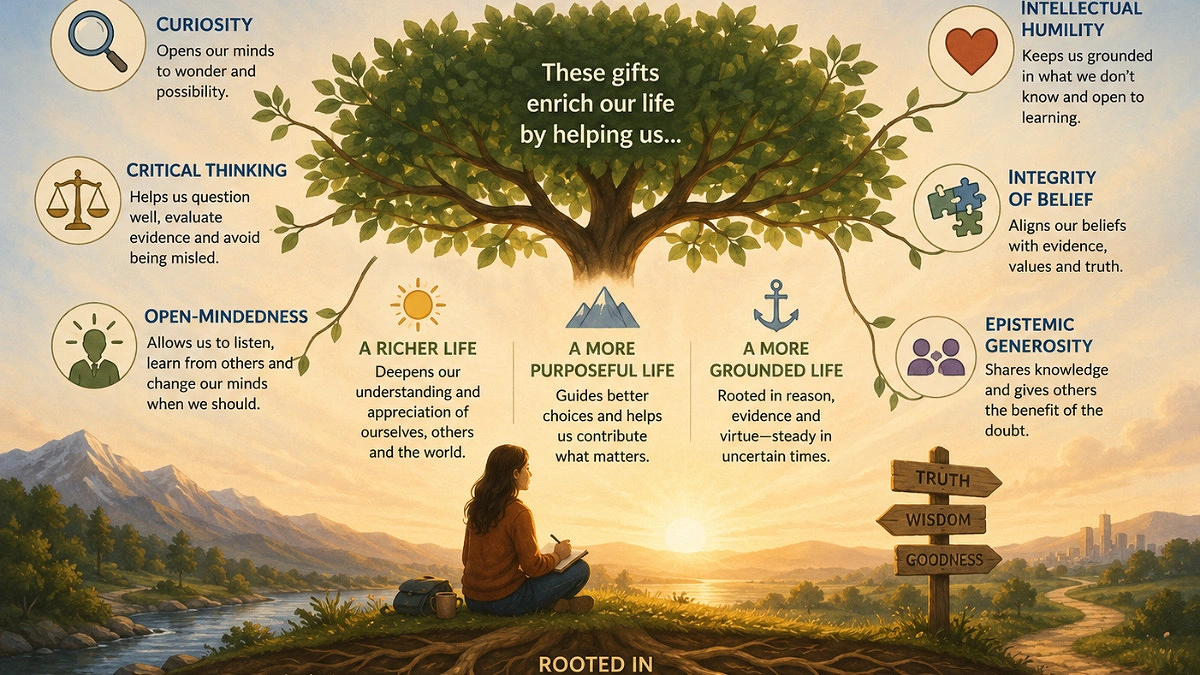
Representational image generated by AI.
How epistemic gifts can make your life richer, more purposeful, and more grounded.
Can you feel thankful for things that make you uneasy—even anxious? Most of us naturally link gratitude to pleasant moments: joys, luck, or comfort. But what if the most transformative gifts aren't the ones that soothe us, but the ones that shake us, unsettle us, and force us to see the world anew?
If we define "good" not merely as what brings happiness, but as what gives our lives depth, success, and moral footing, then some unexpected experiences start to look a lot like presents.
What Are Epistemic Gifts?
In this essay, I want to explore a special category of such gifts.
I call them epistemic gifts. The term "epistemic" relates to knowledge and understanding—so these are experiences that broaden our mental horizons, refine our perspective, and hone our capacity for clear thought.
Some epistemic gifts are easy to recognize: formal education, or the practical skills that boost our career performance.
But here I want to focus on five that are far less obvious:
critical feedback, self-awareness, wisdom, questions, and what I term the epistemic stretch.
Critical Feedback – Learning to accept criticism as a gift can be tough—especially when it's clumsily delivered. Yet much of our personal growth springs from people who tell us what we need to hear, not just what we want to hear. (I've dedicated a full article to unpacking seven practical strategies for handling critical feedback.)
Self‑Awareness – We pour huge energy into figuring out other people. But how much time do we spend understanding ourselves? The three pillars of self‑awareness—introspection, honest external input, and mindful reflection—form the bedrock of real personal development.
Wisdom – Unlike raw intelligence, wisdom comes from lived experience, failure, and the patient distillation of lessons learned. It's the gift that lets us see the bigger picture and act with discernment.
Questions – A good question can be more illuminating than a ready answer. The habit of asking penetrating, open‑ended questions keeps our minds agile and protects us from intellectual stagnation.
The Epistemic Stretch – This is the discomfort of grappling with ideas that push us beyond our current understanding. It's the cognitive workout that strengthens our mental muscles and expands our comfort zone.
Ultimately, these five gifts are not always welcome in the moment. But if we step back and recognise their value, we can reframe discomfort as a doorway to growth. And that shift in perspective might just be the most meaningful gift of all.
Becoming more self‑aware might be one of the most transformative epistemic gifts you can ever receive. Let’s break it down into three core areas:
1. Your motives. What truly drives you? We often act without fully understanding our own intentions—whether that means obsessing over which photo to post on social media or struggling to leave a relationship we know is unhealthy. Asking tough questions like these reveals the hidden currents of fear, desire, and deeper motivation beneath the surface.
2. Your triggers. Have you ever caught yourself overreacting and wondered why? Even the most easy‑going among us can experience sudden bursts of anger or frustration. Identifying those emotional flashpoints can illuminate our unseen vulnerabilities—and that awareness is the first step toward managing them.
3. Your coping strategies. How do you instinctively respond when stress hits? Are your default habits genuinely healthy, and do they serve you well in the long run?
Self‑awareness is a gift because it yanks us off the autopilot that too often governs our behaviour. When we step back and examine our motives, triggers, and coping patterns, we reclaim the freedom to act with genuine intention.
Wisdom ranks among the most priceless epistemic gifts we can acquire. I particularly admire Igor Grossman's perspective, which defines wisdom as the capacity to navigate complex, ambiguous situations with sound judgment—without resorting to simplistic slogans or rigid rules like "always be optimistic" or "never doubt yourself." (I've written a full article on why wisdom deserves such close attention.)
Closely linked to wisdom is the art of asking the right questions. Much of our mental energy goes into hunting for answers: What should I decide? Which path should I take? How will my future unfold? But a well‑framed question can outlast any single answer—it becomes a reusable compass for countless situations.
Here are a few guiding questions that I've found particularly useful:
1. To guard against impulsivity, I often ask: "Seven days from now, will my future self be glad I said or did this?" If the answer is no—or I'm uncertain—that hesitation is my signal to pause.
2. When deciding how to spend my time, I focus on value alignment rather than productivity hacks. I check: "Does what I'm doing right now reflect my core values?" If not, I recalibrate toward something that does.
3. In my previous leadership role, I used questions that fostered inclusion: Who benefits from this policy? Who doesn't? Who gets the most attention, and who deserves more? Which groups might be inadvertently excluded? These prompts helped me lead more fairly and thoughtfully.
What guiding questions have helped you make better decisions?
Now, let’s talk about the epistemic stretch—perhaps the most demanding of all five gifts. How open are you to truly engaging with viewpoints that challenge your deepest beliefs? When you encounter such ideas, is your first reaction disgust—or curiosity?
An epistemic stretch happens when you seriously grapple with an alternative worldview. Sometimes it might shift your own position, even slightly; other times, it simply means making a sincere effort to understand another perspective on its own terms, not just to refute it.
This is tough. When politics, religion, or core values are at stake, it's tempting to write off those who disagree as foolish or ill‑intentioned. But an epistemic stretch leads you down a different road. It sharpens your critical thinking, builds intellectual flexibility, and chips away at self‑righteousness. You may even reach a place where you can honestly say: "I disagree with this view, but I understand how someone could arrive at it." In that sense, the epistemic stretch does more than upgrade your thinking—it deepens your empathy.
If you want to cultivate more epistemic stretches, here are three practical suggestions:
First, go to the primary sources. We often think we understand opposing views because we've read critiques of them. But what we usually have is a caricature. To grasp a viewpoint fairly, read the original works of the people who actually hold it.
Second, watch out for outgroup homogeneity bias—the tendency to assume that everyone in an opposing group thinks exactly alike. Explore the internal diversity within that worldview. Start with its less extreme voices, and you may be surprised to find that they can enrich your own perspective.
Third, build authentic friendships across ideological lines. When genuine relationships exist, conversations about difficult topics naturally become opportunities for mutual learning—not heated debate. And that might be the most rewarding stretch of all.
The Takeaway
Let's circle back to those five epistemic gifts. You might already notice that some of them are quietly present in your life—you just haven't thought of them as gifts before. Take a moment to pause and reflect: Who or what helped these seeds take root? That awareness alone is a reason for gratitude. If someone has nudged you toward greater self‑awareness, deepened your wisdom, or stretched your intellectual flexibility, consider telling them. A simple thank‑you can mean more than you know.
At the same time, you may recognise that certain epistemic gifts are still underdeveloped or missing. Think of that not as a shortcoming, but as an open invitation.
Seek out feedback that challenges your thinking. Ask questions that unsettle your assumptions. Get genuinely curious about perspectives that differ from your own. Yes, these experiences can feel uncomfortable at first—even jarring. But they expand your mental horizons, cultivate empathy, and equip you to navigate life's complexities with greater clarity. Over time, they may well become some of the most valuable gifts you'll ever receive—and ones truly worth being grateful for.
(Joel Wong, Ph.D., is a Provost Professor of Counseling Psychology at Indiana University who studies gratitude interventions and practices.)
Source: Psychology Today

