
Mid-day meal is not just food, it is much more...

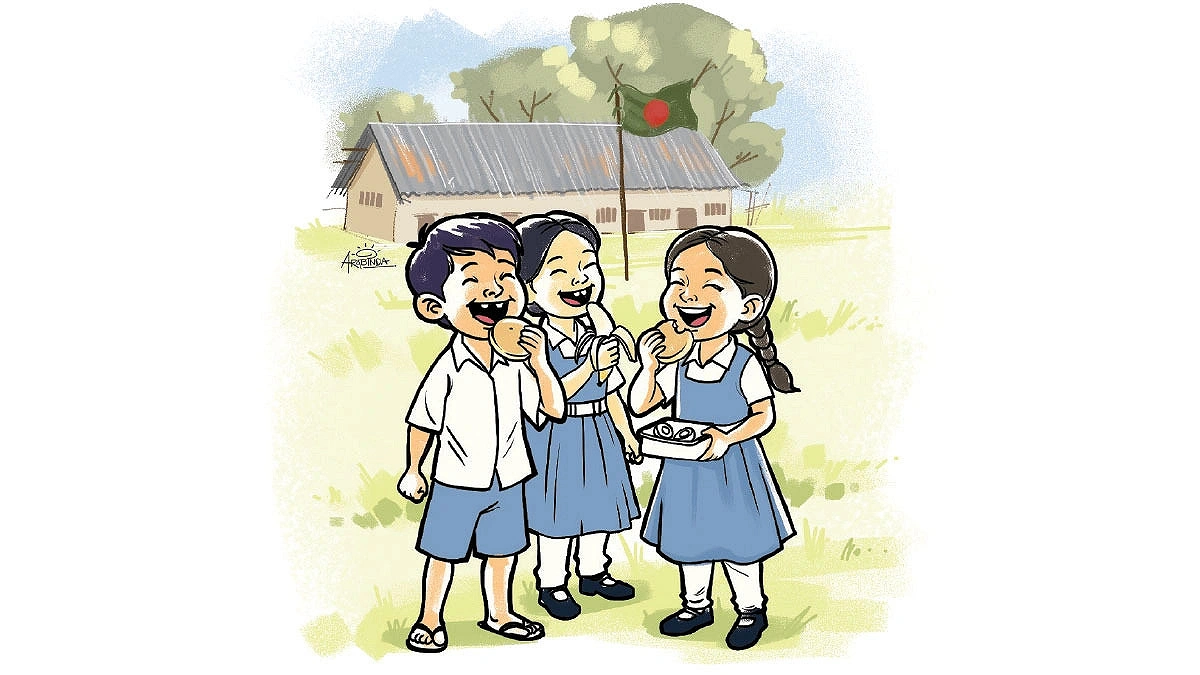
Graphics: Agamir Somoy
The arrangement was that when the strong mid-day sun reached right above the classroom, students of third, fourth and fifth grades would line up for food. However, visiting Kamta Government Primary School in Daudpur Union of Rupganj Upazila revealed a different picture. Five students from the afternoon shift were present early. The sole reason—food is available if they go to school. If they arrive early in the morning, besides the mid-day meal, they get some leftover food from the morning shift. For hungry stomachs, getting a whole or half piece of bread or a few biscuits is an extra bonus.
This school in Narayanganj runs in two shifts—morning and afternoon. In the morning shift, classes for pre-primary, first, and second grade start at 9:00 AM.
The afternoon shift runs from 12:00 PM to 4:15 PM for classes three, four, and five.
On September 10 (Thursday) around 9:15 AM, visiting the school allowed for a conversation with Fabiha and Mahima, two of the five students who arrived early in the morning. They walk for half an hour from far away to reach the school. By the time they arrive, they get hungry. Fabiha's father works at an eatery, while Mahima has lost her father. Sitting on the floor of the room, they began talking to the reporter with a mixture of embarrassment and fear. Mahima's mother works as domestic help. Mahima said that providing one meal at school saves some money for her mother. As they kept talking, Fabiha's timid face gradually relaxed. She nodded, agreeing that getting lunch eases some burden on her father as well. Conversations followed with other students too. Mistaking the reporter for an authority official, a few children requested rice or khichuri instead of dry food once or twice a week.
Parents of the children also spoke about the miracle of the mid-day meal. Parveen, mother of pre-primary student Habibur Rahman, came to drop him off at school. Barefoot, her feet were still smudged with mud. Working as a vegetable farmer on others' land, she shared that previously she had to provide tiffin for her child, but now it is no longer required, reducing daily expenses. Fahima Akhtar, mother of another child, Abu Bakar Siddique, smiled broadly and said that children come to school lured by the tiffin. Previously, he would throw tantrums for chocolates or other treats, but now he comes to school on his own.
Headmistress Reena Akhtar told Agamiri Somoy, "On the morning of September 9 (Wednesday), 10 children from classes three, four, and five arrived early. Among them, five were unfed. Their shift is in the afternoon, and they receive food at 1:30 PM. However, they come in the morning lured by half a piece of bread. When attendance is low, food remains leftover, and we give them extra portions."
Exploring the surroundings of the school showed that human settlement is almost non-existent there, and student numbers are low. Attendance was not high a year ago either. However, the headmistress stated that attendance has increased after starting the mid-day meal. She remarked, "Mostly floating children study here. For them, this is not just food, it is much more..."
Leaving Kamta School, the reporter headed toward Kenduapara Government Primary School No. 47 in Kanchan Municipality of Rupganj. Mohammad Mahbub Alam, headmaster of the primary school, also told Agamiri Somoy that school attendance has increased due to providing lunch. In this school, four-year-old children (piloting) and five-year-olds study in pre-primary. The younger pre-primary students are given mid-day meals at 11:30 AM, while the five-year-olds receive theirs at 12:00 PM. The tiffin distribution for the remaining classes, from first to fifth grade, takes place at 1:00 PM.
As soon as it struck 11:30 AM, it was time to distribute food to the younger pre-primary section. A bustle ensued on the veranda as 20 to 22 children lined up in rows. There was no rush to go home; instead, keeping their eager eyes under control, they waited in line. The moment the teacher granted permission to take food, these children expressed their joy with broad smiles. Boiled eggs and bread—it was no royal feast, but to those children, the value of this meal was no less than a celebration.
With food in hand, Afran took off, making it unnecessary to ask about his feelings separately. The sudden transformation of joy on his tired face would outshine the vocabulary of any language. He nodded, signaling that if the bread distribution stopped, he would no longer come to school. Right after saying this, Afran felt slightly flustered by the burst of laughter from everyone around.
Chowdhurypara Government Primary School is also located in Rupganj Upazila, but in a fairly remote area. Most students at this school come from underprivileged backgrounds. Mid-day meals do not merely fill the stomachs of these students; they also save a meal for family members of many. "I take the bread packet home. I give one to my mother, and my father and I share the other," shared a child student named Mahi. Her eyes were fixed on the ground, and her tone was shy. While speaking, she was quietly tapping the paved floor with her big toes—as if the floor could at least gauge the pain of hunger that her voice failed to express. Siam is also a student at this school. His hope is that the school will serve rice once a week, along with beef.
Harikanta Sarkar Deepak, headmaster of the school, said that attendance has increased compared to before because of the food, especially among female students. Occasionally, there are shortages of food, and a single piece of bread has to be split and served. He also mentioned that the children are willing to share their meals.
Poverty and hunger are major obstacles to primary education. Taking this into consideration, the school feeding program was launched in government primary schools last September. Currently, around 3 million students across 19,419 schools in 150 upazilas of the country receive food under this program. However, the government's goal is much larger. Soon, this canvas of dreams will spread across the whole of Bangladesh.
Sociologists believe that the mid-day meal is no longer limited to a routine government distribution program merely aimed at "satisfying hunger." It has become the strongest magnetic pull to keep children in school. Looking a bit deeper, it becomes clear—it is not just a single meal, but a fight against malnutrition, social inequality, and the risk of dropouts for an entire generation.
The government plans to reach nearly 10.6 million students across 65,567 government primary schools nationwide with this message of nutrition within next year. Currently, the total number of government and non-government primary schools in the country exceeds 118,000.
State Minister for Primary and Mass Education Bobby Hajjaj told Agamiri Somoy that the school feeding program was launched considering various factors, including dropouts among children from low-income families and malnutrition. In the future, the government is also considering providing cooked food in schools as a pilot project.
There is a official list of foods provided by the government for mid-day meals. This list ensures that the same food is served in schools across the country on any given day. Under this menu, schools provide two pieces of bread and one boiled egg on Sundays, Wednesdays, and Thursdays. On Mondays, students receive two pieces of bread and 200 ml of UHT milk (Ultra High Temperature—this milk can be consumed directly upon opening the packet). Additionally, on Tuesdays, students get one banana and a packet of fortified biscuits with special nutritional value.
Days pass, but memories remain. Amidst countless hardships, there is always an anticipation for "something good."
The mid-day meal is also delivering a message of equality. The classroom is buzzing with activity. The most beautiful scene unfolds during mealtime—there are no walls of rich or poor, or religious and social identities. Sitting in the same row, eating the same food—all children are tied together by a single thread. It is right here that children begin learning social empathy, an inclusive mindset, and a sense of harmony from early childhood.
The words of the Kamta school headmistress echo in the reporter's mind—this is not just food, it is much more...
