


GIED Assessment
Productivity declining due to rote learning in education

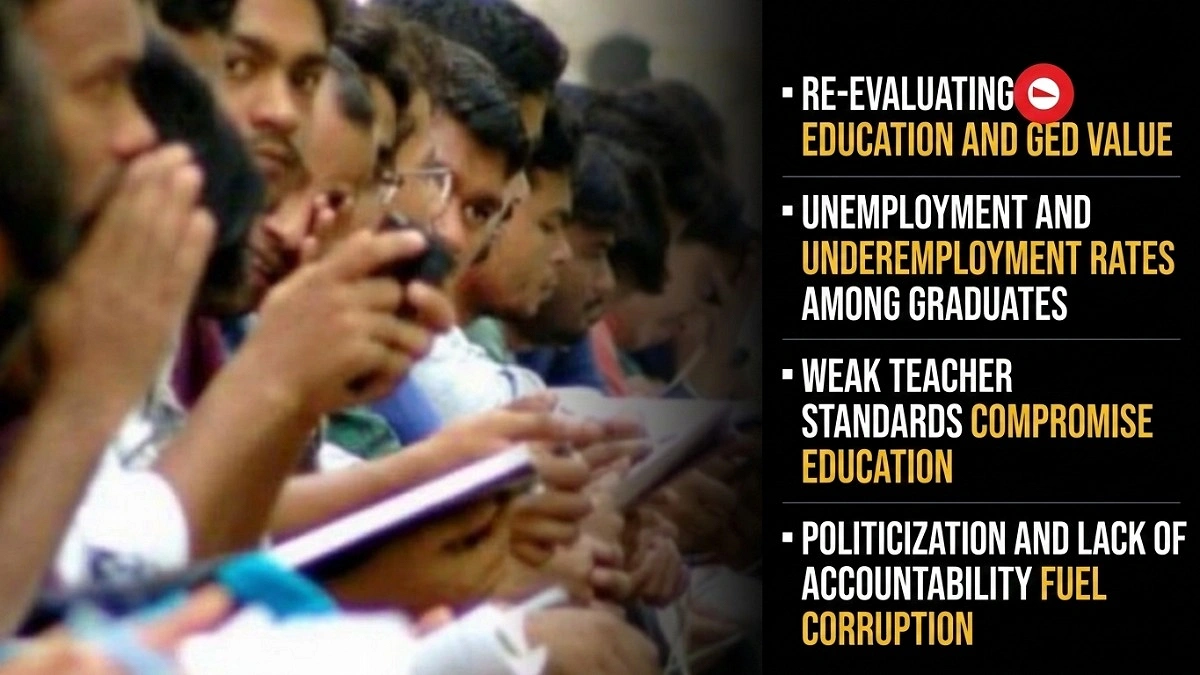
Graphics: Agamir Somoy
The country’s education system has major flaws. The dominance of rote learning in classrooms is reducing students’ productivity. At the same time politicization and weak accountability are increasing the risk of corruption. These issues are also threatening inclusive GDP growth, industrialization and efforts to achieve the demographic dividend. Waste of government investment in education, low skilled labor, expansion of poverty and inequality are also major concerns.
These findings have emerged from an assessment by the General Economics Division (GIED) of the Planning Commission. The ‘Five Year Strategic Framework’ identifies these problems in the education sector and outlines various initiatives to address them.
Planning Secretary S M Shakil Akhter told Agamir Somoy that implementation of the framework began in the current fiscal year. It will continue until fiscal year 2030 31. The framework details which ministries will implement which activities during this period. Strict monitoring from the highest level of the government will be in place to oversee its implementation.
“The problems identified in the education sector will be addressed. So that education becomes employment oriented, practical and truly capable of changing lives,” the planning secretary added.
The strategic framework said that during the initial phase of education reform in Bangladesh the main focus was on improving access to schools. That phase achieved significant success through increased enrollment, gender parity, school construction support programs and student participation.
However, the challenge for the next generation is fundamentally different. The country is now facing a more complex problem. Students need to acquire meaningful knowledge, knowledge based skills, technical qualifications and employable qualities.
It also said that progress is not possible without extensive reforms. The major barriers in the education sector include a learning crisis and low quality. Despite high enrollment rates learning outcomes remain weak. Many students fail to achieve the expected grade level. At higher levels there are also weaknesses in reading comprehension, analytical reasoning, problem solving, application of concepts and written communication.
In addition, rote learning dominates written expression in classrooms and examinations. As a result, students have low confidence, weak academic performance, a higher risk of dropping out and lower future productivity. Many primary level students struggle to read fluently, recognize letters and words, understand texts and solve basic mathematics problems.
The GIED said there are weaknesses in technical and vocational education and skills development. Although technical and vocational education is important for the sector itself and for industrial development, it faces several major weaknesses. The main challenges include weak industry linkages, mismatched job scopes, inadequate equipment, unproductive education, weak digital skills, weak soft skills and negative social perceptions. There are also inadequate practical skills, weaknesses in information and communication technology (ICT) skills, poor problem-solving skills and moderate to weak communication skills.
Many students drop out before completing primary or secondary education. Poor families, rural communities, environmentally vulnerable groups, girls at risk of child marriage and working children are the most affected. Skills mismatch and educated unemployment are among the major problems.
Education outcomes in the country often do not match the demands of the labor market. Graduates remain unemployed or underemployed. The education sector also has structural weaknesses, theory-based curricula, weak practical skills, inadequate information and communication technology skills, gaps in industry analysis skills and limited software facilities. This situation threatens industrial development, export diversification, the digital economy and knowledge-based sectors.
The GIED also said graduate unemployment in the country stands at 28.24 percent while female graduate unemployment is 34.31 percent. Poor teacher quality and low quality of educational standards and teacher effectiveness are among the major problems in education. The main issues include rote learning methods, weak classroom teaching, incomplete competency-based assessment systems, weak integration of information and communication technology and unequal employment opportunities.
The major concerns include politicization, weak accountability, corruption risks, administrative inefficiency, weak monitoring and a lack of coordination. These are reflected in the misallocation of resources, weak reform implementation, declining trust and low spending in the education sector. There is also a digital divide and technological limitations in education.
Asked about the matter, GIED Member (Secretary) Dr. Monzur Hossain told Agamir Somoy that the strategic plan provides a roadmap for transforming Bangladesh’s education system during 2026 to 2031. It is aligned with the Sustainable Development Goals (SDGs), particularly SDG 4 on quality education.
“Bangladesh’s demographic structure characterized by a large youth population presents significant opportunities and challenges. Although there is considerable potential to benefit from the demographic dividend. This potential will only be realized if the education system enhances relevant skills among young people,” Dr. Monzur added.


