
Teachers galore in official posts at Rajshahi University
- No provision for administrator posts in the ordinance; teachers in charge of 9 departments
- Administrative officials aggrieved over not being assigned the responsibility

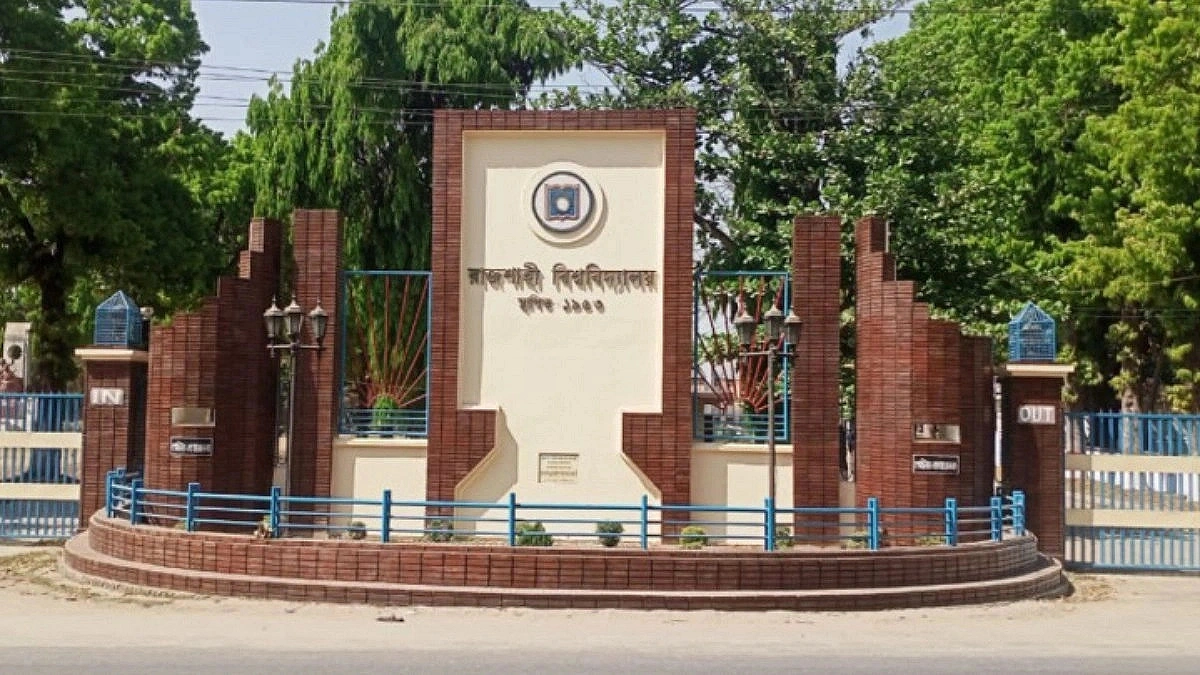
File Photo
There is no existence of a post called "Administrator" in the Rajshahi University (RU) Ordinance. Yet, teachers from various departments are serving as "Administrators" in nine vital departments of the university. According to the rules, these departments are supposed to be managed by officers, but teachers have been occupying these positions for a long time.
Such an awkward situation has raised questions regarding administrative legitimacy and the professional rights of the officers. Additionally, classroom teaching is being affected, and leaving the students deprived.
The heads of the University Public Relations Office, Central Library, Printing Press, Science Workshop, Transport Office, Central Cafeteria, RAKSU Treasurer, Legal Cell, and Shahid Smriti Sangrahashala (Martyrs' Memorial Museum) have conspicuously designated for "Administrators." However, no such position exists in the Rajshahi University Ordinance of 1973.
Not only in the post of Administrator, but also in key administrative roles where officers are supposed to serve according to the ordinance—such as the Registrar, Inspector of Colleges, ICT Center, Controller of Examinations, Mental Health Center, Central Science Laboratory, Shahid Sukharanjan Samaddar Student-Teacher Cultural Center, and Shahid Mir Abdul Kayyum International Dormitory—teachers have been holding responsibilities for a long time.
Officers allege that despite having the requisite administrative experience and qualifications, they are not given charge of these positions. This impedes their promotions and professional growth while negatively impacting administrative functions. Although officers have submitted several memorandums and demands to the university administration at various times requesting the cancellation of the "Administrator" title and the assignment of roles to officers in accordance with the ordinance, the authorities have paid no heed.
Instead, the university administration claims that this issue has turned into an organizational culture over time. Due to a prolonged lack of skilled personnel, teachers have been carrying out these responsibilities. However, the current administration is attempting to bring these matters into a structured framework.
Officers Want Their Rights Restored
Since teachers handle these positions as their additional duties alongside teaching, they cannot dedicate adequate time to them. In the past, questions have repeatedly been raised about their performance. Serious allegations were raised against Iftekharul Alam Masood, a teacher of the Arabic department and recent former registrar, regarding taking irregular classes and keeping exam papers unexamined. This even led to student protests locking up the department. Students have also complained against teachers holding other posts and failing to properly coordinate academic and administrative tasks. For these reasons, officers have demanded that these posts be handed back to officers so teachers can focus solely on teaching.
Highlighting the issue, Rajshahi University Officers' Association President Anwarul Islam said, "If officers do not receive the responsibilities and evaluation they deserve even after working for a long time, it naturally creates a work deterrence. Full-time presence is required in these administrative posts. But due to academic commitments, teachers cannot deploy themselves for full time. As a result, the pace of work slows down in many cases."
Echoing the same grievance, Officers' Association Treasurer Al-Amin Bidyut said that the volumes of the university ordinance clearly state that around 10 to 15 key administrative posts—including Registrar, Director, and Legal Cell—should be run by officers. However, despite repeated assurances, the authorities are not restoring these positions to them.
“Instead of regular teaching and research, teachers are busy with administrative duties. This directly and negatively impacts academic activities. Because classes and exam paper evaluations are not conducted on time, the publication of results gets delayed. Consequently, examinations are postponed, session jams are created, and the academic lives of students confront with uncertainty,” alleged Shariful Islam Tanbir, a student of the Department of Mass Communication and Journalism at the university.
On the other hand, Sakibul Hasan, a student of the Department of Persian Language and Literature, said, “A university is primarily an institution for the pursuit of knowledge, teaching, and research. A teacher’s primary responsibility is teaching in the classroom, academic supervision of students, and creating new knowledge through research. But when they are placed in administrative posts, academic and research activities are disrupted on one hand, while on the other, administrative work also fails to meet expected standards. The university should move away from this culture.”
Explaining the ordinance, former Pro-Vice-Chancellor Professor Farid Uddin Khan said that according to the 1973 Ordinance, apart from the Vice-Chancellor, Pro-Vice-Chancellor, Treasurer, and Registrar, everyone else besides teachers is essentially considered an officer. Therefore, claiming that officer posts belong strictly to a specific group is a misinterpretation of the ordinance. The Vice-Chancellor can assign such responsibilities to anyone qualified—whether a teacher or an officer—at his convenience.
“With the additional administrative burden on teachers, their primary responsibility of research can be hampered. Directly appointing qualified and talented individuals to full-time posts like the Registrar or Controller of Examinations is the best approach for administrative efficiency,” noted Professor Farid.
Citing a lack of skilled personnel, Vice-Chancellor Professor Dr. Faridul Islam said, “Because, officers have not adequately developed the required skills and experience to run these specialized departments, the university has had to rely on teachers until now. The administration is currently working to bring this system into an organized structure. However, changing everything overnight could create instability in the administrative framework. Therefore, this transition will be carried out gradually and in a planned manner.”


