
UI GreenMetric 2026
Greener campuses, sharper data: World University of Bangladesh climbs 60 places in Asia

Collected Photo
When the results of the 2026 UI GreenMetric Sustainable University Rankings were announced at a ceremony in Baku, Azerbaijan, on Thursday, the headline story was scale: 2,016 institutions from 110 countries, up from 1,745 a year earlier. For the World University of Bangladesh (WUB), the story was moving.
The Uttara-based private university rose from 343rd to 283rd among Asian institutions, a jump of 60 places, and from 598th to 492nd in the world, a gain of 106 places, said a press release. The rise is all the more notable because the ranking's own data shows it happened against the current. Of the 1,000 Asian universities that appear in both the 2025 and 2026 lists, the typical (median) institution fell 21 places in the regional ranking. Only 403 moved up at all, and just 132 climbed 60 places or more. WUB's gain puts it ahead of roughly 87 per cent of its Asian peers on year-on-year improvement.
Why GreenMetric matters Launched in 2010 by Universitas Indonesia with 96 participating universities, UI GreenMetric has become the most widely used global yardstick for how universities run their campuses, not just what they teach. Where the better-known league tables lean heavily on research citations and reputation surveys, GreenMetric asks universities to document what they actually do: how much energy they use and where it comes from, how they handle waste and water, how people get to and around campus, how much sustainability runs through teaching and research, and, from this year, how governance and digital systems support that work. That design gives the ranking three kinds of value for universities worldwide. First, it is a management tool: filling in the evidence-based questionnaire forces an institution to measure its own footprint, often for the first time. Second, it is a common language.
A university in Dhaka can benchmark itself directly against one in Jakarta, Istanbul or Wageningen, the Dutch university that tops the 2026 table. Third, it is a signal to students, funders and international partners, who increasingly look for credible evidence that an institution takes climate responsibility and the UN Sustainable Development Goals seriously. The ranking's growth tells its own story. Participation rose from 96 universities in 2010 to 912 in 2020 and past 2,000 this year. The number of ranked Asian institutions alone grew from 1,060 to 1,251 in twelve months. Every new entrant makes it harder for existing participants to hold their positions, which helps explain why so many Asian universities slipped this year.
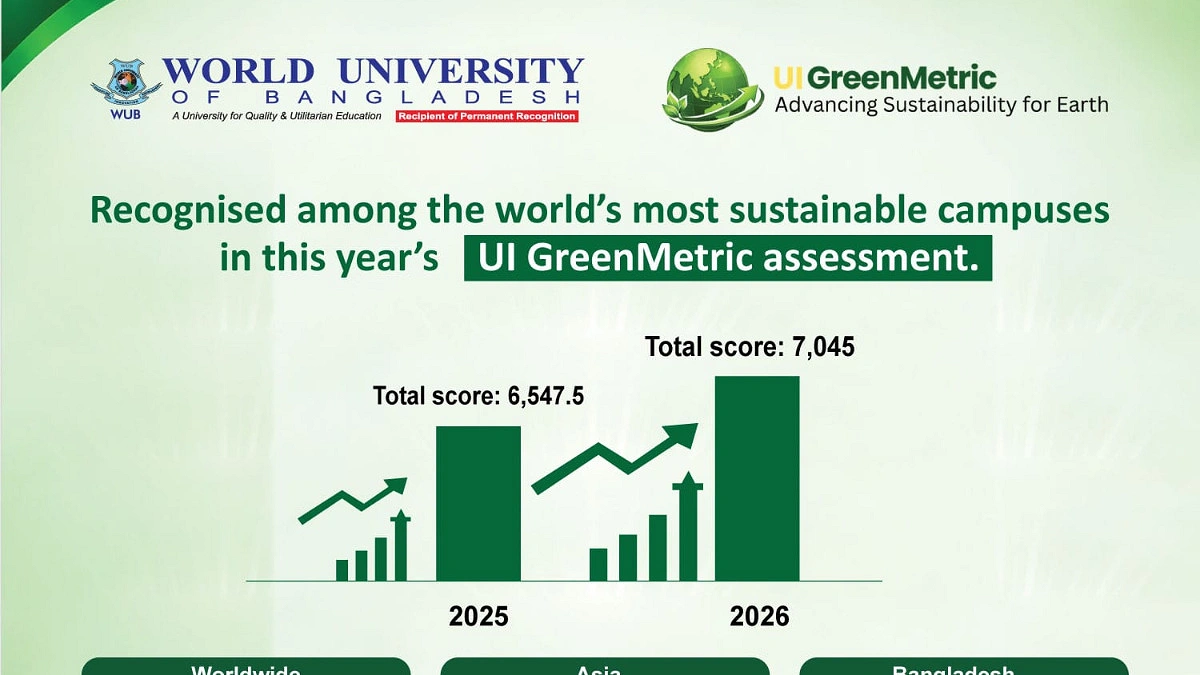
The university's total score climbed from 6,547.5 to 7,045, an increase of nearly 500 points in a year when the methodology itself changed.
Three indicators carried the upliftment. Energy and Climate Change, historically the most heavily weighted area of the ranking, rose by 175 points, the university's single biggest gain. Waste management improved by 150 points and water management by 75. On top of that, WUB scored 822.5 in the new Governance and Digitalization category, a debut that helped it absorb the methodology change better than many peers.
The lesson for other institutions is that GreenMetric rewards evidence. Every figure a university submits must be backed by documents, photographs and policies. Institutions that invest in collecting, organising and verifying their own sustainability data, from meter readings to waste logs to governance records, give the assessors more to score. WUB's 2026 result suggests that is exactly what happened. A Bangladeshi story, and an Asian contrast Bangladesh sent nine ranked universities to the 2026 table, up from six. Among the six that appear in both years, WUB recorded the largest improvement, ahead of two private universities.
The country's top-ranked institution, IUBAT, slipped 18 places in the regional table, while Uttara University and Khulna University fell by more than 180 places each.
Across Asia's largest participating countries, the picture was mostly one of retreat. The median Indonesian university, from the ranking's home country, fell 47 regional places. The median institution in Pakistan fell 43 places, in India 40, and in Iran more than 100. Universities in Thailand, the Philippines and Türkiye broadly held their ground. Against that backdrop, a 60-place rise stands out. WUB now ranks fourth in Bangladesh, close behind BRAC University, and now sits inside the world's top 500, up from outside it a year ago.
What comes next For rising universities like WUB: The challenge will be to hold and extend its gains as the field keeps growing. The categories that fell under the new scale, Setting and Infrastructure and Education and Research, are where the most points remain on the table. Steady improvement in energy, waste and water shows that the approach is working. Extending the same discipline of measurement and documentation to campus infrastructure, curriculum and research output could move the university closer to Bangladesh's top three. The University’s acting Vice Chancellor, Dr Nurul Islam said that there is an intense drive within the University to climb the rankings, bringing focus in research and innovative learning approaches.
