
Enrollment in schools declines, rises in Madrasas

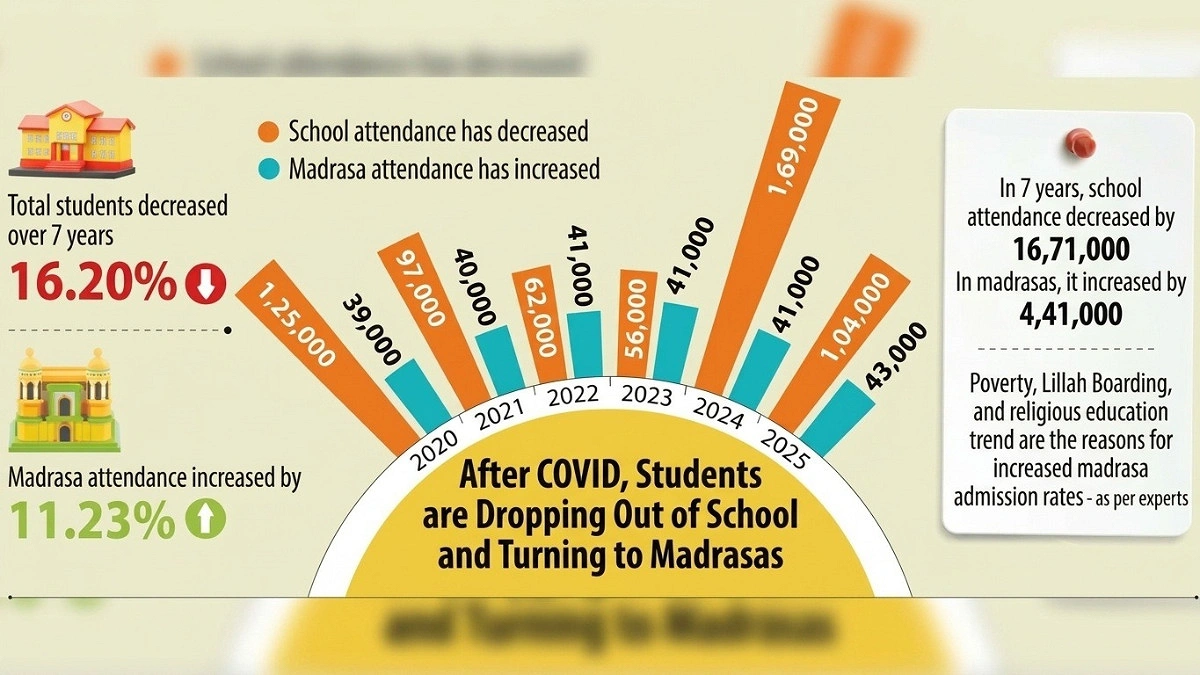
Agamir Somoy graphics translated and re-drawn by AI.
At one time, general schools were the primary pillar of education in the country. With the passage of time, that familiar picture is changing. While the number of students is declining in the country's secondary schools, the opposite trend is visible in madrasas—where enrollment is on the rise. According to the Education Statistics 2025 by the Bangladesh Bureau of Educational Information and Statistics (BANBEIS), secondary school enrollment decreased by more than 1.67 million between 2019 and 2025. During the same period, madrasa enrollment increased by over 440,000. English-medium schools also saw slight growth.
Why is this familiar equation of education changing? According to educationists, dissatisfaction with the quality of general education, family financial crises, lower costs and residential facilities in madrasas, and a growing interest in religious education are driving this shift. Despite an increase in the number of educational institutions and teachers, this trend of declining school enrollment raises new questions about the quality, capacity, and future of the country's education system.
BANBEIS published the Education Statistics 2025 after analyzing data from educational institutions across the country. The report reveals a post-COVID rise in students shifting from schools to madrasas. According to the statistics, this trend is not limited to just seven years; school enrollment began declining after 2018.
1.7 Million Disappear from Schools in Seven Years, Madrasas Gain 440,000
According to the BANBEIS report, in 2019, the onset year of COVID-19, secondary school enrollment stood at 10,309,323, which dropped to 8,638,416 by 2025. This means that during this period, the total number of students decreased by 1,670,907, representing a 16.20 percent drop compared to 2019. The largest drop occurred in the 2023 academic year, when 727,358 students dropped out. During the same period, the picture in madrasas was quite the opposite. Across four levels—Dakhil, Alim, Fazil, and Kamil—total enrollment was 3,806,336 in 2019, which rose to 4,247,020 by 2025. This indicates an increase of 440,684 students in madrasas during this timeframe, a growth of 11.58 percent. Among these, enrollment at the Dakhil (SSC) level grew by 110,099, Alim (HSC) by 72,609, Fazil (Degree) by 145,669, and Kamil (Masters) by 109,297. Analyzing madrasa student data since 2003 shows that total enrollment was 3,438,707 in 2003, reaching 4,247,020 in 2025—an overall growth of 22.99 percent over this period.
Three-Decade Trends (1995–2025)
An analysis of secondary education data across three decades (1995–2025) reveals three distinct phases: growth, stagnation, and decline. The period between 1995 and 2002 is considered the rise of secondary education. In 1995, secondary student enrollment was 5.115 million, with female students accounting for 46.97 percent. By 2002, that number rose to 8.162 million, with female enrollment at 53.43 percent. Slight stagnation was observed between 2003 and 2018. Although student numbers fluctuated between 2004 and 2007, enrollment began to decline in 2008, when the number of secondary students was 6.819 million. From 2009 onward, enrollment began to rise again, reaching an all-time high of 10,475,100 secondary school students in 2018. However, following the COVID-19 pandemic in 2020, secondary school enrollment started falling continuously, dropping to 9.405 million in 2023, 9.063 million in 2024, and further declining to 8.638 million in 2025. In this single year alone, student enrollment dropped by 408,000.
On the other hand, student enrollment in English-medium education has seen a slight increase. There are 143 such schools in the country. In 2024, enrollment in these institutions was 29,077, which increased to 29,672 in 2025.
Teachers and Institutions Increase Despite Falling Student Numbers
Positive aspects highlighted in the education statistics report include the rise in female teacher participation and infrastructural expansion. While female teachers accounted for only 13.88 percent in 1995, that proportion has grown to 32.50 percent in 2025. Concurrently, the number of secondary schools has expanded from 12,012 to 21,314, and the number of teachers has risen from 104,000 to 304,000.
Regarding this issue, Professor Emeritus Manzoor Ahmed of BRAC University told Agamir Somoy that it would be a mistake to view this solely through the lens of poverty or financial savings. The primary reasons behind the decline in secondary school students are the lack of quality in general education, as well as recurring instabilities in curriculum and learning methods. Following the pandemic, schools failed to deliver targeted, direction-oriented instruction capable of retaining students. Moreover, when parents notice that learning outcomes remain inadequate despite substantial expenditures on schooling, they turn toward alternative education systems. Simply expanding infrastructure or increasing the number of teachers will not suffice; unless fundamental changes are brought to administrative oversight and the quality of secondary education, this drop-out trend cannot be halted.
Although BANBEIS did not publish specific reasons for the decline in secondary school students, educationists point to several key post-COVID factors. Chief among these are economic hardship and child marriage. Due to reduced family incomes during the pandemic, many students were forced to enter the workforce. Experts also attribute the relative decrease in children at primary and secondary levels to demographic shifts and declining birth rates.
According to Professor Mohammad Ali Jinnah, Pro-Vice Chancellor of National University and an education researcher, enrollment trends toward madrasas have grown because education there is relatively affordable for many low- and lower-middle-income families. Many madrasas, operated through charitable organizations and individual donations, offer free or low-cost lodging, food, and education via Lillah boardings. As a result, financially distressed families are encouraged to send their children to madrasas. However, he emphasized that even as madrasa enrollment grows, the government must take more effective initiatives to retain students in general schools and prevent dropouts.
Professor Mojibur Rahman of the Institute of Education and Research at Dhaka University told Agamir Somoy that over the past decade, secondary school enrollment has fallen while madrasa enrollment has grown. A major factor behind this is financial incentives and facilities. Donations to madrasas increased particularly after the pandemic, directly benefiting madrasa students. Additionally, compared to schools, lower costs alongside Lillah boarding and residential options make madrasas appealing to lower- and lower-middle-class families. Furthermore, an increasing inclination among parents toward religious devotion and moral education has contributed to the rise in madrasa admissions.
