
Bangladesh’s education paradox: Girls advance, women fall behind

Graphics: Agamir Somoy
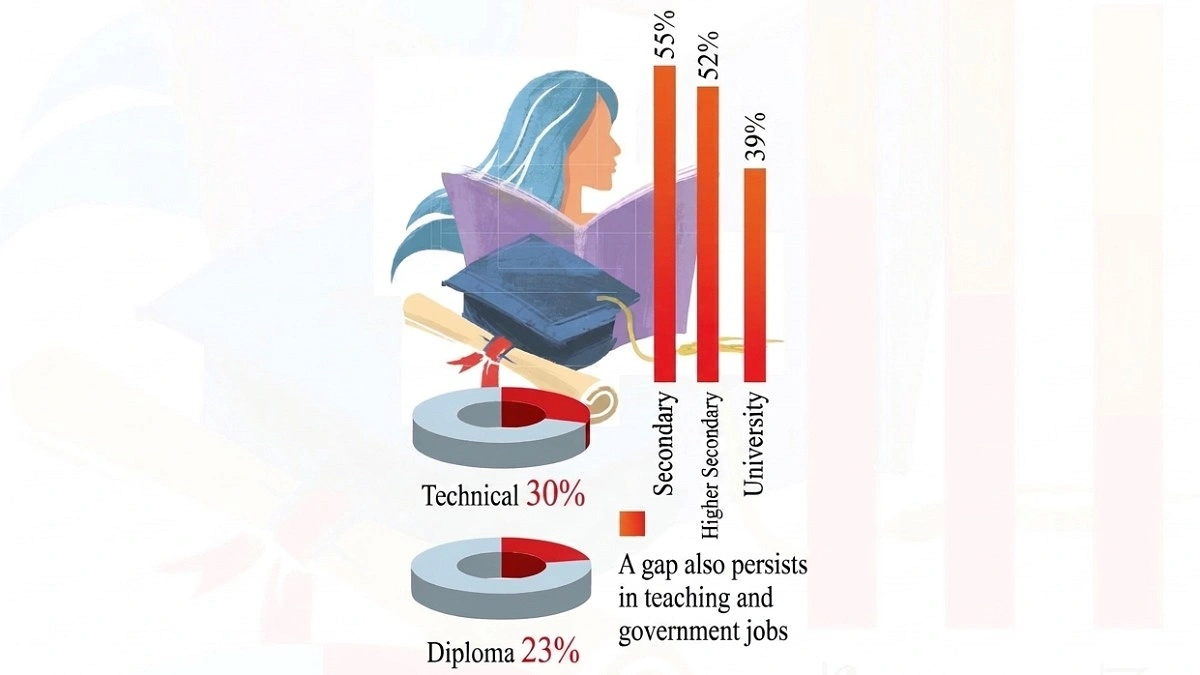
Girls in Bangladesh forge ahead at every step of education, even surpassing boys at some levels. Yet that picture changes as soon as they reach the doorstep of higher education, where only 39 out of every 100 university students are female.
In employment-oriented technical and vocational education, this number is even lower, dropping below 30. At the diploma level, the proportion of female students has plummeted to 23.82 percent.
The momentum achieved by girls in primary and secondary education is no longer moving at the same pace in higher education and skills-based training. Significant gaps in female participation exist not only as students but also in teaching and in crucial government jobs such as administration, police, and foreign service.
As the educational journey lengthens, various obstacles in the path of women’s advancement increasingly come to the fore. An analysis of data from the Education Statistics 2025 report by the Bangladesh Bureau of Educational Information and Statistics (BANBEIS) reveals this paradox in female education.
According to Nazneen Islam of the Department of Public Administration at the University of Dhaka, various opportunity-related and environmental factors lie behind this. A family’s financial capability, lack of safe transportation and housing, child marriage, family responsibilities, and social attitudes - all of these can act as barriers to girls advancing in higher education.
She also believes it is the responsibility of the government to identify why a girl disappears upon reaching higher education after completing 12 years of schooling.
Progress of girls in secondary and college education
Statistics from the past decade reveal that female participation at the secondary and college levels has increased consistently. In 2015, girls accounted for 53.31 percent of total students at the secondary level. By 2025, that figure rose to 54.67 percent, representing a 1.36 percentage point increase in the proportion of female students at this stage over a decade.
The picture of progress is even clearer at the college level. In 2015, women made up 46.46 percent of total college students. That figure increased to 50.55 percent in 2020, and by 2025, the share of female students stood at 51.91 percent - an increase of 5.45 percentage points over the decade.
It is not just the participation rate that has grown; the actual number of female students has increased as well. In 2015, there were 17,09,171 female students in colleges. By 2025, this number grew to 23,81,123, meaning that the number of female college students increased by nearly 6,72,000 over one decade.
Sharp decline in higher and technical education
Although the proportion of female students at the university level has grown over the past decade, it remains far below half of the total student body. In 2015, women comprised 32.85 percent of total university students. This rate rose to 35.19 percent in 2020, and reached 39.34 percent in 2025 - a 6.49 percentage point increase in female student share over ten years.
According to BANBEIS data, in 2025, there were 11,13,982 total students across 174 universities in the country. Among them, 4,38,262 were female, meaning women constitute 39.34 percent of all university students.
Mujibur Rahman of the Institute of Education and Research at the University of Dhaka believes it is essential to identify the reasons why female participation drops when transitioning from one educational tier to another.
Factors such as limited opportunities for admission to higher education, family financial capacity, crisis of safe transportation and housing, child marriage, and family obligations may play a role in creating this gap.
However, BANBEIS statistics do not provide a direct explanation regarding exactly how many girls drop out while transitioning from secondary or college education to university, or the precise reasons preventing them from pursuing higher education.
As a result, experts believe further investigation is needed regarding tier-based transition rates, dropout trends, regional opportunity variations, and female participation in various disciplines, including science and technology.
While girls excel in general education, their participation in employment-focused technical and vocational education is comparatively low.
According to BANBEIS data, in 2025, there were 13,57,894 total students across 10,521 technical and vocational educational institutions in the country. Among them, 4,03,458 were female, meaning women represent 29.71 percent of total students in this sector. The gap is even wider at the diploma level, where the share of female students is only 23.82 percent.
Disparities in teaching and civil service cadres
Alongside female student enrollment, a significant gender gap exists in faculty positions within higher and technical education.
According to BANBEIS data, there are 34,831 total teachers across 174 public and private universities in the country. Among them, 10,618 are female, representing 30.48 percent of all university teachers.
The proportion of female teachers in public universities stands at 27.87 percent, while in private universities it is 33.14 percent. Meanwhile, in technical and vocational education, the share of female teachers is 26.18 percent.
However, the scenario is different in primary education.
According to the latest data from the Integrated Primary Education Management Information System (IPEMIS), there are 3,71,928 total teachers across 65,569 government primary schools in the country.
Among them, 2,48,795 are female, meaning the share of female teachers is around 66.89 percent. Male teachers number 1,23,203, constituting about 33.11 percent of total teachers.
The 60 percent quota reservation for women in the recruitment of assistant teachers in government primary schools is one of the primary reasons for the higher proportion of female teachers at this level.
The advancement of women moving from education into career entry is also not uniform across all sectors.
An analysis of recommendation data across various Bangladesh Civil Service (BCS) cadres reveals that while women perform relatively well in technical and professional cadres and special BCS examinations, their participation remains low in major general cadres such as administration, police, and foreign service.
In the final recommendations for the 44th BCS, only 9 women were recommended against 159 positions in the administration cadre. In the police cadre, 4 out of 64 recommended candidates were female, and in the foreign service cadre, 3 out of 13 were women.
Moreover, one woman was recommended in the Ansar cadre, 5 in audit and accounts, and 3 in the tax cadre.
Out of a total of 934 candidates recommended in this BCS, 249 were female. Women secured 85 out of 449 positions in general cadres. On the other hand, women received 164 out of 885 positions in technical and professional cadres.
A different picture emerges in special BCS examinations. In the recruitment of 4,792 doctors through the 39th Special BCS, women secured over 47 percent of the positions. In the 42nd Special BCS, the rate of female recommendations was also close to 49.2 percent.
This variation across cadres becomes even clearer in the agriculture and education cadres. Against 85 positions in the agriculture cadre, women secured 43. Women also performed relatively well across various positions in the education cadre, including subjects such as English, economics, Bengali, political science, science, and commerce.
