


Tk 500 worth of supporting books now sell at Tk 800

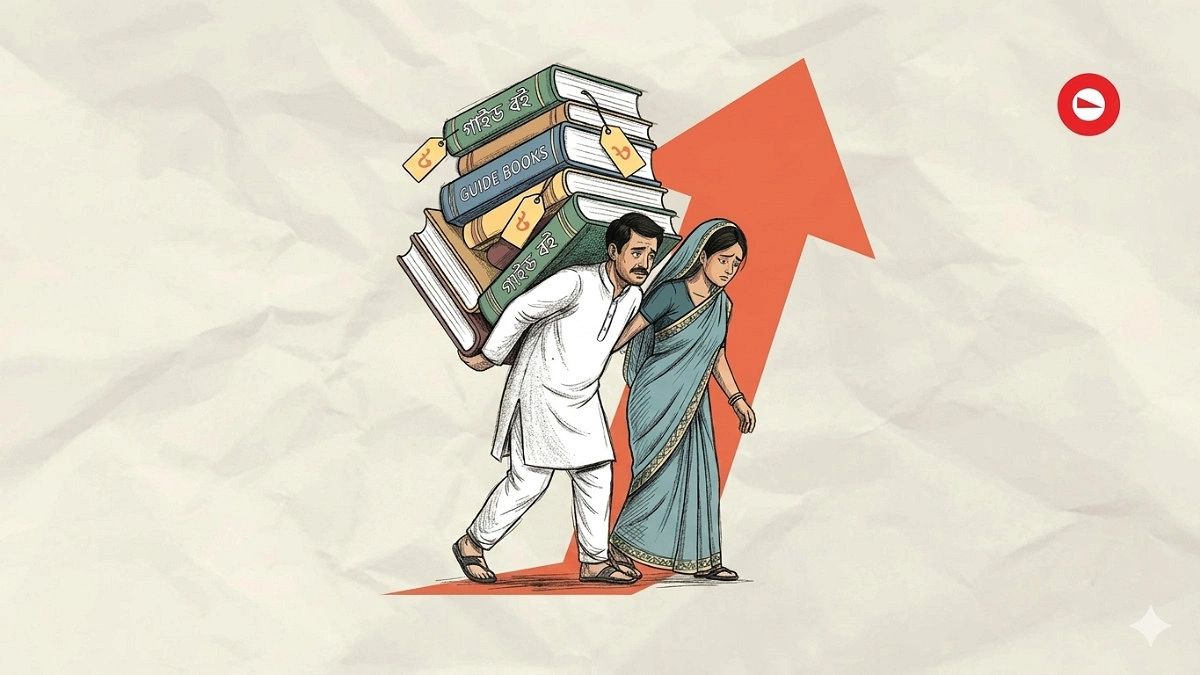
Representational Image, regenerated by AI.
Although students receive free textbooks at the primary and secondary levels, the overall cost of education is not diminishing. Instead, parents are under growing pressure due to uncontrolled price hikes of guidebooks and educational supplies. Not only books, but all kinds of school supplies—from pens and notebooks to geometry boxes—have become more expensive.
A guidebook that was available for 500 taka last year is now selling for 800 taka.
At the higher secondary level, while a class requires around 12–13 board textbooks, students also need an additional 7–8 guidebooks. Even though board textbooks are provided free of cost, the high prices of guidebooks are causing serious concern among students and parents.
Mohammad Ziad, a fifth-grade student of Karnaphuli Public School and College in Chattogram, is one such example. Recently, his mother went to buy an “all-in-one” guidebook for her son. She said that the book which cost 700 taka last year had to be bought this year for 900 taka. Expressing her frustration, she said, “How are we supposed to educate our children if we have to spend so much money just on books?”
The price increase is not limited to guidebooks alone; almost all educational supplies have become more expensive. An eraser that used to cost 12 taka is now selling for 15 taka. The price of pencil sharpeners has increased by 3 taka each. A ruler that once cost 40 taka now costs 55 taka, and a geometry box that was priced at 70 taka now costs 110 taka. Paper, pens, pencils, and art paper have not been spared either.
Booksellers say there are reasons behind the rising prices. Abdul Hanan, a book seller at Chawkbazar, said that the price of paper has increased, along with the cost of ink, which has driven up production expenses. As a result, a book that sold for 500 taka last year now has to be sold for 800 taka.
Another bookseller, Mohammad Shimul, pointed out that the rising prices of offset paper and newsprint have significantly increased printing costs. According to him, the paper used for high-quality images and printing has become more expensive, forcing publishers to raise book prices depending on page count and quality.
The free textbook distribution program for students from first to tenth grade was launched in 2010 with the aim of making education affordable and accessible to all. While parents initially felt relieved, over time the market has seen a growing proliferation of guidebooks.
Previously, guidebooks were limited in number, but now publishers are releasing multiple “topic-based” guidebooks to meet commercial demand. In many cases, teachers also recommend specific guidebooks. As a result, students are compelled to buy them, adding to the extra financial burden on parents.

