
Seven reasons behind HSC examination results collapse
- Shift from lenient to strict answer script evaluation
- Students turning away from classrooms and relying on coaching centers and guidebooks

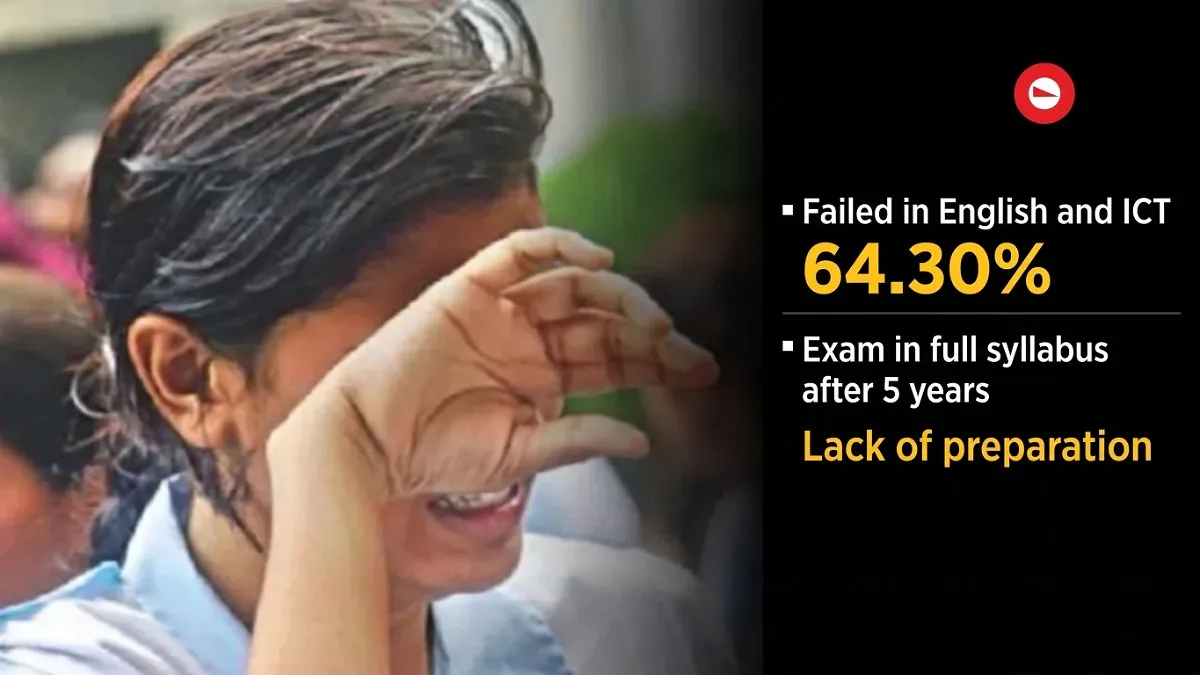
Graphics: Agamir Somoy
The results of this year’s Higher Secondary Certificate (HSC) and equivalent examinations have witnessed a significant decline. The reasons behind this poor performance go beyond students’ inadequate preparation and point to several structural problems in the education system.
Among the factors identified are the failure of 64 percent of students in English and Information and Communication Technology (ICT), a shortage of subject-specific skilled teachers and students’ reluctance to attend classes alongside their dependence on coaching centers and guidebooks.
Initial observations by teachers and others concerned with the education sector have also highlighted the return to full syllabus examinations after five years, stricter answer script evaluation instead of the previous lenient approach and a lack of academic focus among some students following the July uprising.
Half of the students fail English and ICT
An analysis of subject-wise results shows that students performed worst in English and ICT. Of the 1,240,798 candidates who took the examinations this year, 646,685 passed while 594,113 failed.
Among those who failed, 382,021 students failed English and ICT. Of them, 243,528 failed English and 138,493 failed ICT. This means 64.30 percent of the students who failed did so in these two subjects.
Professor Syed Akhtaruzzaman, coordinator of the Inter-Education Board and chairman of the Dhaka Education Board, attributed the high failure rates in these subjects to the shortage of qualified teachers and the practice of assigning teachers from other disciplines to teach them.
He said, “We have been witnessing this picture for decades. An analysis of the results shows that the pass rate in English across the nine general education boards was around 63.34 percent. The pass rate in ICT was 72.46 percent. This means around 36.66 percent of students failed English while 27.54 percent failed ICT.”
According to Professor Mojibur Rahman of the Institute of Education and Research at the University of Dhaka, there is already a shortage of English teachers. Moreover, those who are available do not always conduct classes properly. A large proportion of these teachers also have weaknesses in grammar and vocabulary. They lack regular practice in reading, writing and speaking.
In ICT, meanwhile, the major problems include inadequate practical education, insufficient computers and laboratory facilities and a shortage of trained teachers.
Professor Dr. Md. Shahiduzzaman of Bangladesh Agricultural University believes that ICT cannot be learned through textbooks alone. It requires practical skills. However, teachers from other disciplines are often assigned to teach the subject. Even teachers who cannot operate computers themselves are teaching students how to use computers and different software programs.
