
Inside the Tk 13.47 Billion ICT Project
Project Gets Tk 100,000 After Tk 300 Crore Scandal

Graphics: Agamir Somoy
The government launched the Tk 13.47 billion project titled ‘Introduction of ICT at the Secondary and Higher Secondary Levels’ in 2016 to expand digital education. However, allegations of irregularities surfaced almost from the outset, including ghost purchases, advance payments without training, fraudulent training certificates, and the procurement of substandard computers and multimedia equipment. Investigations later found that nearly Tk 3 billion had been misappropriated. The then Awami League government subsequently halted funding following inquiries by senior authorities. Now, the Ministry of Education has allocated a symbolic Tk 100,000 in the national budget to keep the nearly defunct project alive.
Officials say there is a different reason behind the decision to preserve the project. According to planning officials, the current government’s election pledge includes establishing multimedia classrooms across the country. Since the objectives of the old project align with that commitment, authorities have opted to keep it alive on paper rather than launch a new project and navigate a lengthy approval process and bureaucratic hurdles.
Documents from the ministry’s development wing show that the project received a Tk 100,000 allocation in the 2026-27 fiscal year budget alongside other ongoing projects. The project’s tenure expired on June 30 and has since been extended through the token allocation. Officials cited the government’s commitment to establishing multimedia classrooms in schools nationwide as the reason for retaining the project under a new name and format rather than shutting it down completely.
Md. Shahjahan, additional secretary (development) at the Secondary and Higher Education Division, told Agamir Somoy, “Like several other projects, this one has received a token allocation. Since its tenure expired on June 30, we made a fresh allocation to keep it alive. We are considering whether the government's election commitments can be incorporated within this framework.”
Officials involved with the project said launching a new initiative would be time-consuming because preparing a Development Project Proposal (DPP) and obtaining approval from the Planning Commission involves a lengthy process. Of the project’s total allocation of Tk 13.47 billion, around Tk 3 billion has already been spent, while more than Tk 10 billion remains on paper. Reviving and revising the existing project would allow authorities to avoid additional bureaucratic procedures.
According to project documents, the original objectives included providing ICT training to 572,840 teachers, establishing 36,084 multimedia classrooms, supplying 15,270 computers and related equipment, and organizing 6,592 meetings, seminars, and conferences. However, reports of irregularities emerged before procurement activities had progressed very far.
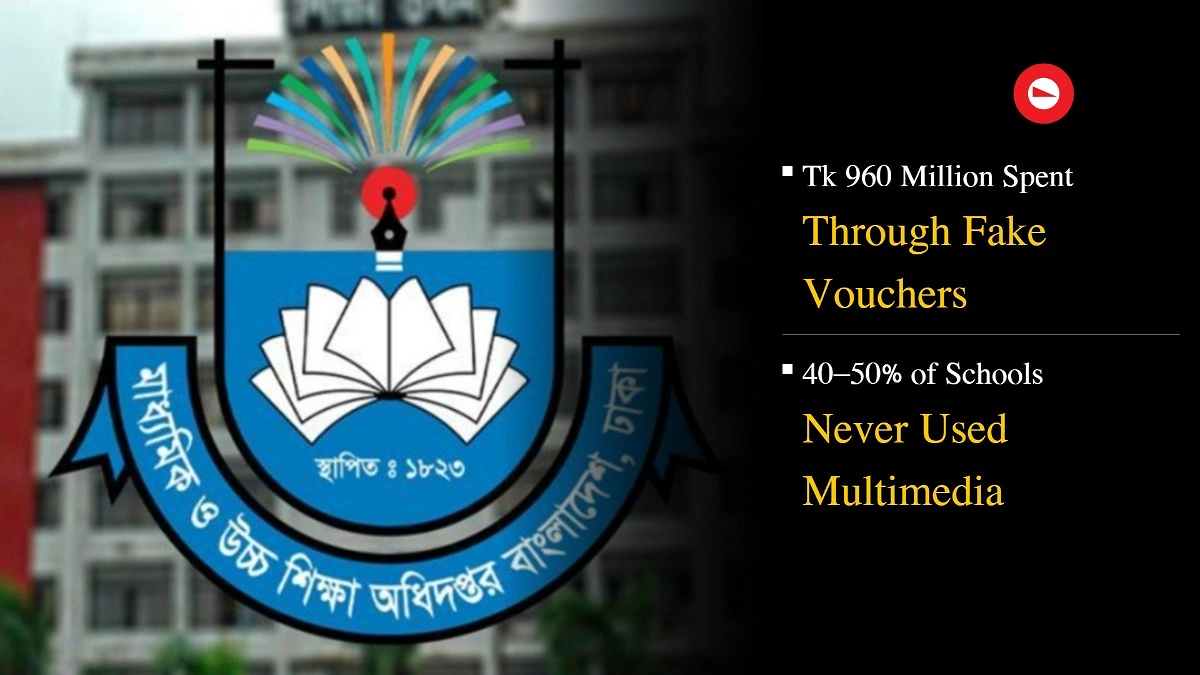
Among the major allegations were the preparation of training manuals without following public procurement rules, the issuance of training certificates without conducting training sessions, and the withdrawal of funds without delivering equipment. Authorities also accused project officials of spending nearly Tk 960 million by merging funds from different budget heads without approval and misappropriating money through fake bills and vouchers for venue charges, internet expenses, and other costs. Investigators also found that some officials collected honorariums despite not attending training programs.
Investigations conducted by the Ministry of Education, the Directorate of Secondary and Higher Education (DSHE), and the Implementation Monitoring and Evaluation Division (IMED) of the Planning Ministry substantiated many of these allegations. The reports found evidence of ghost purchases, training certificates issued without training, and the supply of low-quality laptops and multimedia equipment. As a result, teachers and students in nearly 40 to 50 percent of schools that received equipment were unable to use it even for a single day.
The government subsequently stopped funding the project. By that time, project officials had already completed procurements worth Tk 2.98 billion. Funding was later suspended entirely because of the government’s austerity measures following the COVID-19 pandemic and the project’s slow progress. Plans to purchase additional computers and ICT equipment were also put on hold.
The project aimed to train 572,840 teachers in ICT, establish modern multimedia classrooms in 36,084 educational institutions, procure 15,270 computers and related equipment, and purchase ICT materials on a large scale. It also sought to promote digital education through 6,592 meetings, seminars, and conferences.
Project documents show that large-scale irregularities in ICT equipment procurement came to light in 2019. According to the allegations, training manuals, certificates, and materials were supplied without following public procurement rules. Authorities spent nearly Tk 960 million by consolidating funds from different project components without obtaining the required approvals. Allegations also emerged of embezzlement through fake bills and vouchers covering venue charges, internet expenses, and other expenditures. Investigators further found that some officials collected honorariums without participating in training activities. Although the project aimed to establish nearly 50,000 multimedia classrooms, not a single classroom had been set up when the allegations surfaced.
An IMED investigation report found that multimedia classrooms do not operate regularly in about 40 to 50 percent of schools across the country. Many teachers lack the necessary skills, while much of the purchased equipment was of poor quality.
According to officials involved in the project, despite substantial spending over the past decade, implementation at the field level has never been fully satisfactory. They argue that rather than keeping the project alive through temporary measures, the priority should be assessing the current condition of the computers and classrooms already purchased and ensuring that trained teachers are actually using ICT in classrooms.
Professor Dr. Mir Zahida Nazneen, director of planning and development at DSHE, told Agamir Somoy, “Launching a new project is a lengthy process. Since the objectives of the previous project align with the government’s election manifesto, we are trying to avoid the complications of starting a new one. However, schools and colleges will no longer be allowed to make purchases indiscriminately as before. We are developing new strategies to close loopholes that enabled corruption.”
Addressing concerns over the alleged misappropriation of Tk 3 billion, she said, “We are reviewing responsibility for past irregularities. This time, we will not focus solely on purchasing laptops and projectors. We will digitally track whether the equipment already purchased remains operational in schools. No major new funding will be released without ensuring accountability.”
Professor Dr. Khan Moinuddin Al Mahmud Sohel, director general of DSHE, told Agamir Somoy, “Many aspects of the project are consistent with the current government’s election manifesto. For that reason, we have decided not to abandon it but to relaunch it in a new form. A nominal allocation has been provided to keep the project active.”
Commenting on past allegations of corruption and mismanagement, he said, “The project itself was very well designed. It failed to achieve its objectives because of corruption and poor management. We intend to address those shortcomings.”
