
71 sexual harassment complaints reported in schools in three months

Graphics: Agamir Somoy
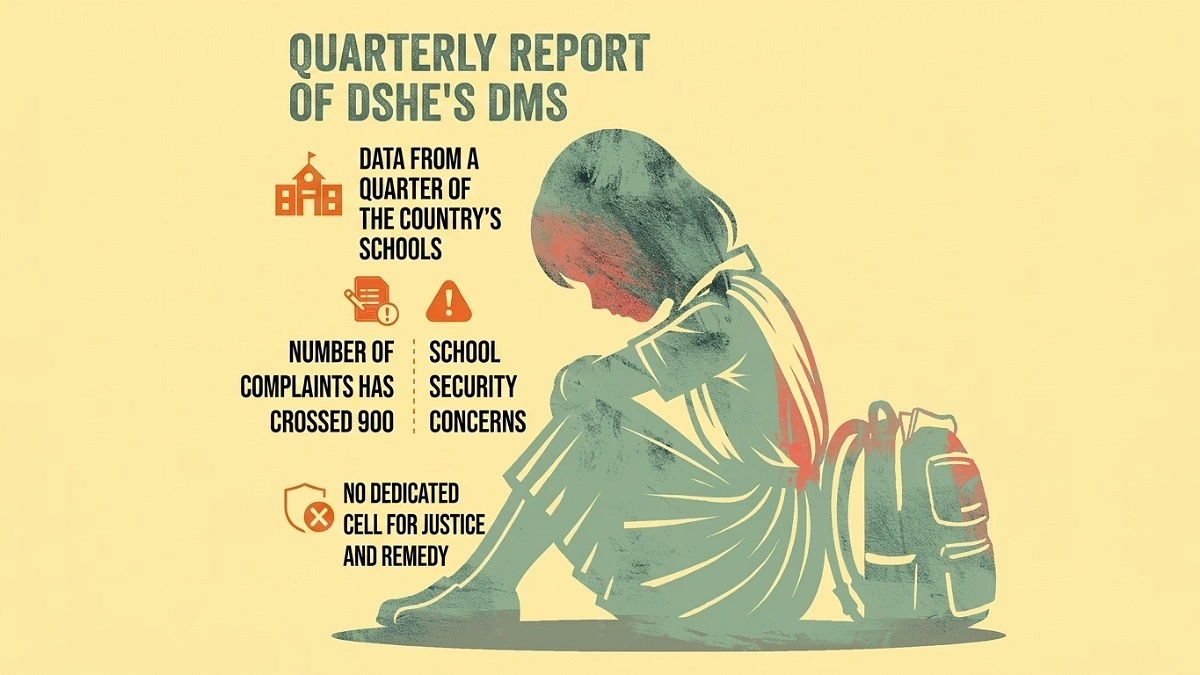
Slogans of hope are written across school walls. Students go to these institutions to be enlightened by that message and to learn humanity, values and proper conduct. But beyond teaching, some teachers are also subjecting students to violence despite the trust and affection of their parents. The situation has become so serious that 71 sexual harassment complaints were reported at schools in just three months. This is not a picture of the entire country, but only one fourth of the schools. The Directorate of Secondary and Higher Education, recently published the information. The complaints were identified through the Directorate’s Digital Monitoring System, or DMS.
The DMS prepared the report after field level inspections at 5,431 educational institutions across the country between April and June this year. The incidents were identified as highly sensitive, and the Directorate recommended priority monitoring and preventive measures.
The report recommended giving special attention to the 71 sexual harassment complaints, notifying the relevant authorities and sending letters to the heads of the educational institutions instructing them to take effective preventive measures. It also mentioned notifying law enforcement agencies when necessary, according to the second quarterly integrated monitoring report of DSHE’s Monitoring and Evaluation Wing.
926 complaints in three months: Not only sexual harassment, but a total of 926 complaints were submitted from various educational institutions and related levels during the three-month period. Of these, 845 were resolved. As a result, the resolution rate for new complaints was 91.2 percent.
According to DSHE data, no complaints were received from 2,305 educational institutions between April and June. This does not mean that there was no sexual harassment or irregularity at those institutions. Such information also depends on the environment for reporting complaints, the awareness of students and parents, and the institutions’ systems for receiving and reporting complaints.
According to the monitoring report, although most complaints were resolved between April and June, 71 were separately identified. As these were related to sexual harassment, they are being given special attention.
Major gap in monitoring: Although sensitive incidents such as sexual harassment require monitoring, there are significant shortcomings in DSHE’s field level inspections. Between April and June, inspections were planned at 20,018 educational institutions, but only 5,447 were completed, representing just 27.21 percent of the planned inspections. Of these, 29.6 percent of the inspections were completed within the scheduled time. The remaining 70.4 percent were delayed.
As a result, questions have arisen over whether the safety of students, sexual harassment and other irregularities at schools are being brought under regular monitoring.
Preventive cells absent despite directives: A 2009 High Court directive on preventing sexual harassment in educational institutions and workplaces called for the formation of committees to receive and investigate complaints. Although the relevant committees are supposed to become active after receiving a complaint, DSHE officials said many educational institutions across the country have yet to form such preventive committees.
As a result, those concerned believe that, alongside taking action after complaints are identified, it is essential to ensure effective sexual harassment prevention cells at every educational institution, a safe environment for reporting complaints, and prompt and impartial investigations into complaints.
Describing the information in the report as concerning, DSHE Director General Professor Dr. Khan Moinuddin Al Mahmud Sohel said, “This information on sexual harassment is undoubtedly a matter of concern. Although many educational institutions have sexual harassment prevention committees, most schools have still been unable to form such committees. An indicator related to sexual harassment has been added to the DSHE’s DMS app to obtain information on sexual harassment incidents across the country. Necessary initiatives will be taken to expedite approval of the guidelines on preventing sexual harassment. At the same time, regular monitoring issues.”
