
Scarcity hits Teesta river char areas during Ashwin and Kartik

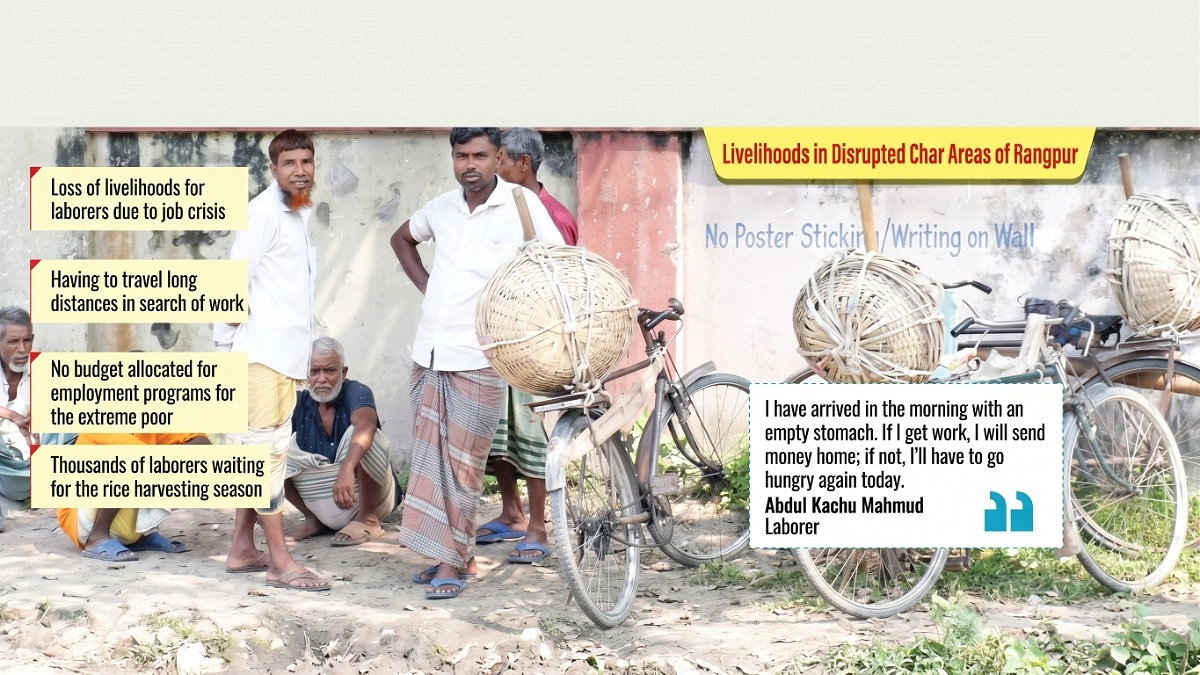
Graphics: Agamir Somoy
Abdul Qayyum leaves home at dawn every day. He travels from Chhalapachar in the Teesta River char area to Shimulbag in Rangpur city in search of work. However, he does not find work every day. If he gets work for one day, he has to return empty handed for the next three days. When he cannot find work, no food can be cooked at home. He and his wife and children have to spend their days with little or no food.
A shortage of work emerges in the Teesta River char areas of Rangpur every year during the Bengali months of Ashwin and Kartik. After transplanted Aman rice is planted, agricultural work declines because harvesting and threshing do not begin immediately. With work available for no more than three days a week, laborers like Qayyum are struggling to support their families. Their hardships have worsened due to rising prices of rice and other essential commodities and the government's failure to allocate funds for its employment program for the extremely poor.
Abdul Qayyum was sitting in Shimulbag waiting for work when he said, “Every morning, I leave home in the name of Allah, hoping to find work. I have to put food in my children's mouths. But if I get work for one day, I have to return home disappointed and empty handed for the next three days.”
Abdul Kachu Mamud, a 65 year old man from Shankardaha char in Gangachara, was also waiting for work at the same spot. He had cycled nearly 20 kilometers to get there. Sitting exhausted and hungry as he waited for work, he said, “My wife and children and I have been struggling since yesterday. I came here this morning on an empty stomach. If I find work, I will earn enough to cover my expenses and return home. If I do not find work, I will have to go without food again today.”
Qayyum and Kachu Mamud are not alone. Many other working people are struggling to support their families because of the lack of employment. At least 30 more laborers were seen gathering in Shimulbag. Several of them, including Nowsha Mia, Omar Ali and Naya Mia, said they could not find work for more than three days a week. Rising prices of rice and other essential commodities have made it difficult to run their households. Their hardship has further increased because the government has not yet allocated funds for its employment program for the extremely poor in the current fiscal year.
The Bengali months of Ashwin and Kartik are a difficult period for agricultural laborers in the Rangpur region. Agricultural work declines after transplanted Aman rice is planted and before harvesting and threshing begin. As a result, many working people face seasonal unemployment.
Discussions with people concerned revealed that Rangpur has approximately 200,000 agricultural laborers. In addition to the Teesta River char areas, laborers from Gangachara, Kaunia and Taraganj travel to different places in search of work during this period. Many carry tools such as baskets, sickles, hoes, machetes and digging tools tied to the backs of their bicycles.
Laborers wait for work in areas including Shimulbag, Jamtala intersection, the central bus terminal, Betpatti and the railway station. Those who find work earn a daily wage of Tk 500. Those who do not find work have to return empty handed.
Local Union Parishad member Ramzan Ali said that half of the 400 families in Shankardaha char have moved elsewhere due to river erosion. Members of the approximately 200 families still living there earn their livelihoods by selling their labor.
During this period of seasonal unemployment, the government's Employment Generation Program for the Poorest plays an important role in helping low income people cope with food shortages. However, the lack of fund allocation in the current fiscal year has prevented them from accessing this opportunity.
Dr. Tuhin Wadud, a teacher at Begum Rokeya University, has been working on Rangpur's development for a long time. According to him, failing to bring unemployed people into the mainstream economy will have a significant negative impact on the country's poverty situation.
Gholam Kibria, Rangpur District Relief and Rehabilitation Officer, acknowledged the shortage of work faced by laborers. He said, “It is true that working people face difficult times during this period. The employment program operates every year to address the situation. Funding for this program was supposed to arrive in August or September. However, it has not arrived yet in the current fiscal year.”
He hopes the allocation will arrive soon.
