
Police develop three phase master plan to curb crime

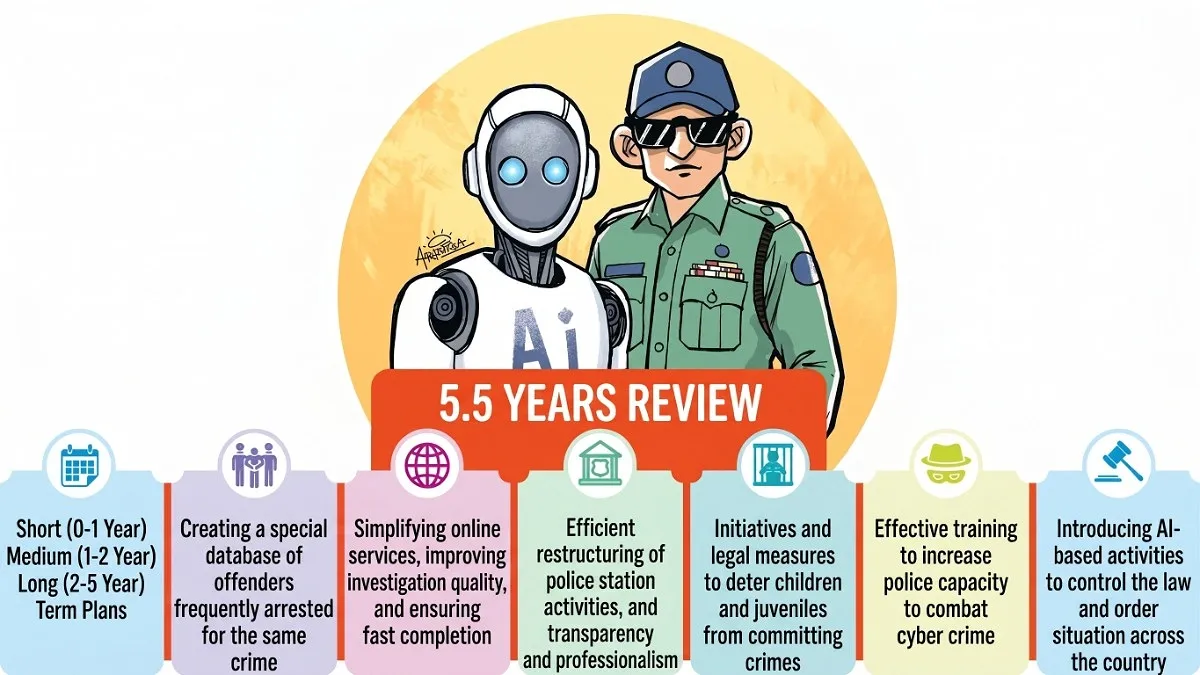
Graphics: Agamir Somoy
The demand for safer communities has always been a priority. To curb rising crime, the Police Headquarters has now drawn up a long term and specific action plan. The three-phase roadmap was developed after analysing crime trends over the past several years. Its implementation has already begun at the field level.
A special police committee is examining crime data and patterns from 2021 through May this year, covering a period of five and a half years. Crime routes, gang culture and the nature of criminal activities have changed significantly. Meanwhile, the morale of police personnel at the field level has also declined. Against this backdrop, law enforcement agencies are preparing to break away from traditional approaches and resume their duties with renewed determination.
The Metropolitan Police, District Police, Police Bureau of Investigation (PBI), Criminal Investigation Department (CID), Railway Police, Highway Police, River Police, Tourist Police and Armed Police Battalion (APBn) are all working together to implement the plan.
The year-based roadmap includes short, medium- and long-term measures. Under the short-term plan, covering zero to one year, priority will be given to tackling minor crimes and restoring police morale.
The medium-term plan, covering one to two years, includes installing CCTV cameras across the country. A specialised database is also being developed to track individuals repeatedly arrested for similar offences.
The long-term plan, covering two to five years, includes the introduction of artificial intelligence-based initiatives to detect crimes.
Additional Inspector General of Police Khondkar Rafiqul Islam told Agamir Somoy, “Work on recommendations that can be implemented quickly has already begun. Some recommendations require funding for implementation. Those will be implemented in phases.”
Short term measures
After collecting intelligence information, vulnerable and strategically important locations will be identified to strengthen police patrols and search operations. Strategic locations will also be brought under CCTV surveillance to prevent crimes.
The time required for police to reach a crime scene after receiving information about an incident will be reduced. The time spent on investigations will also be shortened to ensure speedy justice. The rate of producing witnesses before courts on scheduled dates will be increased to accelerate judicial proceedings.
The rate of executing arrest warrants against fugitives will be increased while the time required to execute those warrants will be reduced.
Special drives will be conducted based on specific intelligence to identify and bring to justice individuals involved in robbery, banditry, kidnapping, illegal possession of firearms and drug related crimes. Databases will be developed on these offenders.
Alongside strict enforcement of the law, public engagement programmes will be undertaken to raise awareness and prevent violence against women and children. Police stations across the country will create an appropriate environment for women and children who have experienced abuse to file complaints.
Initiatives will be taken to identify members of juvenile gangs and reintegrate them into society. Where necessary, action will be taken under Section 110 of the Code of Criminal Procedure (CrPC), while gang cases will be filed under Regulation 628 of the Police Regulations of Bengal (PRB).
Effective monitoring of social media platforms will be strengthened to prevent online crimes.
A visitor management system containing necessary information will be introduced at police stations to ensure transparency and accountability in their operations.
To strengthen proactive policing, information about various disputes and conflicts within police station jurisdictions will be collected. Preventive measures will be taken in advance to stop potential criminal offences.
Intelligence surveillance will be strengthened along routes used for drug, human and arms trafficking as well as smuggling. Effective preventive measures will also be taken.
The use of body worn cameras will be introduced to ensure transparency and accountability during police drives and search operations.
Medium term plan
Surveillance through CCTV cameras will be expanded across the country to prevent crimes. People seeking police services will be able to file complaints online more easily.
The capacity of the National Emergency Service 999 will also be increased to ensure a rapid response during emergencies and improve public safety.
The use of scientific and forensic evidence in investigations will be increased alongside oral testimony.
Crime scene management systems will be established for cases involving murder, robbery, burglary, shop theft, kidnapping, riots, arson, crimes committed using firearms, ammunition and explosives, as well as major cyberattacks. Trained personnel will also be developed to handle such cases.
Investigation allowances for all types of cases will be made more realistic.
A witness management desk will be established to ensure witnesses appear in court on time and receive necessary assistance. This will also help make judicial proceedings more efficient.
An automated messaging system will be introduced to notify witnesses about their scheduled testimony dates.
Drug prevention cells will be established at district and metropolitan levels to strengthen investigations into drug related cases and improve coordination and support for prosecution.
An advanced technology-based system and an integrated database will be developed to identify unidentified bodies quickly and accurately.
Technical capabilities will be strengthened to improve the detection, prevention and effective investigation of cybercrimes.
Cybercrime units comprising trained personnel will be established under every district and metropolitan police unit to strengthen efforts against cybercrime at the field level.
Waiting rooms equipped with necessary facilities will be introduced at police stations to reduce public inconvenience and create a more service friendly environment.
Crime indices will be developed by analysing area-based crime data to ensure evidence based and effective law enforcement management.
Long term plan
Artificial intelligence powered CCTV cameras will be installed and used to identify potential crime scenes. Police presence will be ensured at those locations with appropriate equipment.
The investigation process will be digitised to ensure transparency, accountability and efficiency.
Adequate computers will be provided to police stations to digitise station operations and investigations.
Crime scene vans will be provided to all district and metropolitan police units. Trained personnel will also be recruited to strengthen crime scene management and investigation capabilities.
The management of police evidence storage facilities, known as malkhanas, will be modernised and upgraded. Adequate secure storage space will also be ensured for preserving evidence.
The Crime Investigation Digital Monitoring System (CIDMS) will be introduced nationwide to monitor the activities of investigating officers and beat officers.
Police station personnel will be divided into operational and investigation branches to handle case investigations and operational activities.
Adequate personnel will be appointed based on the population and crime situation within each police station’s jurisdiction.
Sufficient vehicles will be provided to strengthen patrol activities and ensure rapid responses.
Freezer vans will be provided to every police station and metropolitan police unit across the country to transport bodies for autopsies.
Other priority areas beyond the plan
Police response times will be reduced to ensure victims receive protection quickly and suspects are arrested without delay.
Databases of habitual offenders will be developed. Regular operations will be conducted based on intelligence information.
The rate of executing arrest warrants will be increased and the time required to execute them will be reduced to ensure the swift arrest of fugitives.
The facility for filing complaints online will be expanded and made effective at all police stations across the country.
Police station personnel will be reorganised to handle crime prevention, law and order maintenance and case investigations.
The quality of investigations will be improved to enhance police efficiency, transparency and professionalism.
Necessary technology, training and capabilities will be strengthened to prevent, detect and investigate cybercrimes and other technology driven offences.
An appropriate environment will be created to prevent violence against women and children and ensure their protection.
Effective witness management systems will be introduced to reduce the difficulties faced by witnesses and provide them with necessary assistance.
Awareness initiatives and legal measures will be undertaken to keep children and adolescents away from criminal activities.
Modern and technology-based initiatives will be introduced to ensure the quick identification of unidentified bodies.
To prevent stolen mobile phones taken through snatching or pickpocketing from being used for criminal activities after their International Mobile Equipment Identity (IMEI) numbers are changed, individuals and organised groups involved in altering IMEI numbers will be identified and brought under the law.
Intelligence activities will be strengthened to identify organised criminal groups involved in snatching CNG powered auto rickshaws. Effective legal action will be taken against them.
