
Bangladesh’s coffee boom: demand surges, imports dominate market

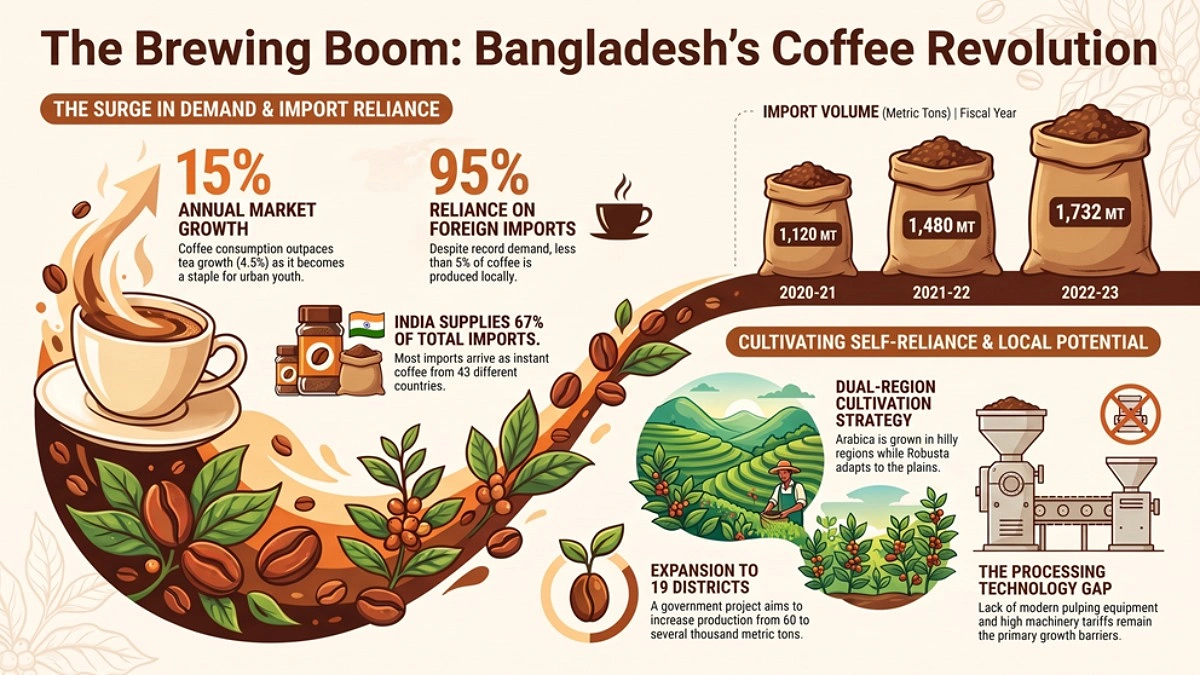
Graphics: Agamir Somoy
Bangladesh, traditionally a tea-drinking nation, is now experiencing a coffee revolution fueled by youth, students, and the working class, whose demand is surging rapidly.
According to concerned sources, the domestic coffee market has surpassed Tk 500 crore, with the market expanding at an annual rate of nearly 15 percent. However, despite the massive surge in demand, nearly 95 percent of the total requirement still has to be met through imports.
According to data from the National Board of Revenue, imports of coffee and coffee beans in Bangladesh have recorded significant growth over the past five years. In the 2020-21 fiscal year, around 1,120 metric tons of coffee were imported annually into the country.
Keeping pace with rising demand, imports rose to around 1,480 metric tons in the 2021-22 fiscal year. In the 2022-23 fiscal year, the import volume reached a record 1,732 metric tons. Although imports slightly dropped to 1,439 metric tons in the 2023-24 fiscal year due to rising global prices and a dollar shortage, consumer demand in the local market did not diminish.
In recent years, an average of 1,400-1,500 metric tons of coffee has been imported annually, with its monetary value exceeding millions of dollars in the international market.
Around 83-90 percent of imported coffee enters the country as instant coffee, while the remainder arrives as premium coffee beans. Although coffee arrives from nearly 43 countries worldwide, neighboring India alone supplies nearly 67 percent of total imports.
Substantial quantities of coffee beans and processed coffee enter the market from Brazil, Vietnam, Indonesia, Malaysia, and Colombia. An analysis of consumer demand reveals that while the annual sales growth of tea in Bangladesh averages 4-5 percent, the trend of coffee consumption is growing at an average annual rate of 13-15 percent.
While nearly 15 percent of households in the country are accustomed to regular coffee drinking, it has become a fashion statement and a key element of social interaction among the urban youth aged 18-35.
Over the past few years, hundreds of premium coffee shops have cropped up across major cities, including Dhaka, Chattogram, and Sylhet. At the same time, the widespread use of three-in-one sachet coffee - ranging from small tea stalls to households and corporate offices - has brought coffee within easy reach of the middle class.
Primarily, two types of coffee are produced globally, both of which are found in Bangladesh. Arabica coffee, characterized by a mild aroma and lower caffeine content, is suitable for cultivation in hilly areas such as Bandarban and Khagrachari.
On the other hand, Robusta coffee, known for its strong flavor and bitter notes, easily adapts to the climate of plain regions like Tangail, Sherpur, and Nilphamari. Only about 25-60 metric tons of coffee are produced annually in the country, accounting for less than 5 percent of total annual demand.
However, under a special project of the Department of Agricultural Extension, coffee cultivation is being expanded across 45 upazilas in 19 districts, aimed at elevating domestic production to several thousand metric tons.
Among the market’s leading brands, Switzerland’s multinational brand Nestlé or Nescafé has long maintained a dominant monopoly, controlling 27-47 percent of total imports.
Domestic industrial conglomerates have built a strong presence in this market in recent years. Among them, Abul Khair Group’s “Ama Coffee” has climbed to second place with an estimated 27 percent share of the imported coffee market.
Several local companies, including Meghna Group of Industries and PRAN Group, have entered the marketing space. In the coffee and cafe category in particular, market leadership in importing premium beans and roasting them locally is being driven by North End Coffee Roasters, Gloria Jean’s, Crimson Cup, and the hill tract region’s local brand “Furomon Coffee”.
The future potential of the coffee sector is immense. Meeting local demand will make it possible to reduce import dependence and save a substantial amount of foreign exchange annually.
Moreover, because coffee can be cultivated under the shade of fruit orchards in both hill and plain areas, it has created a highly profitable opportunity for farmers to generate supplementary income. The greatest challenge in this sector is the lack of processing technology and modern equipment at the local level.
Although farmers produce coffee cherries, they are unable to prepare quality coffee due to a lack of proper training in pulping and processing. The absence of a direct supply chain between local farmers and large processors, coupled with high tariffs on imported machinery, is slowing down the growth of this emerging sector.
Bangladesh’s coffee industry is no longer confined to a few elite cafes; it represents a promising new horizon for the country’s agro-economy. With timely government initiatives, modern processing facilities, and proper training for farmers, Bangladesh will soon be able to reduce import dependency and become self-reliant in coffee production.
