
How Many More Statements Do You Want?

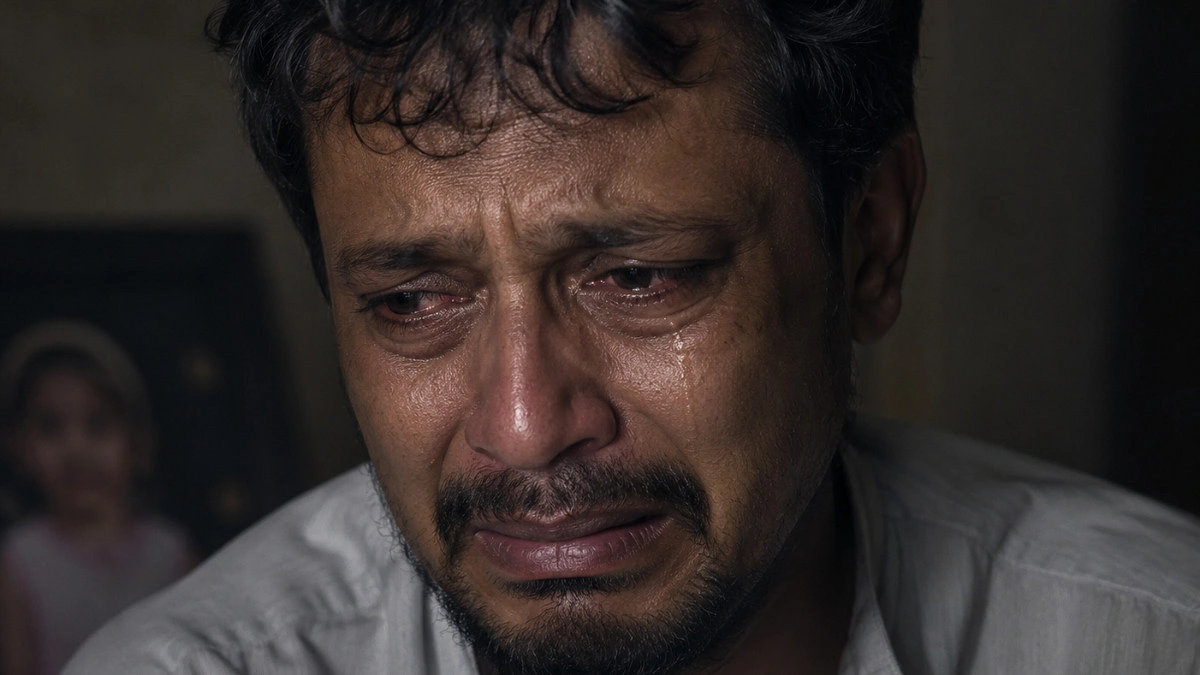
Representational image drawn by AI.
"I do not want justice. Because you have no record of delivering justice. This will last for fifteen days at best, then another incident will happen, and this will be hushed up."
This comment was uttered by an entirely hand-to-mouth, ordinary man, more specifically, the father of the brutally murdered young girl, Ramisa. It is not a momentary lament, nor is it a personal surrender. Rather, it is a sharp satire, a definitive protest, and a final counterstrike right in the face of the state, society, and administration’s failures, marking an era of our collective defeat. For a father whose back is against the wall, this "refusal to seek justice" is actually the funeral of our familiar judicial system. When retreat or silence feels more reliable than knocking on the doors of the court, we must understand that we are standing before an ocean of moral bankruptcy. This is the highest and final language of protest from an ordinary father. It is also a whip of burning truth on the skin of the media, which hypes up this bloodshed for a few days before moving on in search of some new, sensational "issue."
We are now living in a strange, Kafkaesque labyrinth. Much like the novels of Franz Kafka, this is a state system where the process of seeking justice is more painful, confusing, and terrifying for a citizen than the crime itself. Hoping for fair justice in court here is merely an endless journey of exhaustion. Through repeated hearings, ugly and suspicious cross-examinations by the opposing side, invisible social pressures, and the magic tricks of wealth, the victim's family is forced to stand in the dock daily to constantly prove their own purity. Trapped in the maze of this complex and ruthless system, people gradually lose the very will to resist. The citizen then remains silent simply out of a desire to be well, for the sake of keeping their bare existence intact.
Eight-year-old Ramisa Akter of Dhaka's Pallabi was the top girl in her class. The tiny pair of shoes she took off before entering the house now sits alone outside the door, putting this state in the dock. Falling victim to a neighbor's twisted lust, her innocent body had to be chopped into pieces. Yet on the very same day, ten-year-old madrasa student Md. Abdullah sank into a deep darkness. His hanging body was found in a bathroom. Regarding this incident, a netizen wrote on Facebook—
"If, even for a brief moment, Abdullah's corpse could speak, he too might have said like Ramisa— my life was unique too, so why did no one speak about me?"
Why do some deaths receive the spotlight while others are lost simply in the ledger of statistics? Here, even grief has a hierarchy, and crying has a market price!
In truth, this country has now become an inevitable death trap for children, be it a boy or a girl. Flipping through the pages of statistics makes one's skin crawl. In just seven days, four children were brutally murdered after being raped! From Pallabi to Sylhet—there is terror everywhere. In Sylhet, four-year-old Fahima was dumped in a ditch inside a bag after being sexually assaulted by her own paternal uncle. In Thakurgaon, the body of a four-year-old child was hidden in a cornfield after being raped; the killer is a ninth-grade student! In Munshiganj, another ten-year-old child lost her life to the lust of her step-maternal uncle. When the surrounding air grows heavy with such devilry, a mother searches for the touch and scent of her dead child's lips on an unused feeding bottle or clothing in the dark of night, while a father, acting tough in front of society, shatters into pieces the moment he is alone.
Sometimes it is the negligence of a hospital taking the lives of Ayan or Ahnaf, sometimes it is on the roads, sometimes in open drains, or sometimes it is through the demonic brutality faced by Asiya in Magura. Although justice for Asiya's murder was delivered in just 14 working days, it has been hanging in the High Court for a year now. Have we forgotten about young Puja from 2016? The monster Saiful had mutilated her private parts with a razor blade. Although the court sentenced him to life imprisonment, he walked free on bail just last year! Is this the specimen of our justice? Our children are being born and spending their childhoods within this terrified and uncertain environment. Meanwhile, shattered by the trauma of losing their children, parents in this society are left to survive helplessly. The culture of forced normalcy and compromise teaches us to swallow it all—that staying silent is the best strategy to remain safe. Children head to school carrying the daily challenge of simply returning home alive.
Yet, this cruelty is not confined to this territory alone; human civilization across the globe has collapsed flat on its face today. Missiles rain down upon the brightly painted houses of Ukraine. In Syria's Aleppo, dust-covered Omran Daqneesh sits in an ambulance with silent eyes—a child whose very language of crying has been stripped away. In the ruins of Gaza, a dust-laden infant searches for milk, suckling at the breast of its deceased mother. And when the lifeless body of three-and-a-half-year-old Kurdish boy Alan Kurdi washes ashore on the Mediterranean—it returns as a supreme condemnation and a question mark at the feet of civilization standing on the Mediterranean sands. Is this the ultimate culmination of all your civilization's grand arrangements?
Alan’s lifeless body, clad in that red t-shirt and blue shorts, grew larger than the conscience of Europe, and indeed, the entire world. Helpless parents across the globe today seem to be floating in trawlers on turbulent seas, searching for just a safe shelter for their children. Ramisa, Abdullah, or Alan have all proven that in this civilization, it is not just children who are unsafe, but justice itself. Standing before this collective sin, no excuses hold ground anymore. The parents who cannot provide security for their children are losing from the depths of their souls. The society that brutally kills its children is rotten to the core. The state from which fathers no longer demand justice for the murder of their children has failed. Standing beside these mutilated corpses of children, you tell us now, O State—how many more statements do you want?
