July Uprising justice trapped in endless investigations

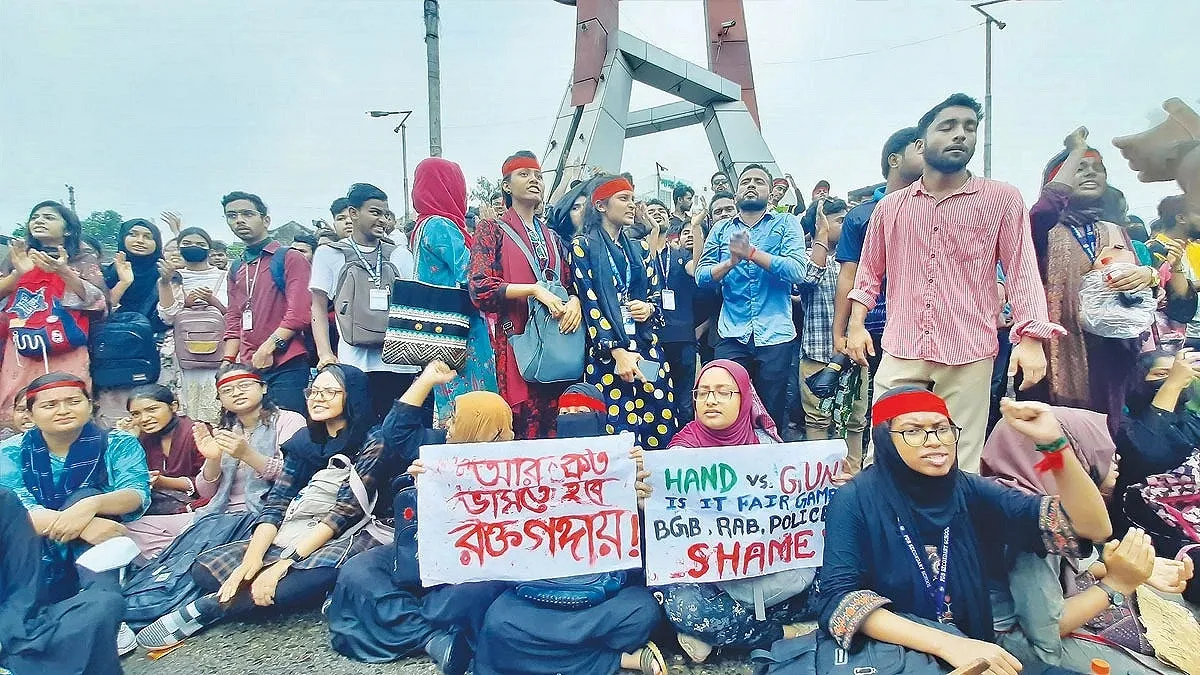
File Photo
Two years have passed since the July Mass Uprising 2024, yet the wait for the families who lost their loved ones has not ended.
Carrying suppressed pain and tears in their hearts, they are looking forward to receiving justice, but that justice remains imprisoned in court corridors and police station records.
Investigations for 86 percent of the cases filed in connection with the Anti-Discrimination Student Movement have not yet been completed. An analysis of Police Headquarters data shows that 1,866 cases were filed across the country regarding the movement.
Among these, investigations for only 264 cases have been completed in the last two years, meaning around 85.85 percent of cases are still hanging at the investigation stage.
Out of the total cases, 802 are murder cases and 1,064 are cases under other sections, with more than 6,10,000 accused individuals. Among them, about 1,54,000 are named accused, while more than 4,56,000 are suspects.
The investigation process is facing challenges due to the massive list of accused and the complexity of evidence. There is no clear statement from the police regarding when these investigations might be completed, although Police Headquarters said their priority is ensuring a quality investigation, not just speed.
Those involved in the investigations added that hundreds of people were named as accused in cases filed over clashes, violence, murders, attacks, and vandalism during the Anti-Discrimination Student Movement.
Later, upon investigating, no clear evidence or truth was found against many of the accused, and questions have also arisen because the same individual has been named as an accused in multiple cases, including several murder cases.
Investigators have fallen into a difficult situation as police and government officials are also named as accused in most cases. It is known that after the July uprising, 1,866 cases were filed in courts and police stations across the country on various charges, including murder, attempted murder, torture, attacks, and vandalism.
To investigate these cases correctly, Police Headquarters formed a “Mentoring and Monitoring” or advisory committee. The monitoring of these cases is ongoing through 10 advisory committees.
An analysis of the investigation disposal statistics of the advisory committees shows that investigations for 101 murder cases have been settled, with charge sheets filed in 63 and Final Truth Reports (FRT) submitted in 38.
Moreover, investigations for 163 cases under other sections have been settled, with charge sheets filed in 145 and Final Truth Reports (FRT) submitted in 18. It is reported that out of the 264 completed investigations, the Police Bureau of Investigation (PBI) finished 203.
PBI is investigating 278 cases, including 196 Magistrate Court (CR) cases and 82 police station (GR) cases.
A review of the cases shows that the investigation agency has submitted final reports to the court for 203 cases. Among the 196 cases filed in court, allegations were proven in 100 cases, where 9,956 people had been accused.
Investigations proved allegations against 3,395 of them, while no evidence of involvement was found against the remaining 6,561 people, meaning 65.89 percent of the total accused in these cases were found innocent in the investigation.
Moreover, 35 cases are under investigation, while the remaining 61 cases include 32 where allegations were unproven, 6 where the plaintiff is missing, 20 cases of false allegations, and 6 cases involving non-cooperation from the plaintiff and a lack of witnesses and evidence.
When asked why the investigation disposal rate of the Anti-Discrimination cases is so low, AHM Shahadat Hossain, AIG (Media & PR) of Police Headquarters, said, “The cases related to the anti-discrimination movement are very sensitive and most involve multiple accused, a large number of witnesses, digital and forensic evidence, and the collection of proof from various locations.
“Therefore, it is taking necessary time to complete the investigation of each case in a neutral, evidence-based, and legal manner. Our priority is to ensure a quality investigation, not just speed.”
Regarding the completion of the remaining investigations, Shahadat added that necessary instructions have been given to the units to complete the investigations quickly. However, as the nature and complexity of each case are different, it is not possible to state a specific timeframe, and investigations will be completed gradually by following legal processes and collecting adequate evidence.
Detective Branch (DB) of the Dhaka Metropolitan Police (DMP) is investigating 59 cases. Md Shofiqul Islam, additional commissioner (DB), said around 40 GB of data, forensic evidence, and the roles of those involved are being analyzed to uncover the true facts. As the number of accused in each case is high, their locations must be identified and their roles during the movement verified.
He added, “We are investigating the cases with importance. Investigation reports will be submitted to ensure the maximum punishment for the actual criminals through the law.”
Sajjad Siddiqui, chairman of the Department of Peace and Conflict Studies at University of Dhaka, told Agamir Somoy, “Out of the last two years following the July uprising, 18 months were under an interim government. During this time, it has often been seen that countless cases were filed for the sake of filing cases or for the purpose of harassment.
“As a result, the path to the trial of actual crimes and obtaining justice for true victims is being blocked in the crowd of unnecessary cases. If the government had announced from the beginning that they would only work on meaningful cases based on merit or importance, it would have reflected the government’s seriousness or importance and created an accountable position, which would have also instilled confidence in the hearts of the victims.”
It is reported that on 4 August 2024, a youth named Emon Hossain Akash, 22, was shot and killed during a student-mass procession in front of the Popular Diagnostic Center on the road at Mirpur-10.
Akash’s mother, Baby Akter, is in doubt regarding the justice for her son’s murder. She said, “Even though the accused are roaming around openly, the police claim they cannot find anyone. On the contrary, the police ask me if anyone is threatening me to withdraw the case. If those who are supposed to ensure justice side with injustice, then who will try this murder?”
Senior Advocate of the Supreme Court and President of the human rights organization Human Rights and Peace for Bangladesh (HRPB), Manzil Murshid, said, “Many cases filed regarding the anti-discrimination student movement are now under question. There are allegations that individuals who were not involved in the actual incidents have also been made accused.
“As a result, the credibility of these cases is weakening and doubts are being created about whether they will hold up in court.”
He added, “If persons are held responsible in a murder case without acceptable evidence during the investigation, then that case will not stand in court. The real victims and their families will suffer the most from this.
“Because the justice they hoped for might ultimately remain elusive. If there are inconsistencies and questions from the beginning of a case, the fear of the correct judicial process being hindered is high.”