
Chief Prosecutor: Over 250 enforced disappearance victims still untraced

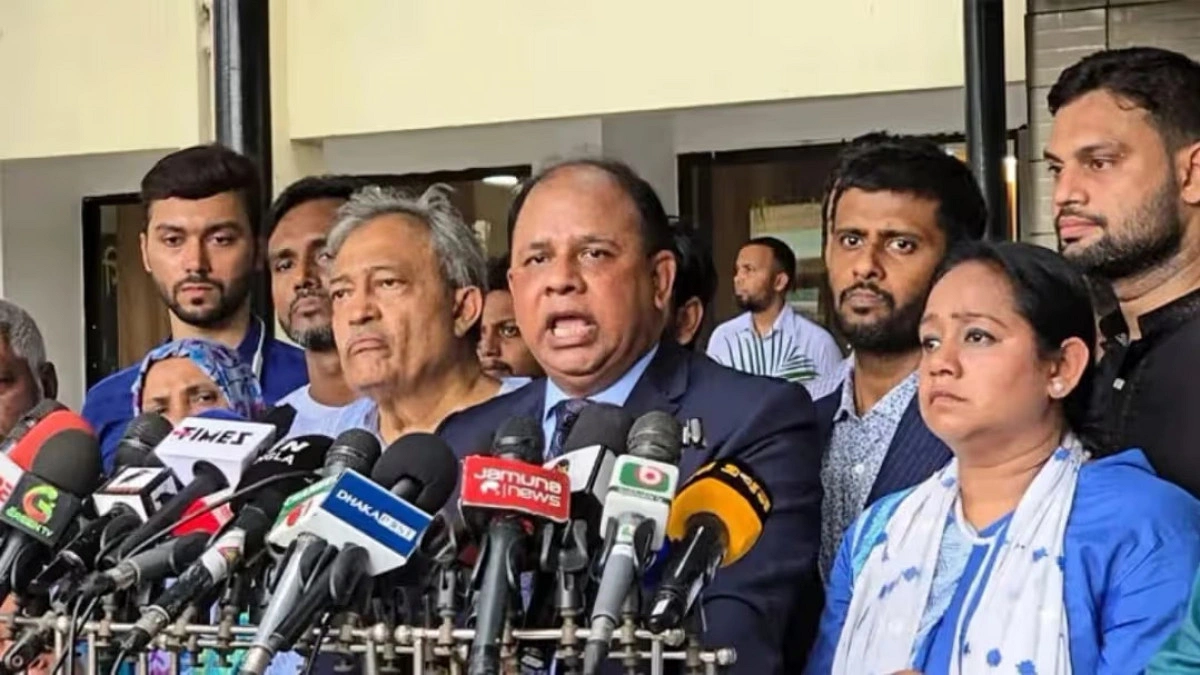
Mohammad Aminul Islam, Chief Prosecutor of the International Crimes Tribunal briefs journalists after visiting some Secret Detention Centers in the city. Photo: Collected.
More than 250 victims of enforced disappearance have still not been found, said Mohammad Aminul Islam, Chief Prosecutor of the International Crimes Tribunal. He said many of those who were disappeared were later released and implicated in false cases, while others have been killed or remain missing.
As part of the ongoing trial proceedings for crimes against humanity, a delegation comprising three judges of the International Crimes Tribunal-1, the prosecution team, and defense lawyers visited the secret detention facility known as the "Taskforce for Interrogation Cell (TFI Cell)," located at the RAB-1 headquarters in Dhaka's Uttara area, on Saturday morning.
The Chief Prosecutor talked about some details during a press briefing after the visit.
During the briefing, he said that this judicial visit was conducted under the rules of the International Crimes Tribunal and the relevant provisions of the Rome Statute. He explained that the initiative was taken so that the judges could observe the crime scenes firsthand, rather than relying solely on testimonies, evidence, or documents. The judges' observations will be compiled into a judicial memorandum, which will become part of the case files and will be taken into consideration during the trial.
The Chief Prosecutor claimed that during the inspection, they found a total of 29 cells, both large and small, where victims were allegedly kept for extended periods in inhuman conditions, with their hands, feet, and eyes bound, and subjected to torture.
"Preliminary investigations have revealed that the current Home Minister, Salauddin Ahmed, was also once held in this detention facility," he added. He further stated that the tribunal's investigation has uncovered another similar secret detention center, located at a DGFI (Directorate General of Forces Intelligence) establishment in Dhaka Cantonment, and the tribunal judges will visit that facility next Saturday.
Mohammad Aminul Islam said that such secret detention facilities are in contravention of Article 33 of the Constitution and Sections 61 and 167 of the Code of Criminal Procedure, which mandate that an arrested person must be produced before a magistrate within 24 hours. He claimed that these allegations of illegal detention, enforced disappearance, and murder fall under the purview of crimes against humanity, and that they are striving to conduct the trial in line with international standards.
He added that many might think of this "Aynaghor" (mirror room) as a fairy tale. But it was no fairy tale; it was stark reality. Through this mirror room, the character of the then government and the state—that it was a fascist state, and how fascist its rulers were—has now been exposed.
On the other hand, defense counsel Barrister A. B. M. Hamidul Mishbah disagreed with the prosecution's statements. He said that failure to produce an arrested person before a court within 24 hours does not immediately become a crime against humanity; the matter is first triable under existing laws. In his view, "Under no circumstances will it be a crime against humanity. We must remember that very clearly. If any law enforcement member—be it RAB or any other force—fails to produce someone within 24 hours, that will be subject to departmental proceedings. Only after adjudication there can we consider whether it actually falls under the ICT International Crimes Tribunal]. I am leaving this as a big question before you."
He also claimed that the actual scene observed during the visit did not match the description presented by the prosecution, and that this visit would assist the defense side in preparing their case.
Also present during the visit were human rights activist Nur Khan Litun, Sanjida Islam Tuli—coordinator of "Ma'er Dak" (an organisation of relatives of enforced disappearance victims), defense lawyer Md. Tabarak Hossain Bhuiyan, and others.
