
Political violence surges amidst deadly feuds

Graphics: Agamir Somoy
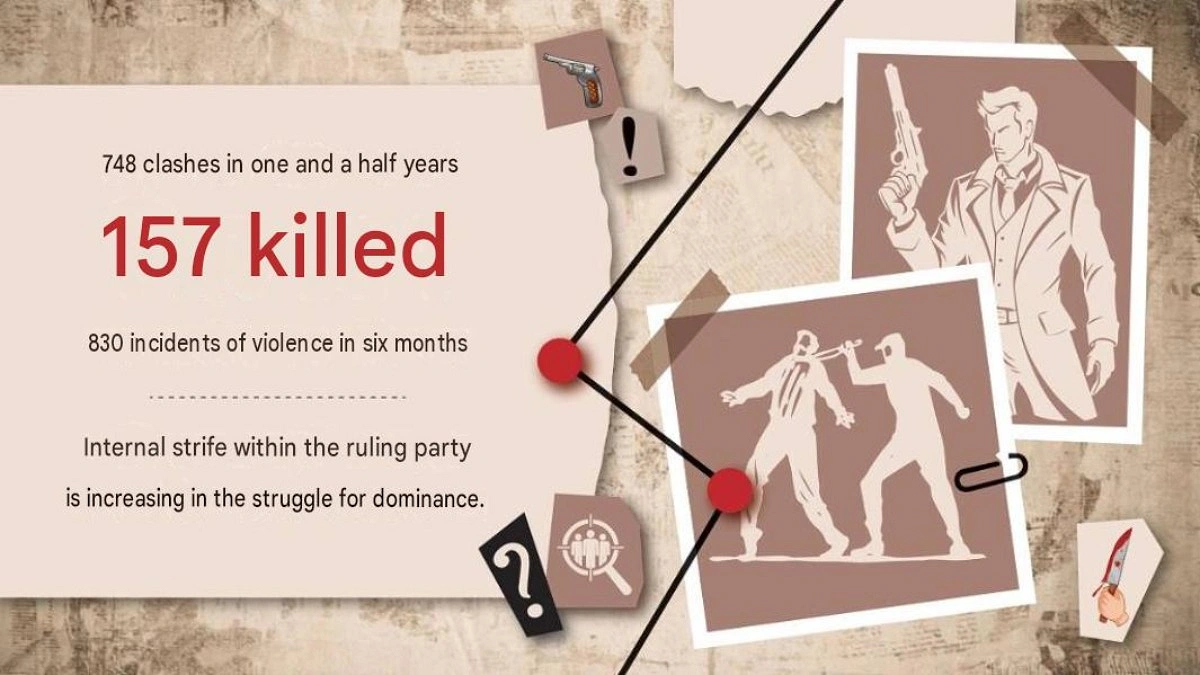
The cycle of killings is not stopping in any way. The country cannot escape the circle of political tension and violence, where illegal weapons are being used. In the first six months of this year, 56 people were killed and more than 5,246 were injured in 830 incidents of political and electoral violence.
On July, more than 10 murders have occurred across the country. Over the past year and a half, at least 157 people have been killed and 7,381 injured in at least 748 political clashes nationwide.
Allegations suggested that most of the criminals are reckless due to the patronage of political influence. Even when law enforcement agencies conduct operations to arrest them, various labels are being placed on the members of the agencies.
Data from crime analysts and human rights organizations said rather than ideological conflicts, the main reasons for political violence are now establishing local dominance, extortion, tender control, exerting influence, and internal feuds within the ruling party.
Investigations showed that among those killed in political violence, 86 were leaders and activists of the BNP and its affiliate organizations, a large portion of whom were victims of internal party feuds. On 21 July, a Ward BNP activist named Md Palash, 36, was hacked to death in Dhaka’s Sabujbagh due to past enmity.
On 24 July, miscreants shot and killed Md Hafizul Islam Babu, the member secretary of Kafrul Thana BNP. A vegetable vendor named Nalam Sardar and a pedestrian named Md Monir Hossain were also injured.
Local sources and investigators said the murder was due to internal conflict. Upcoming councilor elections, land business, and past enmity are also cited as major reasons for the killing.
Earlier, on 8 July, miscreants shot Saiful Islam Siju, the joint convener of Mirpur Thana Swecchasebak Dal, in the Falpatti area due to internal feuds. While attempting to flee, locals caught a youth named Shanto Bhuiyan with a weapon and handed him over to the police. Siju, who was shot in the leg and waist, survived.
Additional IGP (Crime & Ops) of Police Khondker Rafiqul Islam told Agamir Somoy, “The law and order situation is much more under control than before. A nationwide crackdown has been ongoing since 1 May. Some miscreants had been in hiding for a long time. They have now returned to the country and are patronizing various crimes. However, we are trying our best to bring them under justice.”
On 9 June, Badal Morol, the president of the Union Krishak Dal in Fakirhat, Bagerhat, was hacked to death. Abdullah Morol, the local Union BNP president, was injured.
A day earlier, Billal Hossain, a Swecchasebak Dal leader, was stabbed to death in Dhaka’s Mouchak area over control of sidewalk extortion. Those named in the murder are activists of the Jubodal.
Statistics from Police Headquarters showed that during a special operation from 1 May to 14 July, 244 firearms, 2,317 rounds of bullets and cartridges, 88 magazines, 43 hand bombs, and 2.25 kg of gunpowder were recovered. As of Tuesday, 625 illegal arms holders have been arrested and 1,191 extortionists have been arrested.
However, intelligence information suggested that shipments of weapons are entering the country one after another from the “Black Triangle” (Bangladesh-India-Myanmar), Thailand, and Cambodia.
Payments for shipments arriving through at least 15 unprotected land and Bay of Bengal routes are being made in cryptocurrency. Beyond this, arms traders have brought large shipments of weapons from a neighboring country after 5 August 2024, which have already spread to various parts of the country.
Analysis of statistics from the human rights organization Ain o Salish Kendra (ASK) showed that in the last year and a half, 157 people were killed and 7,381 injured in 748 political clashes. Among them, 86 were killed in BNP’s internal feuds. Last year, 102 people were killed and 4,744 injured in political violence.
Among the deceased, 70 were leaders and activists of the BNP and its affiliates. In 192 incidents of BNP’s internal feuds alone, 40 were killed and at least 2,380 were injured. Multiple fatalities occurred in internal conflicts within the Jubodal and mutual clashes between various wings including BNP-Jubodal, Krishak Dal, Swecchasebak Dal, Chatradal, and Shramik Dal.
From January to May of this year, 55 people were killed and 2,636 injured in 347 political clashes. Among these, 14 were killed and 745 injured in 79 incidents of BNP’s internal conflict.
The semi-annual report of the human rights organization Human Rights Support Society (HRSS) reveals that from January to June of this year, 56 people were killed and more than 5,246 were injured in 830 incidents of political and electoral violence.
During the same period in 2025, 79 people were killed and 4,124 injured in 529 incidents.
According to HRSS data, of the 56 killed, 37 were from the BNP, six from Jamaat-e-Islami, three from the Awami League, eight from other parties, one extremist, and one woman.
The organization said 673 out of 830 violent incidents, or around 81 percent, centered around BNP’s internal feuds or clashes between BNP and other political parties. Among these, 31 were killed and 2,092 injured in 273 incidents of BNP internal conflict.
Moreover, 10 were killed and 1,852 injured in 290 incidents of BNP-Jamaat clashes. Seven were killed and 464 injured in 77 incidents of BNP-Awami League clashes. Hundreds were also injured in clashes between BNP-NCP, Awami League-NCP, and BNP vs other parties.
The report noted that at least 64 incidents of attacks by miscreants on political leaders and activists in six months. In these attacks, 38 were killed and 90 injured. During the same period, over a hundred political figures were shot, and more than 900 houses, businesses, and political offices were attacked, vandalized, looted, and set on fire due to party feuds.
Tauhidul Haque, associate professor at the Institute of Social Welfare and Research, University of Dhaka, told Agamir Somoy, “After a party comes to power, a competition begins at the local level to establish positions, influence, and economic control.
“Conflict arises from there. Often, personal or family disputes are carried out under the guise of political identity. However, the culture of establishing dominance and impunity is further fueling internal conflict within the ruling party.”
In his view, the government and the political party must be kept separate, and exemplary organizational measures and strict law enforcement must be ensured to stop the trend of establishing dominance through political influence.
However, RAB Additional Director General (Ops) Col Iftekhar Ahmed told Agamir Somoy, “RAB views a criminal only as a criminal.”
