Police stretched thin as political violence fuels crime fears

Graphics: Agamir Somoy
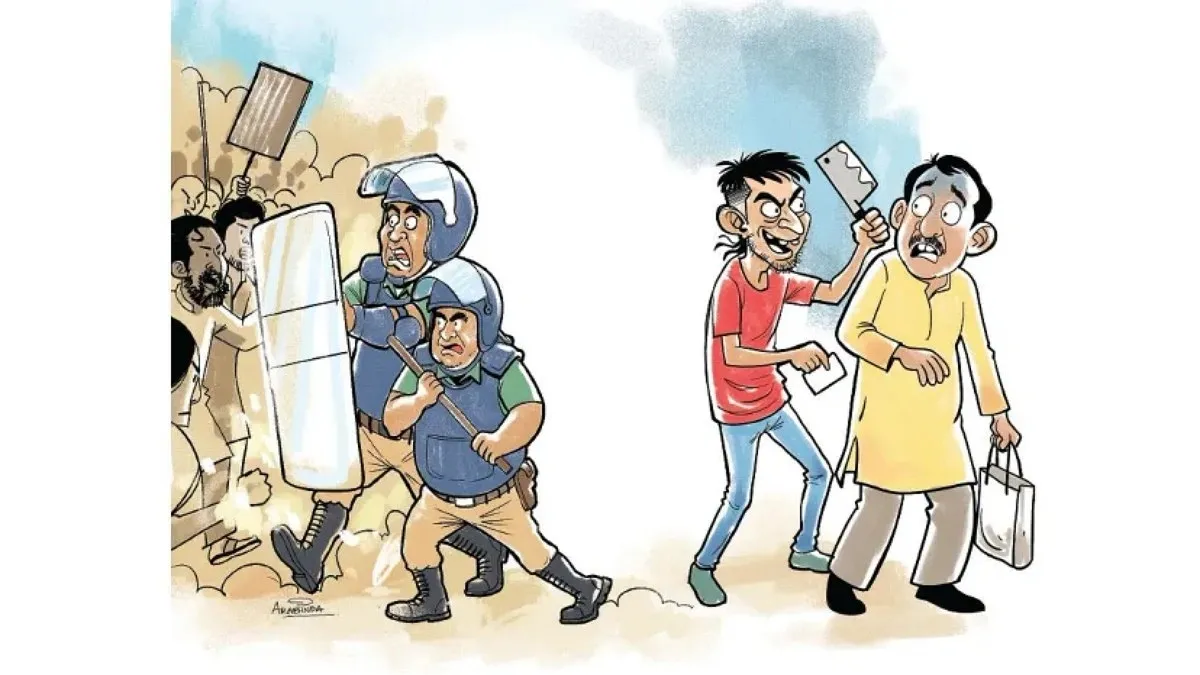
The political arena has turned volatile following announcements regarding the return of ousted prime minister Sheikh Hasina, who fled to India during July uprising 2024. Incidents of arson and cocktail bomb explosions are occurring daily across various parts of the country, including Gopalganj. Industrial zones are also unstable due to labor unrest.
Security has been heightened across key state installations, political offices, highways, and sensitive areas. A major portion of the police force is remaining occupied with these deployment duties.
As a result, police oversight and action against daily criminal activities in various areas have decreased, fueling growing concern among the public. Complaints have emerged in some areas about failing to receive prompt police assistance after becoming victims of crime, while questions have been raised in other places regarding a lack of regular patrols.
On-duty police officers in the field have also voiced the strain of handling so many simultaneous challenges with limited personnel. Crime analysts said political conflict has become a major challenge for law enforcement agencies, creating deep anxiety over public safety.
According to analysts, police operations cannot remain limited to merely taking action after a crime has been committed. Emphasis must be placed on intelligence gathering, technology-based surveillance, and community-based security systems to prevent crime.
This approach would make it possible to identify risks and take effective measures before crimes occur, as ensuring the safety of the general public is the primary responsibility of the police.
Iqbal Hossain, a resident of the Tongi area under Gazipur City Corporation, shared his experience of not receiving regular police services. He said a close relative of his filed a general diary (GD) at Tongi East Police Station three days prior regarding an incident, but police could not visit the scene for investigation due to various engagements.
The investigating officer assigned to the GD explained that he was tied up on the highway due to labor protests and was thus unable to conduct the investigation. The officer added that they are currently unable to place strong emphasis on drives to apprehend individuals involved in crimes such as theft, mugging, and illegal drugs.
Another victim like Iqbal Hossain is 55-year-old Rafiqul Islam from Rupganj, Narayanganj, who has been visiting administrative offices for over a month after lodging a complaint with the police.
Although the Upazila Nirbahi Officer (UNO) ordered police to take action, no progress has been made on his complaint.
In his written complaint submitted to Rupganj Police Station, Rafiqul Islam added that on 21 October, several individuals - including local resident Torab Ali’s son Mahfuzur Rahman Khorshed, Al Amin Bhuiyan, and Mozammel’s son Syed Rayhan Mostaq - abducted him from the street and took him beside Golakandail Primary School, where they beat him. They forcibly obtained his signatures on nine blank non-judicial stamps.
Additionally, they issued death threats to him and his family if he pursued the matter further. Regarding Rafiqul’s allegation, AHM Salahuddin, the Officer-in-Charge (OC) of Rupganj Police Station, said based on what they learned, the issue involved a financial transaction. He added that he had understood the two parties would resolve the matter among themselves.
However, when informed that the accused individuals were denying the financial transaction issue, the OC remarked, “I will look into the entire matter thoroughly.” Nevertheless, Rafiqul Islam claimed that despite instructions from the UNO office, police took no action and failed to dedicate proper time to his complaint.
Sajjad Siddiqui, a sociology and criminology expert and Chairman of the Department of Peace and Conflict Studies at University of Dhaka, noted that the police force’s preoccupation with controlling political violence could adversely affect general crime suppression.
According to him, when police become excessively tied up in controlling political conflict, the force’s manpower, time, and institutional focus get divided. This creates risks of disrupting regular patrols, crime prevention, and investigation activities. Performing excessive duties can also heighten mental stress among police officers, which may weaken the force’s standard capability to control everyday crime.
Highlighting the need for strategic shifts in crime control, the expert stated that qualification, skill, and professionalism must be prioritized over political affiliations when it comes to postings and promotions within the force. For this, explicit and transparent merit criteria are essential.
Only individuals deemed qualified under set benchmarks must be ensured appointments and promotions to key posts. Moreover, internal reforms within the force, boosting member morale, and providing necessary logistical support must be ensured.
Sabotage activities began continuously on the 8th of the month centered around announcements of Hasina’s return to the country. In just these few days, incidents such as cocktail bomb explosions and bus arson occurred across 11 districts, including Dhaka, Gazipur, and Chattogram.
Reports of fatalities have also emerged. Attacks were launched on police in Gopalganj, where a police station and vehicles were set on fire. According to Police Headquarters estimates, 213 incidents of cocktail and bomb explosions as well as transport arson took place nationwide during the first 23 days of November.
One person was killed and 11 others were injured in these incidents. A total of 62 cases and 27 general diaries (GDs) were filed in connection with these events, and 100 people were arrested. These statistics were revealed in a report titled “Information Regarding Sabotage and Subversive Activities of Banned Groups” prepared by the Operations Branch of Police Headquarters, covering the country’s situation from 1 to 23 November.
According to Police Headquarters data, 121 cocktail and bomb explosions and 99 incidents of transport arson occurred at various places across the country during this timeframe. Alongside acts of sabotage, 72 flash processions were organized by the activity-banned Awami League, Krishak League, Jubo League, and Chhatra League during the first 23 days of November. In connection with these processions, 22 cases and five GDs were lodged, and 66 individuals were arrested.
Attacks on police installations, setting fire to vehicles, and hurling cocktail bombs targeting infrastructure and vehicles were also recorded. Twenty-one police officers were injured in these incidents.
One case was filed, and four persons were arrested regarding these attacks. Grameen Bank has also emerged as a target of recent sabotage attacks. Incidents involving cocktail and bomb explosions and arson occurred at the bank’s branches and facilities across various regions of the country.
Police Headquarters report detailed a total of 34 sabotage incidents targeting Grameen Bank. While there were no reported casualties, eight cases and 19 GDs were filed, and eight individuals were arrested.
Kamarum Munira, Assistant Inspector General (Media and PR) at Police Headquarters, stated that the primary function of the police is to maintain public safety. She noted that to keep the law and order situation normal, police have already arranged an integrated security plan. Under this framework, arrangements have been established for advance intelligence collection, increased surveillance at critical locations, strengthened regular patrolling, setting up necessary checkpoints, and maintaining rapid response capabilities for any situation.
In addition, special surveillance is being maintained over high-risk areas and key installations. She stated that police will remain on highest alert to prevent any banned political organization from attempting sabotage, violence, or disrupting public security.
Anyone attempting to create chaotic conditions or cause law and order to deteriorate will be dealt with firmly. She maintained that ensuring public security, maintaining normal law and order, and protecting the lives and property of citizens remain the fundamental goals of the police force.