
Parents' Maintenance Act, 2013
Conviction Alone Not Enough for Job Termination

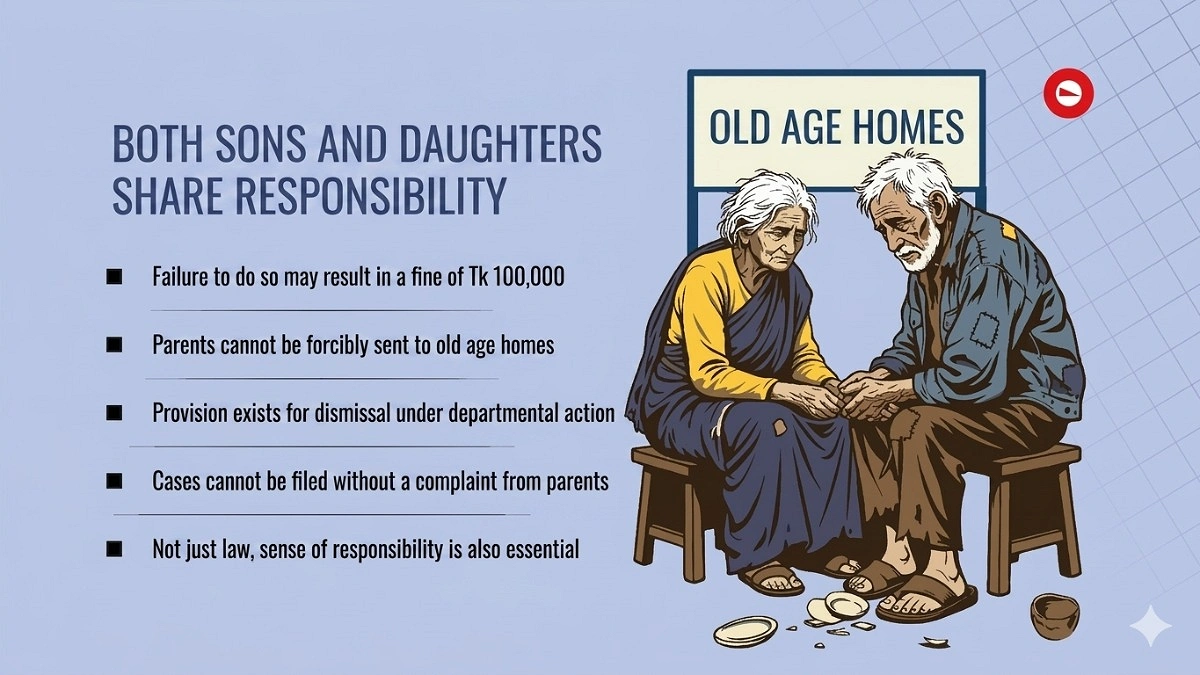
Graphics: Agamir Somoy
Neglecting the maintenance of elderly parents can lead to legal action and fines of up to Tk 100,000. Failure to pay the fine may result in imprisonment of up to three months. However, such punishment does not lead to job loss in government service. According to civil service regulations, termination from government employment requires a criminal conviction resulting in more than one year of imprisonment. As a result, despite legal provisions for punishment, the law in many cases remains a symbolic warning.
Following the recovery of the body of 75-year-old Nurjahan Begum in Mirpur, discussions have intensified nationwide over children’s sense of responsibility, family values, and the safety of elderly parents. The case has also raised questions about administrative action against public servants convicted of failing to support their parents.
Legal and public administration experts say that although the Maintenance of Parents Act, 2013 includes punitive provisions, the framework of the Government Service Act, 2018 does not allow automatic dismissal of a government employee convicted under this law. However, authorities may take strict administrative action through departmental investigations.
In the wake of public outcry over Nurjahan Begum’s death, her son Anisur Rahman was made an officer on special duty (OSD). The incident has also brought renewed attention to the 2013 maintenance law.
To ensure the protection of elderly parents, the Maintenance of Parents Act, 2013 was enacted. The law makes no distinction between sons and daughters, placing equal responsibility on both to support their parents.
Section 3 of the law states that every child is legally obliged to ensure the maintenance of their parents. If there are multiple children, responsibilities must be shared through discussion and mutual agreement. Maintenance includes not only financial support but also medical care, caregiving, regular contact, ensuring safety, and providing emotional support.
No child can force a parent to live in an old age home or any other place against their will. Even if parents live separately, children are required to maintain regular contact with them.
Section 4 of Law Includes Grandparents’ Maintenance Responsibilities
Section 4 of the law also includes provisions for the maintenance of paternal grandparents as well as maternal grandparents. In the absence of the father, the responsibility for paternal grandparents falls on the child, and in the absence of the mother, the responsibility for maternal grandparents is similarly assigned.
Under Section 5(1) of the Act, any child who fails to provide maintenance for their parents may be punished with a fine of up to Tk 100,000. In case of non-payment of the fine, the offender may face imprisonment of up to three months. Not only children, but also a spouse of the child, their sons or daughters, or other close relatives who obstruct or fail to cooperate in providing maintenance may face similar punishment.
Public administration expert Firoz Mia said, “Under Section 42 of the Government Service Act, 2018, if a public servant is convicted in a criminal case and sentenced to death or imprisonment for more than one year, their employment is automatically terminated from the date of the judgment.”
“The Maintenance of Parents Act, 2013 prescribes a maximum sentence of three months’ imprisonment. Therefore, a government official does not automatically lose their job solely on the basis of conviction under this law,” he added.
Firoz Mia noted that even if the sentence is less than one year and the job is retained, the individual is not exempt from administrative accountability. In such cases, the appointing authority may initiate departmental proceedings against them.
He said that under the Government Servants (Discipline and Appeal) Rules, if allegations of misconduct or breach of discipline are proven in an inquiry, a range of disciplinary actions may be taken, including warning, reprimand, withholding of salary increments, demotion, compulsory retirement, removal, or dismissal from service.
Criminal and Administrative Punishment Are Separate
A former additional secretary of the Ministry of Public Administration said, “Criminal punishment imposed by a court and departmental punishment are two separate matters. Even if a government employee does not automatically lose their job after being convicted under the Maintenance of Parents Act, there is legal scope to take strict administrative action against them if allegations are proven in a departmental investigation.”
Under Sections 6 and 7 of the Act, a father or mother can directly file a written complaint with a first-class judicial magistrate or metropolitan magistrate court. The court itself tries such cases. However, there is a key limitation: the court cannot take up such cases on its own initiative. Proceedings can begin only after a written complaint from the parent.
Experts say that for this reason, many incidents never reach the courts despite becoming public. Many elderly parents avoid filing complaints due to social stigma, fear of damaging family relationships, or concern for their children’s future.
Nur Khan Liton, executive director of the human rights organization Human Rights Support Society, said that ensuring the maintenance of parents is not only a legal obligation but also a fundamental human and moral responsibility.
He noted that punishment alone, whether imprisonment or fines, cannot solve the problem. Equal importance must be given to fostering a sense of responsibility within families and promoting social values. Families, educational institutions, and society as a whole must work to raise responsible children, he said, adding that most elderly parents do not want to go to court; they simply want responsible behavior from their children.
The death of Nurjahan Begum has once again raised questions about elderly safety, family responsibility, and the effectiveness of existing laws.
Legal experts say that although the current law provides for punishment, its practical application remains limited due to procedural constraints in filing complaints and prevailing social realities.
They add that ensuring protection for the elderly requires more than just laws. It demands coordinated efforts involving law enforcement, social awareness, family responsibility, and state oversight.
