
JOURNALISM IN BANGLADESH
Corraled By Partisanship, When Will Professional Journalism Return?

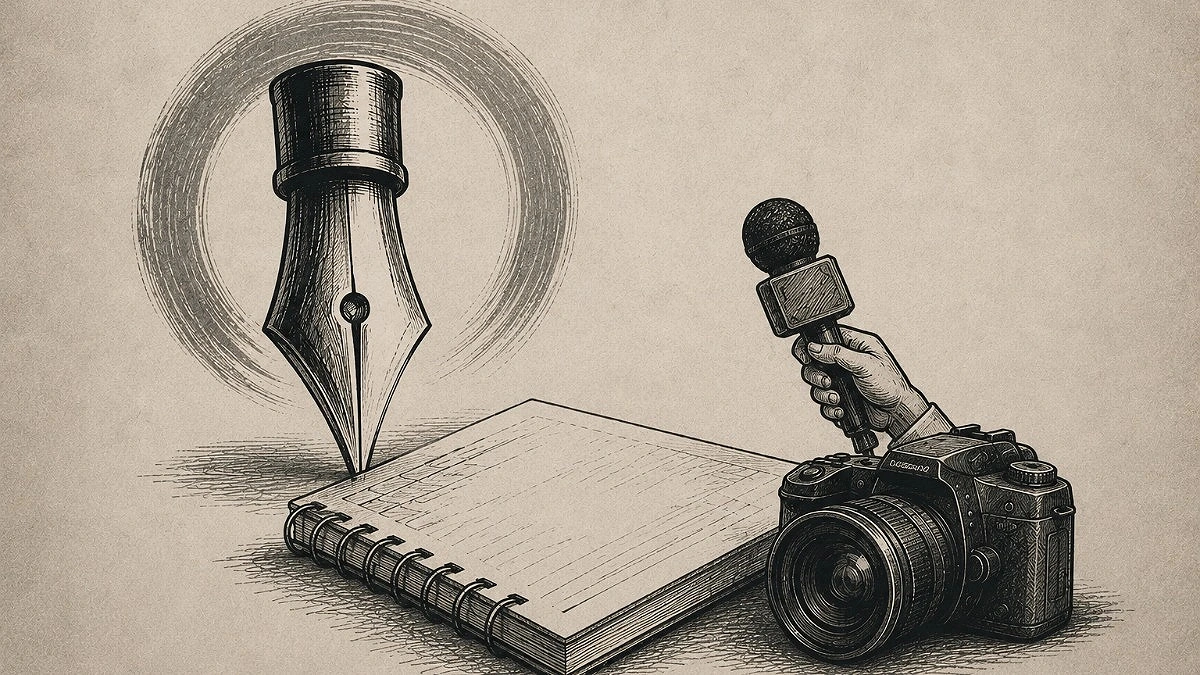
Graphics: Agamir Somoy
Journalism in Bangladesh today stands before a harsh reality. Newspapers, television channels, online portals, and even journalists’ organizations all seem divided by an invisible line. In some places, journalists have been aligned with BNP dominance; in others, those aligned with the Awami League hold sway. When governments change, the centers of power shift, and with them the status, privileges, and influence of journalists switch. As a result, journalism as a profession is increasingly being overshadowed by partisan identity.
Once, journalism was a noble profession devoted to the search for truth, the protection of public interest, and ensuring accountability of those in power. Now, in many cases, a journalist’s identity has been reduced to which political party they are close to. Journalists’ organizations, instead of focusing on professional or ethical issues, have also become divided along party lines. The shadow of political parties is clearly visible even in National Press Club activities and elections of journalists’ bodies. This has weakened unity among journalists communities and decayed their professional dignity and independence.
This reality is dangerous not only for journalists but for society and the state as a whole. When journalism is used to serve partisan interests, truth is concealed, information is distorted, and people are deprived of impartial news. If a journalist gains opportunities solely because of political loyalty while another, despite professional competence, is deprived, then merit and ethics lose their value.
In Bangladesh, the culture of journalists’ fortunes changing with political transitions has been existing for a long time. Journalists close to the ruling party gain prominence, while those with opposing views get marginalized. Some lose their jobs, some face harassment, and others become socially and professionally alienated. This creates insecurity among journalists, leading many to prioritize political protection over professional integrity.
This culture is polluting journalism. Trust and solidarity within the profession are shrinking. When one journalist begins to see another not as a colleague but as a political adversary, the very essence of journalism is destroyed. Journalists then cease to be the voice of the people and instead become part of political power structures.
To overcome this situation, what needed is patronizing a strong culture of professionalism.
Journalists must first see themselves as journalists, not as representatives of any political party. Political ideology may exist on a personal level, but it should not influence professional responsibility. In news reporting, truth, neutrality, objectivity, and ethics must be the primary standards.
Journalists’ organizations must be freed from partisan influence. Their role should be to protect journalists’ rights, provide training, enhance professional standards, and ensure media freedom. Similarly, media owners must move away from the culture of recruitment and promotion based on political loyalty.
The state and society also need to understand that partisan journalism ultimately weakens democracy. A healthy democracy is impossible without an independent, neutral, and professional media. The role of journalists is not to act as propagandists for any party, but to present the truth in the public interest.
Journalism in Bangladesh is now at a crossroads. If the profession is not taken away from partisan divisions and rebuilt on the foundations of professionalism, ethics, and independence, public trust will continue to erode. Journalism will then no longer remain an institution serving the public interest; it will become merely a tool of shifting power.
Therefore, the time has come for self-reflection. Journalists themselves must decide whether they will act as political cadres or stand as professional journalists committed to truth and the people.
