
Benefits of Padma Barrage won't materialize without increased ganges water flow
- A project worth 34,000 crore
- Plan to irrigate 2.9 million hectares of land
- Risk of flooding upstream of the barrage and erosion downstream
- Government taking the Farakka experience into account

Graphics: Agamir Somoy
At one time, the country's western and south-western regions were populated areas surrounded by rivers, canals, and green crop fields. The livelihoods of millions of people were tied to water flow. But over time, that familiar picture has changed. Due to India's withdrawal of water upstream over several decades, many rivers in Bangladesh have lost their navigability.
In some places, salinity has increased. Negative impacts have fallen on agriculture, fisheries, the environment, and the Sundarbans. To address this situation, the government has undertaken an initiative to build the Padma Barrage at a cost of Tk 34,000 crore. Water will be conserved during the monsoon and supplied to various distributary rivers and canals during the dry season. However, questions remain about whether the necessary water supply will be ensured to implement the project.
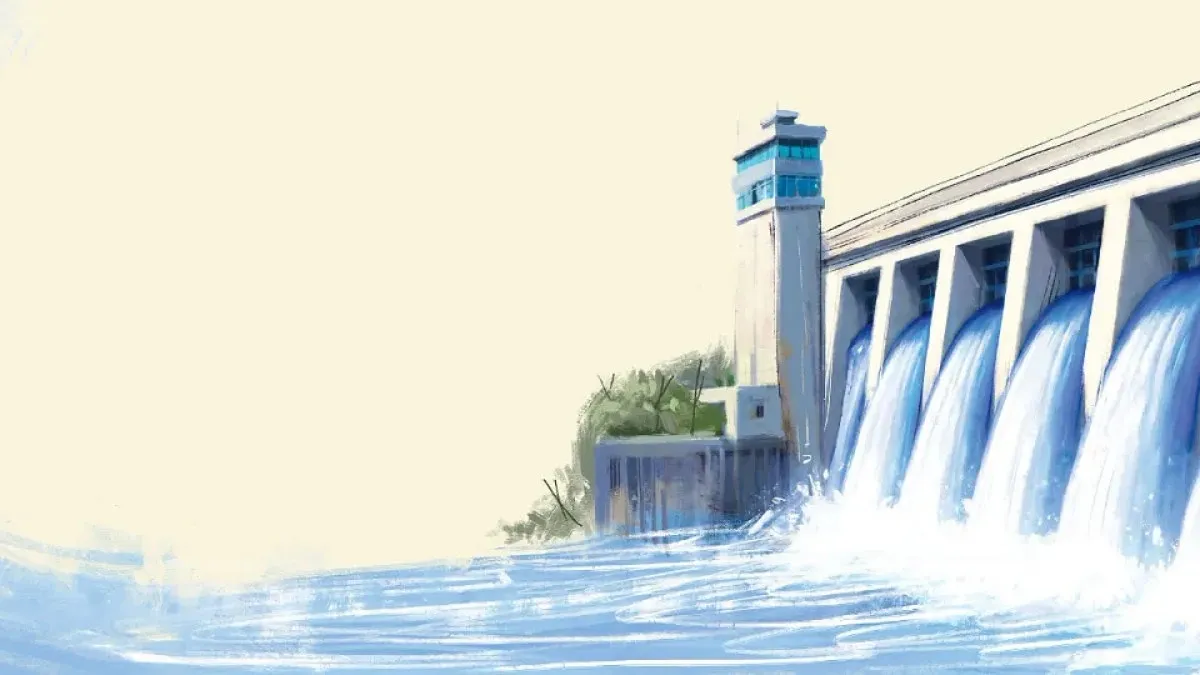
According to the plan, a barrage about 2.1 kilometers long will be built across the Padma at Pangsha in Rajbari. It will have 78 spillways, 18 under-sluices, and two fish passes for fish movement. About 3 BSM of water will be conserved. That water will be supplied to the Gorai-Madhumati, Hisna-Mathabhanga, Chandana, Barasia, Boral, and Ichamati river systems. There are also plans for river re-excavation and dredging for this purpose. The target is to supply about 800 cusecs of water to these rivers during the dry season.
According to the government's estimate, about seven crore people in 24 districts will benefit from the implementation of the project. Irrigation facilities can be provided to about 29 lakh hectares of land. There is also an expectation of producing an additional 24 lakh tons of rice and 2 lakh 25 thousand tons of fish annually. In addition, there are plans to build three hydroelectric power stations and seven satellite towns. The government also wants to supply water to several installations, including the Ganges-Kobadak and North Rajshahi irrigation projects.
The cost of the first phase of the project has been estimated at Tk 34,347 crore. According to the proposed timeline, construction work is scheduled to run from July 2026 to June 2033. If subsequent phases are added, the total cost of the project may exceed Tk 50,000 to 55,000 crore.
According to experts, an environmental impact assessment of the entire river basin is essential before implementing the Padma Barrage. Potential damage from upstream siltation, downstream river erosion, floods, salinity, and biodiversity must be taken into consideration. At the same time, dredging, canal re-excavation, and drainage system improvement are needed to restore the navigability of the Gorai-Madhumati River. An effective fish pass design must be ensured for the natural movement of fish, and a rehabilitation plan must be in place to address the potential loss of local people's land, settlements, and livelihoods.
Dr. Md. Khalequzzaman, Vice President of the Bangladesh Environmental Movement (BAPA) and Professor of the Department of Geology and Oceanography at Commonwealth University of Pennsylvania, has raised questions about the project's water supply and feasibility. He said, "The Ganges Water Sharing Treaty is expiring this year. We have found through various studies that even with the treaty in place (based on data from 1997-2016), Bangladesh was deprived of the fair share mentioned in the treaty 52 percent of the time. During the same period, Bangladesh did not receive its fair share 65 percent of the time during the critical period (March-May). There is also uncertainty about exactly how much water Bangladesh will receive in the future. For this reason, it is incomprehensible how the barrage will be useful if the necessary water is not received upstream."
"Plans have been made to supply about 28,000 cusecs of water to five rivers on the right bank of the Padma. But the data on Ganges water flow during the dry season presented in the project's survey is not consistent with this promise. According to data from 1997 to 2000, the average flow of the Ganges in April was about 32,000 cusecs. At times it dropped to 11,000 cusecs. The minimum flow in March was about seven thousand cusecs. In addition, the project documents do not contain updated water flow data after 2010," he added.
His advice is that before building such a large barrage, it is essential to restore the rivers and canals of the south-western region. About 13,064 kilometers of rivers and canals have been found in the Kushtia, Jashore, and Khulna regions. If these are re-excavated to an average width of 50 meters and a depth of five meters, a capacity to hold about 3.25 BCM of water can be created. Alongside this, expansion of TRM or tidal river management in the Beel Dakatia region, restoration of natural water flow connections, and reform of polder management are needed.
Stating that renewal of the Ganges Treaty with India is very important for Bangladesh's water security, this expert said the new treaty must be long-term, 12-month, and basin-based. It must have an effective guarantee clause to ensure a fair share of water. In this regard, the principles of the United Nations' 1997 Convention on International Watercourses can be considered. This convention has important provisions regarding the rights of upstream and downstream countries, fair water distribution, and dispute resolution. These principles should be used as a basis in discussions with India, Nepal, and other basin countries.
Professor Dr. Nazmul Islam, Dean of the Faculty of Environment and Earth Sciences at Pabna University of Science and Technology, has expressed deep concern about implementing the project under the existing design. In his words, given the geographical location and natural characteristics of the Padma River, if a barrage is built, there is a risk of the riverbed rapidly filling up due to silt being trapped upstream. This will make the water flowing downstream silt-free and "hungry," which will create severe erosion along the riverbanks. In addition, if the freshwater pressure in the Meghna estuary decreases, there is an extreme risk of seawater salinity penetrating deeper, even into the low-lying haor region in the north-east.
