
BRAC study: 83% of Rohingya youth want to return to Myanmar

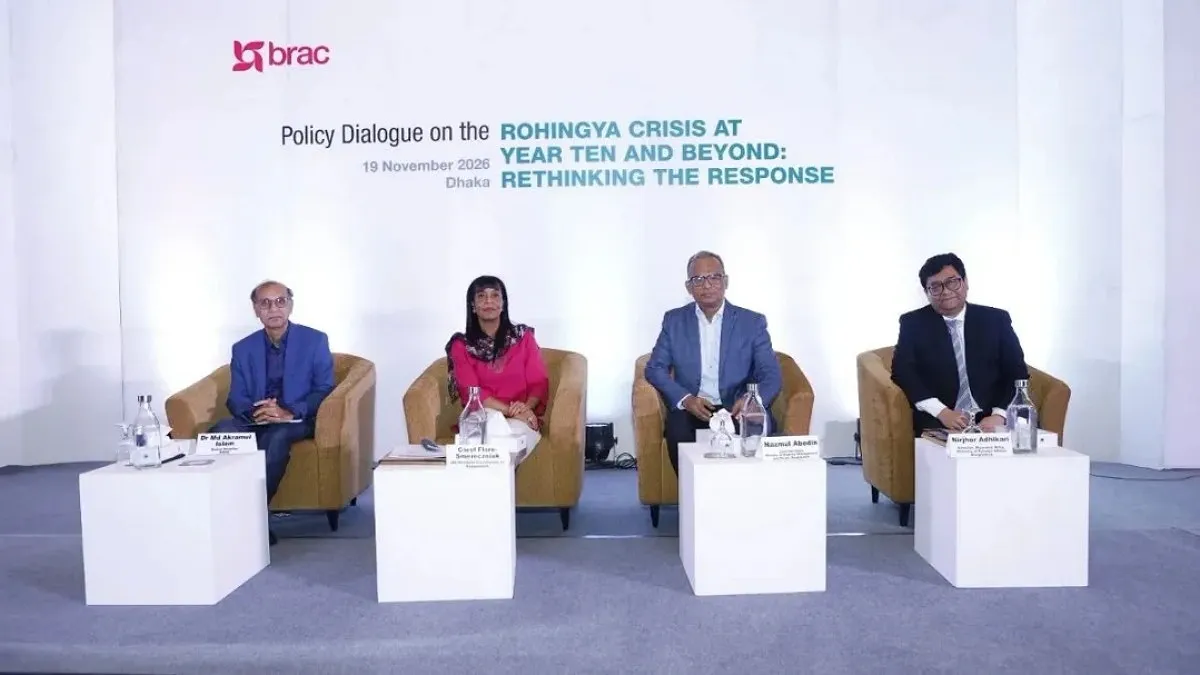
Photo: Courtesy
Rohingya youth seek citizenship, equal rights, security, and job opportunities. Among them, 82.6 percent of youth wish to return to Myanmar if citizenship and equal rights are guaranteed.
However, if only specific repatriation conditions are met, the interest drops slightly to 76.6 percent. Meanwhile, if citizenship is granted without security and employment opportunities, only 19.4 percent express a desire to return.
BRAC confirmed the findings on Thursday during a policy dialogue titled “Rohingya Crisis at Year Ten and Beyond: Rethinking the Response” held at the Hotel Sonargaon in Dhaka.
The research was conducted by BRAC Advocacy for Social Change, focusing on two main areas: one examining the Rohingya population and the other analyzing the impact of the Rohingya crisis on the local host community.
Conducted in March-April 2025, the survey interviewed 1,152 youth aged 15-35 years. Among the respondents, 576 were residents of Rohingya refugee camps and 576 were members of the local host community living adjacent to the camps.
Protracted crisis in refugee camps
According to the study on the Rohingya population, titled “Between Expectations and Reality: Livelihoods, Life in Camps, and Repatriation Hopes Through the Eyes of Rohingya Youth,” 49.7 percent of Rohingya youth are not engaged in education or employment.
Among young women, this rate reaches 84.5 percent, compared to 14 percent among young men and 17.9 percent of youth are pursuing education, while 38.4 percent are engaged in livelihood activities.
A major portion of these working youth serve as NGO volunteers, day laborers, or operate small businesses. On average, they secure work opportunities for only 15 days a month, and their employment ceases once projects conclude.
As a result, their sources of income remain uncertain, leaving most struggling with deficits in meeting basic needs.
The BRAC study also established a direct link between income levels and interest in repatriation. Among youth with some form of income, 79.3 percent desire to return home, whereas among those without an income, the figure drops to 53.4 percent.
The research indicates that if assistance and employment opportunities in the camps are reduced, 52.6 percent of youth prefer to remain there. On the other hand, if security in the camps deteriorates and instability in Myanmar persists, 27.8 percent are considering moving elsewhere.
Pressure on local livelihoods
The study on the local population, titled “Living in the Shadow of Crisis: Livelihoods, Gender Equality, and Coexistence Through the Eyes of Local Youth in Ukhiya and Teknaf,” revealed that 66.7 percent of local youth reported their livelihoods have been adversely affected by the Rohingya crisis.
Among them, 85.8 percent stated that finding employment has become difficult, 65.9 percent noted a reduction in wages, and 36.4 percent lost their jobs entirely.
In Teknaf, Cox’s Bazar, 71.6 percent of youth reported livelihood damage, compared to 60.1 percent in Ukhiya. Although local young women lead in education, they lag behind in employment, with only 20.8 percent of young women engaged in income-generating activities compared to 70.2 percent of young men.
Additionally, 72.2 percent of local youth feel they have suffered losses due to hosting the Rohingya population. However, only 23.4 percent support forced repatriation, while 95.5 percent demand more employment opportunities from the government.
Both studies emphasize that continuing humanitarian aid alone is insufficient to manage the prolonged crisis. Beyond expanding education, skill development, and livelihood opportunities for Rohingya youth, it is essential to guarantee employment for the local host population and foster economic participation for local women.
Effective steps must be taken to create a conducive environment for safe, voluntary, and dignified repatriation to Myanmar.
Insights from policy makers
The BRAC report highlights that in 2017, over 7,00,000 Rohingya fled to Bangladesh to escape violence in Rakhine State, Myanmar. Nine years later, around 1.2 million Rohingya live in Bangladesh, yet no organized repatriation has taken place.
Most areas of northern Rakhine are currently beyond the control of the Myanmar government. In 2026, nearly 31 percent of the humanitarian appeal funds remained unfunded, causing an entire generation of youth to grow up in camps without adequate education or job opportunities.
Speaking at the seminar, Finance and Planning Adviser Rashed Al Mahmud Titumir said the solution to the Rohingya crisis must be found in Myanmar. He added, “The political rights of the Rohingya must be restored, and an environment suitable for their safe and dignified return home must be created.”
Mentioning the landmark judgment in the genocide case filed against Myanmar by The Gambia, he noted that this ruling provides them with a stronger legal foundation.
BRAC Executive Director Asif Saleh said the prospect of repatriating the Rohingya to Myanmar anytime soon remains low. He noted, “Therefore, their livelihoods and skill development should not be viewed as an integration process with the people of Bangladesh, but rather as preparation for returning to their homeland with dignity.”
UNHCR Country Representative Yvo Fresen added that the safe, voluntary, and dignified return of the Rohingya to their homeland remains uncertain. He called for long-term planning, policy changes, international cooperation, and continued humanitarian assistance.
UN Resident Coordinator in Bangladesh Carol Flore-Smereczniak said emergency humanitarian assistance alone is not sufficient. She noted, “Taking into account the long-term needs of refugees and local host communities, investments in education, health, livelihoods, and disaster resilience in Cox’s Bazar must be increased.”
