
Mob violence claims 249 lives in 12 months

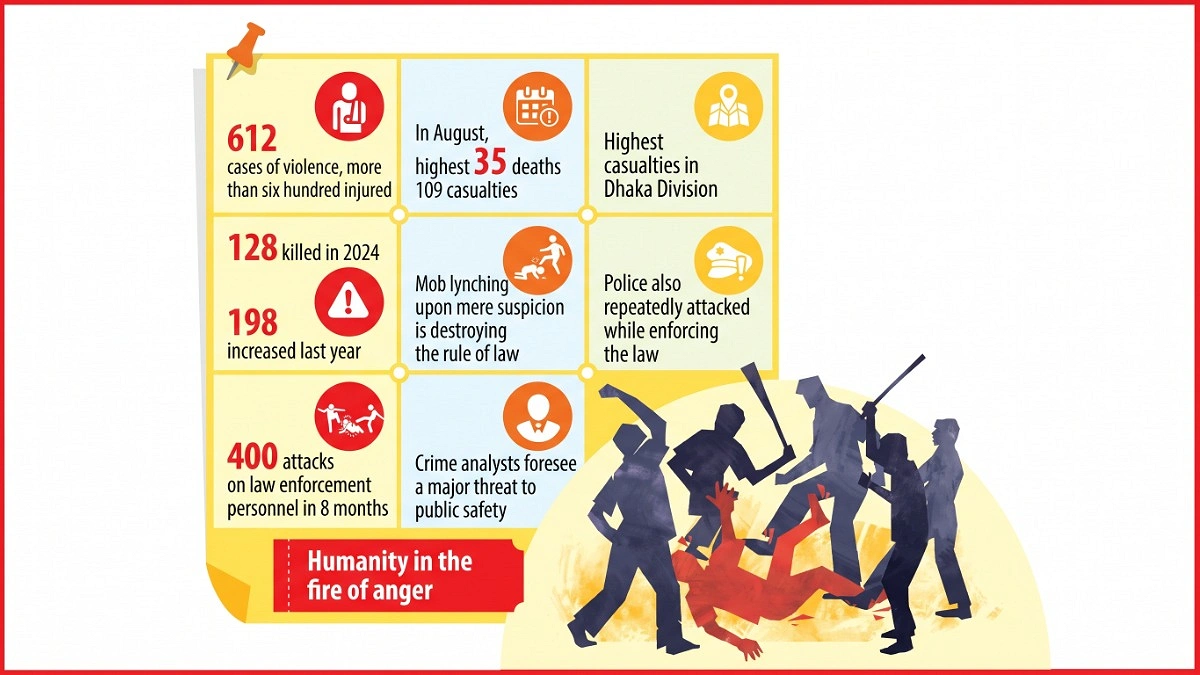
Graphics: Agamir Somoy
It was around 11 pm when several young men arrived in the village of Baliyadanga in a private car and on motorcycles. Local residents became suspicious. An announcement was made over a loudspeaker: “Robbers have arrived!” The men tried to flee as people chased them. However, they could not escape. Five people were caught in Malopara and beaten by a mob. They were later handed over to police. The incident took place on the night of September 29 in Jashore Sadar Upazila. It is just one example of mob violence in the country.
Just a few days earlier, university student Azmul was beaten to death at a mess in Khulna over allegations that he had stolen food and eaten rice. On the same day in Pabna, a group of people set fire to the two-story house of the prime accused in a rape case and then demolished it. Such incidents show how allegations of theft, previous disputes, rape or harassment can trigger sudden violence that claims lives. Organized violence of this kind, commonly known as mob violence, is increasing at an alarming rate in the country. Fatal incidents are reported almost every day in different areas.
A report by the Manobadhikar Sanskriti Foundation (MSF) presents an alarming picture. Between October last year and September this year, 612 incidents of mob violence were recorded, leaving 249 people dead and at least 664 injured.
The report, which monitors the human rights situation, states that 501 incidents of mob violence occurred during the first nine months of this year, from January to September. A total of 235 people were killed and 540 injured. This means 775 people were affected by mob violence during the period. August recorded the highest number of deaths, with 35 people killed.
Human rights activists and crime analysts say a culture of impunity is the main reason behind such violence. The tendency to deliver “justice by the public” before verifying the facts of an alleged crime is pushing society toward a dangerous path.
The tendency to take the law into one’s own hands is putting not only ordinary people but also police officers at risk. According to Police Headquarters data, police personnel were attacked in 400 incidents in just the first eight months of this year.
Mob violence claims the lives of ordinary people as well as those accused of crimes. In addition to people accused of theft, robbery and mugging, victims include police officers, teachers and people from all walks of life. Foreign nationals are also among the victims.
Human rights organizations say mob violence has emerged as a deep-rooted social crisis. Even minor disputes are rapidly escalating into deadly violence. A lack of social tolerance is contributing to the problem.
Human rights activists and crime experts say that alongside ensuring justice for offenders, authorities must take swift and visible legal action against those involved in mob violence. It is also essential to prevent rumors and incitement and restore public confidence in the legal system. If justice for crimes begins to be delivered on the streets instead of in courtrooms, not only the rule of law but also the safety of ordinary people will ultimately be threatened.
According to data from the human rights organization Ain o Salish Kendra (ASK), 154 people were killed in mob violence between January and August this year. Dhaka Division recorded the highest number of deaths at 57. The toll stood at 34 in Chattogram, 20 in Khulna, 15 in Rajshahi, 11 each in Barishal and Mymensingh, and six in Rangpur Division.
In 2024, 128 people were killed in mob violence. The number rose to 198 in 2025. Of these deaths, 81 occurred in Dhaka Division, 19 in Khulna, 17 in Rajshahi, 12 in Rangpur, four in Sylhet, 36 in Chattogram, 16 in Barishal and 13 in Mymensingh.
Professor Dr. Sazzad Siddiqui, chairman of the Department of Peace and Conflict Studies at the University of Dhaka and a crime expert, described the alarming picture of mob violence emerging in the country as “deeply concerning.”
He told Agamir Somoy, “Protecting people’s lives, security and dignity is one of the primary responsibilities of the state. Ensuring the rule of law and justice lies at the heart of that responsibility. When the law becomes weak or people begin to take justice into their own hands instead of seeking legal remedies, insecurity increases in society and the path to justice becomes narrower. In this situation, the state must take swift and visible measures to stop mob violence.”
The crime expert stressed the need to identify those involved in every incident and bring them under the law while ensuring the safety of people accused of crimes.
He said, “We must restore public confidence by ensuring swift investigations and trials so that people understand that crimes will be judged in courtrooms, not on the streets. At the same time, we must prevent rumors and incitement, ensure a rapid response from law enforcement agencies and strengthen early warning measures at the local level. Ending mob justice and establishing the rule of law can be the most effective way to ensure public safety.”
Professor Sazzad Siddiqui said that no individual or group has the right to punish someone merely because they have been accused of a crime.
He said, “The responsibility for verifying allegations, collecting evidence and ensuring that offenders are brought to justice rests with the state. If mob justice continues, not only will the lives of innocent people be put at risk, but public confidence in the law will gradually erode. Therefore, while ensuring justice for offenders, we must stop the practice of taking the law into our own hands at all costs.”
An analysis of MSF statistics shows that mob violence remained relatively low at the beginning of the year. In January, 29 incidents left 21 people dead and 26 injured. In February, the number of incidents rose to 31, with 18 deaths and 33 injuries. In March, 36 incidents resulted in 19 deaths and 31 injuries.
The situation began to deteriorate clearly in April. That month, 49 incidents left 21 people dead and 49 injured. The number of incidents rose to 69 in May, when 32 people were killed and 71 injured.
Mob violence reached an even more alarming level in June. A total of 78 incidents left 33 people dead and 126 injured. This was the highest number of injuries recorded in the first nine months of the year.
The number of incidents fell slightly to 66 in July but rose to 78 in August. That month, 35 people were killed, the highest monthly death toll in the first nine months. The 78 incidents of mob violence in August left 109 people dead or injured, including 35 deaths and 74 injuries.
In September, the death toll fell to 23 while the number of injured people remained unchanged at 74. Although the number of deaths declined, MSF’s report shows that mob violence linked to allegations of theft, land disputes, extortion, drug dealing, rape, robbery and other crimes remains a major concern for public safety.
In October 2025, at least 44 incidents of mob beatings were recorded, leaving 12 people dead and 52 seriously injured. Another 25 injured victims of beatings were handed over to police. According to MSF statistics, at least 46 incidents of mob beatings occurred in November that year, leaving 19 people dead and 41 seriously injured. In December, 24 incidents of beatings resulted in 14 deaths and at least 34 injuries.
The organization’s report highlights another alarming aspect of mob violence: personal and social disputes. Even minor disagreements are turning into deadly violence. Another new and worrying trend involves allegations of sexual violence. In September, six people were injured in incidents linked to allegations of attempted rape or harassment.
Police personnel are also falling victim to mob violence. A review of crime statistics from Police Headquarters shows that 601 attacks on police personnel occurred while they were performing their duties between January and December last year. During the first eight months of this year, from January to August, police personnel were attacked in 400 incidents.
Of these attacks, 42 occurred in January, 42 in February, 63 in March and 66 in April. There were 55 attacks in May, 49 in June, 42 in July and 41 in August.
Advocate Saidur Rahman, a human rights activist and chief executive of MSF, identified a lack of tolerance in society as a key reason behind recurring incidents of mob violence.
He said, “The police administration must become more active to stop these incidents. As soon as the police receive information about a mob, they must go to the scene, protect the person under attack and bring those involved in the mob under the law. Those who lead or participate in mob violence must also be identified and arrested quickly.”
The human rights activist believes community policing needs to be strengthened further.
He said, “It may take time for police to reach remote areas. Therefore, local people must be made aware and involved in preventing mob violence. Raising awareness among community members against mob violence and educating the public about not taking the law into their own hands are also responsibilities of the police.”
He added, “At the same time, mob violence cases must be investigated quickly and impartially, and appropriate charge sheets must be submitted to the court. The judiciary must also take steps to dispose of these cases promptly. Appointing judges as needed, increasing court capacity and modernizing the judicial system are essential. If a mob violence case is tried five or 10 years later, its impact on the general public diminishes. Therefore, it is essential to bring offenders under the law quickly and ensure visible justice. A coordinated role involving the police administration, communities and the judiciary is necessary to prevent mob violence.”
Police Headquarters’ recently retired spokesperson, AIG (Media and Public Relations) A. H. M. Shahadat Hossain, said there could be several reasons behind attacks on police personnel.
He told Agamir Somoy, “If someone commits a crime, it is the responsibility of the state to ensure justice. The country’s existing laws clearly provide for the trial of offenders. Even if someone is considered a criminal, no one has the right to punish that person personally. If there is an allegation, the person must be handed over to the law enforcement authorities. Any attempt to deliver justice or impose punishment by taking the law into one’s own hands is entirely illegal.”
The police official warned that strict action would be taken against anyone who took the law into their own hands.
Regarding attacks on police personnel, he said, “Attacks on police are in no way acceptable. Alongside ensuring the safety of police personnel while they perform their duties, those involved in such incidents are being identified on the basis of specific information and evidence, and legal action is being taken against them. At the same time, emphasis is being placed on professionalism, restraint and taking lawful measures as necessary to control the situation.”
