
From Tk 627 to Tk12,500
How reasonable is the apparel workers' demand for a Tk30,000 wage?

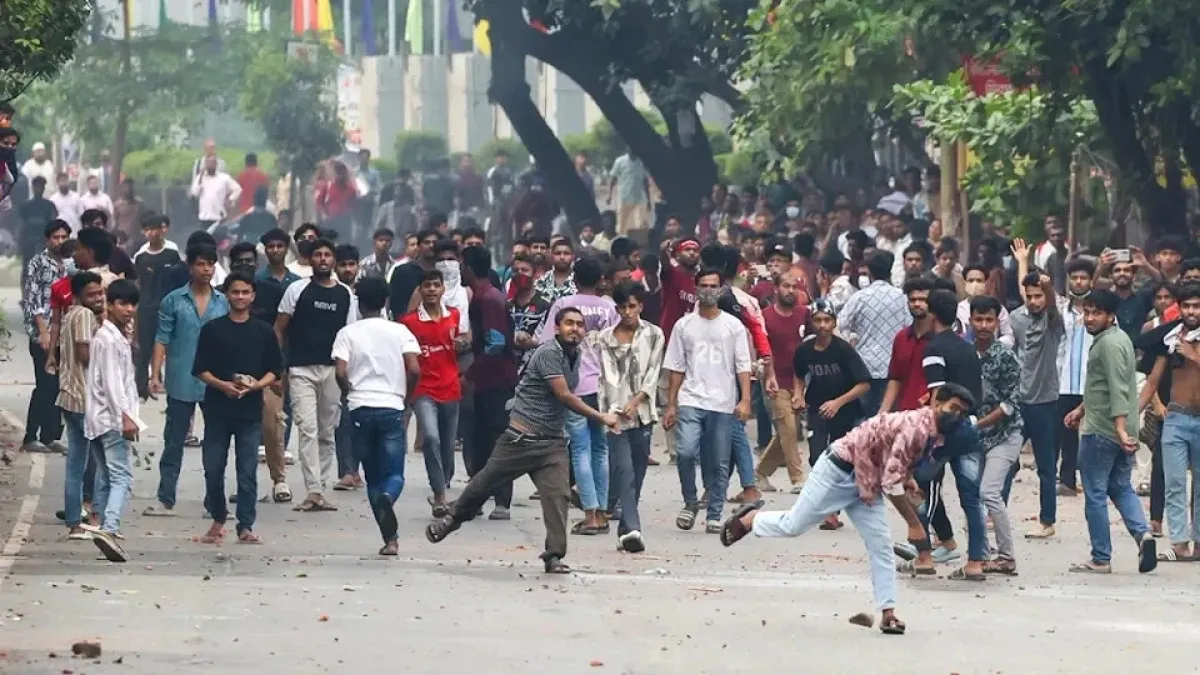
Workers are throwing stones at the police. Photo: Agamir Somoy.
Bangladesh's ready-made garment industry is one of the main pillars of the country's economy. It is this industry through which Bangladesh has established its position in the global market, and it is on this industry that a large portion of the country's export earnings depends.
The ultimate truth is the lifeblood of this clothing industry is its millions of workers. Yet whenever questions arise about these workers' fair wages, cost of living, and workplace safety, the industrial belt repeatedly gets heated. Workers take to the streets; protests begin, factories shut down, production stalls, and export uncertainty is looms.
This seems to be a familiar script for Bangladesh's garment industry. Workers' discontent grows, movements begin, the government forms a wage board, discussions are held with owners' and workers' representatives, and a new wage is announced. The situation remains calm for a while. Then, as inflation rises and house rents and the prices of essential goods increase, old discontent rears its head again.
Toward the end of last month, that same picture emerged once again. This time, the workers' demand is a monthly minimum wage of Tk30,000. Amid the workers' agitation, the government formed a new wage board on November 1.
While announcing the formation of the new wage board at the secretariat, Labour and Employment Minister Ariful Haque Choudhury called on the workers to go back to work. The gist of his statement was that the new board would now discuss wage determination, so there was no need to block roads.
He warned at the time that if factories remained closed, production, the supply system, and export shipments could be disrupted. Ultimately, this would also affect the workers' wages and employment.
The minister's words, however, did not stop the workers' movement. The next day, November 2, workers also blocked roads and protested in the capital and surrounding industrial areas.
So the question naturally arises: after seven changes to the wage structure, why do workers still have to take to the streets again and again? Is the wage board solving the problem, or merely keeping the situation calm temporarily? And, there are also questions about how reasonable the workers' demand for a minimum wage of Tk30,000 in the recent movement really is.
In remarks made last Sunday in the context of the movement in Mirpur, Dhaka, Khondaker Khairul Mamun Mintu, legal affairs secretary of the Bangladesh Garment and Sweater Workers Trade Union Centre, said that this time the workers have three main demands. Among them, setting the minimum wage at Tk30,000 is one. He also mentioned as a cause of discontent that the wage board was not formed by October as previously promised.
From 1984 to 2026: The History of Wage Increases, the Recurrence of Discontent
The first minimum wage structure in Bangladesh's ready-made garment industry was announced in 1984. At that time, the monthly wage for workers in the lowest grade was set at 627 taka. After that, it rose to 930 taka in 1994, 1,662 taka 50 paisa in 2006, 3,000 taka in 2010, 5,300 taka in 2013, 8,000 taka in 2018, and most recently 12,500 taka in 2023.In other words, over nearly four decades, the minimum wage has on paper increased about 20 times. But if inflation, house rent, medical care, transportation, food, and children's education costs are factored into this calculation, the real picture changes.One thing is noticeable in this history: every time before a wage increase, workers' demands and movements have come to the fore. That is, when it comes to re-evaluating workers' income, pressure from movements has often proven more effective than regular and proactive initiatives.On October 31, Touhidur Rahman, former general secretary of the Industrial Bangladesh Council, told journalists that workers' organizations had long been demanding the rapid formation of a wage board, but the government delayed the matter.According to him, if the board had been formed on time, the current discontent could have been avoided. However, he cautioned that interested quarters could push the workers' legitimate movement toward disorder.Fahmida Khatun, Distinguished Fellow of the Centre for Policy Dialogue, said the government should have begun reviewing wages in line with the cost of living before waiting for workers to take to the streets.She further said that alongside raising wages, the industry's business environment must be improved through an uninterrupted energy supply, reduced operating costs, and the removal of administrative complexities.In 2006, worker discontent in the garment industry grew large. Because the wage set in 1994 had remained in force for a long time and the cost of living had risen, workers took to the streets. At that time, the workers' demand was to set the minimum wage at Tk3,000. After the movement, the government revised the wage structure and set the minimum wage at 1,662 taka and 50 paisa. In other words, what was received was much less than the demand.The Bangladesh Center for Workers Solidarity says that the same situation arose in 2010. Among the workers' demands was a minimum wage of 5,000 taka. After movement and discussions, the erstwhile government set the minimum wage at Tk3,000.Then, in 2013, the horror of the Rana Plaza collapse brought the entire apparel industry into discussion anew. On April 24, more than 1,134 people were killed in the Rana Plaza collapse in Savar. At that time, the issues of garment workers' safety, working environment, labour rights, and wages gained importance internationally as well.A Reuters report published on September 21, 2013, said that in September of that year, about 50,000 workers protested in Dhaka demanding a wage increase. Another report published on September 23 said that more than a hundred factories were closed due to protests in the Gazipur and Savar areas, and at least 50 people were injured in clashes. Even the owners' proposal of a 20 percent increase, as against the workers' demand, was not acceptable to the workers at that time.These events show that in Bangladesh's garment industry, the wage question was never merely a question of a number. Linked to it were the workers' standard of living, safety, dignity, and their participation in the decision-making process.In 2018, before the announcement of the new wage structure, movement began again. The demand of workers' organizations was a minimum wage of 16,000 taka. On the other hand, the owners' position was that wages had to be increased in consideration of production costs and competition in the international market.In September 2018, the government announced a minimum wage of 8,000 taka. That was an increase of about 51 percent from the previous 5,300 taka. But discontent arose over the gap in wage increases among workers of different grades under the new structure. In particular, some workers in the middle grades complained that they did not receive the expected benefits.According to the Business and Human Rights Centre, in January 2019, protests began again in Ashulia, Savar, and various other areas. To manage the situation, the government formed a tripartite committee. Although wages in several grades were adjusted through the committee's discussions, the minimum wage was kept at 8,000 taka. Allegations also arose at that time that about 12,000 workers were dismissed after the movement.In October-November 2023, major worker discontent was again seen in the apparel industry. At that time, a section of workers' organizations demanded a minimum wage of 23,000 to 25,000 taka. The owners initially proposed 10,400 taka. On the other hand, workers' representatives proposed 20,390 taka.After long discussions, protests and clashes, on November 7, 2023, the then State Minister of Labour and Employment, Begum Monnujan Sufian, announced the new minimum wage of 12,500 taka. It was announced that the new wage would take effect from December 1, 2023. This increase from the previous 8,000 taka was 56 percent.After the announcement that day, State Minister Monnujan Sufian said that, per the prime minister's directive, the wage had been increased by 56 percent.On the other hand, Sirajul Islam Rony, workers' representative on the wage board and president of the Bangladesh National Garment Workers League, commented that the decision was acceptable. After the wage announcement on November 7, he said that, considering the realities of the garment industry and the prime minister's directive, the workers would accept the board's decision.However, not all workers' organizations agreed with this decision. Many organizations objected, saying this wage was not consistent with inflation.The most painful chapter of the 2023 movement was the loss of life. That year, on October 30, two workers named Russell Howlader and Imran Hossain died in clashes and a fire at a factory.Before even three years had passed, a new wage movement began again. In other words, the 2023 decision could not provide a permanent solution to the workers' long-term cost-of-living crisis.
