
Over 1.1 million people affected by floods

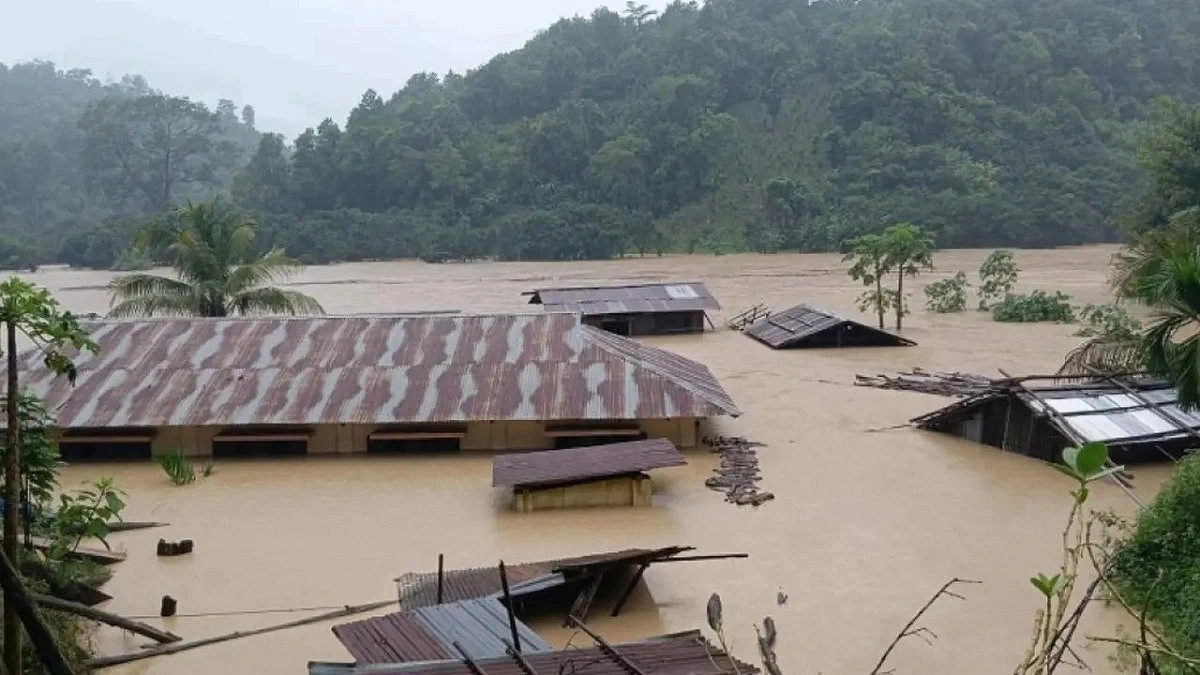
Collected Photo
The International Federation of Red Cross and Red Crescent Societies (IFRC) has reported that more than 1.1 million people have been affected by the ongoing floods across 10 districts in the country. Citing government data, the organization stated that the floods have so far claimed 59 lives. Additionally, over 38,000 people have been displaced.
According to an IFRC report published yesterday (Sunday), several days of continuous heavy monsoon rains have caused widespread flooding, flash floods, river floods, and landslides in the southeastern and northeastern regions of Bangladesh. Unusually high rainfall was recorded, particularly in Chattogram, Teknaf, Bandarban, and Sylhet. On July 9, Chattogram recorded 298.8 millimeters of rainfall, followed by 203 millimeters on July 10. Teknaf experienced 245 millimeters of rainfall on July 10. The highest rainfall on July 11 was recorded in Sylhet's Jaflong at 156 millimeters. The following day, Bandarban's Lama recorded 155 millimeters, and Cox's Bazar's Teknaf recorded 139 millimeters.
The report said that water levels in major rivers, including the Surma in the northeast, have started to recede. This has raised hopes for further improvement in the flood situation in the low-lying areas of Sylhet and Sunamganj. Similarly, water levels in the Teesta, Dharla, and Dudhkumar rivers in the Rangpur division are also declining. However, suffering persists in many areas due to damaged roads, disrupted communication systems, waterlogging, and the risk of landslides.
The IFRC stated that 267,918 families across seven districts are marooned or isolated. According to a preliminary government assessment, 15,881 houses in Bandarban, 13,860 in Chattogram, 1,040 in Khagrachhari, and 1,613 in Cox's Bazar have been damaged. Furthermore, the floods have affected 374 unions and four municipalities within 56 upazilas (sub-districts).
The floods and landslides have also significantly impacted 33 Rohingya refugee camps in Cox's Bazar. Over 28,000 people there have been affected, with more than 3,000 shelters damaged and over 4,700 people displaced. The UN Refugee Agency (UNHCR) has confirmed the deaths of 15 Rohingya individuals.
The report added that the most severely affected districts include Chattogram, Cox's Bazar, Bandarban, Rangamati, Khagrachhari, Moulvibazar, and Habiganj. Residents in these areas are enduring extreme hardship due to damaged homes, disrupted livelihoods, limited access to essential services, and destroyed infrastructure.
The IFRC noted that the Bangladesh Army, Navy, Coast Guard, Fire Service and Civil Defense, and local administration are conducting rescue and relief operations. Over 1,000 shelters have been opened for affected people. To ensure emergency healthcare, 516 medical teams have been deployed across 50 upazilas.
The government has allocated 3,350 tons of rice, 235 million Taka in cash aid, 4,200 bundles of corrugated iron sheets, and 12.6 million Taka for house repairs in seven districts.
Additionally, the report mentioned that Bangladesh Red Crescent Society (BDRCS), IFRC, World Food Programme (WFP), and other development organizations are distributing cash, dry food, hygiene kits, and shelter repair materials in the affected areas.
