Children form human chain demanding a Sundarbans free of forest pirates

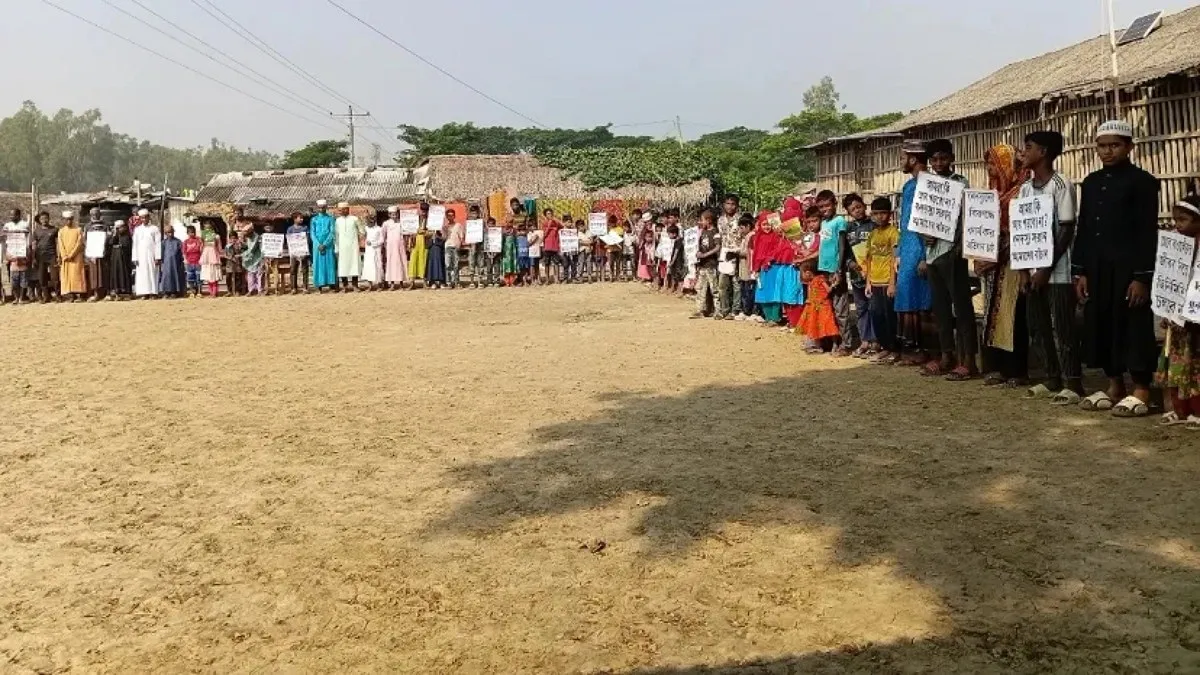
Photo: Agamir Somoy
They are between eight and 10 years old. Some hold placards while others chant slogans. Their message reads, “We want to study, we want to live, we want a Sundarbans free of pirates.”
At an age when they should be going to school with books and notebooks, these children have taken to the streets demanding an end to piracy in the Sundarbans. The reason is that their parents cannot enter the forest because of fear of forest pirates. Their families’ sources of income have dried up, affecting the children’s education.
Around 200 students gathered at the field of No. 9 Sora Ebtedayi Madrasa in Gabura Union of Shyamnagar, Satkhira, at around 11:30 am on Friday. They formed a human chain demanding that the Sundarbans be freed from forest pirates.
Most of the participating children’s parents earn their livelihoods by catching fish and crabs in the rivers and canals of the Sundarbans. However, they can no longer enter the forest because of the threat posed by pirates. Their boats remain tied up at the riverbank while fishing nets lie unused on their verandas.
With their income cut off, the families are facing financial hardship. This has affected their ability to pay for their children’s books, notebooks, clothing and education.
Standing in the human chain, Ayezkuruni, a fourth-grade student at Gabura Drishtinandan Government Primary School, questioned the adults. He said, “My parents cannot go to the Sundarbans. So, we cannot study. They cannot afford our expenses. People in our area have been protesting for one or two months, but the Sundarbans has still not been freed from pirates. So, this time, we have taken to the streets ourselves. If our parents cannot go to the forest, how will we build our future? How will we study in school and college?”
Hamim Islam, a fifth-grade student at the same institution, has a father who catches crabs in the Sundarbans. His earnings support the family and Hamim’s education.
Hamim said, “My father catches crabs in the Sundarbans to support our family. My education expenses are paid with that money. But now my father cannot go to the forest because of robberies. Even the fees for my private tutor have been unpaid for three months. I cannot study properly. Our demand to the government is to make the Sundarbans free of pirates as soon as possible.”
Aishi Akter, a student of the madrasa, expressed the same concern. She said, “My father cannot go to the forest. So, he cannot afford our education expenses. That is why I have joined this human chain. We want to study. Our demand is that our fathers should be able to work in the forest safely.”
Parents have also expressed solidarity with the children’s demands.
A parent named Ammat Hossain said, “We ourselves cannot even afford to eat properly. The number of pirates in the forest has increased so much that we cannot go there to work. We barely have enough food to survive. How can we afford our children’s education?”
The activities of forest pirates have put not only fishing families but also local mosques, madrasas and educational institutions in difficulty.
Hafez Maulana Shafiqul Islam, imam of No. 9 Sora Mosque, said these institutions also depend considerably on the income of people in the coastal area. With the increase in pirate activities, fishermen and forest workers can no longer enter the forest. As a result, families are facing financial hardship. Many parents cannot afford their children’s education expenses.
He said, “Our appeal to the government is to free the Sundarbans from forest pirates as soon as possible and ensure that fishermen and forest workers can safely return to their livelihoods.”
During the human chain, the children chanted together, “We want to study, we want to live, we want a Sundarbans free of pirates.”
They also demanded that the safety of fishermen and forest workers be ensured and effective action be taken against forest pirates without delay.
Retired primary school headteacher Nasir Uddin described the children’s demands as extremely important.
He said, “There is nothing complicated about what these children want. They do not want to go to the forest themselves. They want their parents to be able to go there safely. When their parents’ boats leave the riverbank again and return safely, income will return to their homes. With that income, the children will be able to return to school with their books and notebooks.
“During my long career as a teacher, I have seen that when parents lose their income, children’s names are first removed from school attendance registers. Today, many of those standing in line and chanting slogans are already attending school less regularly. If this hardship continues, we cannot rule out the possibility that many of them will drop out.
“In this community, where people depend on rivers and forests for their livelihoods, the safety of a family is also the security of the next generation’s education.”