
Wage board delay sparks fresh unrest in garment factories

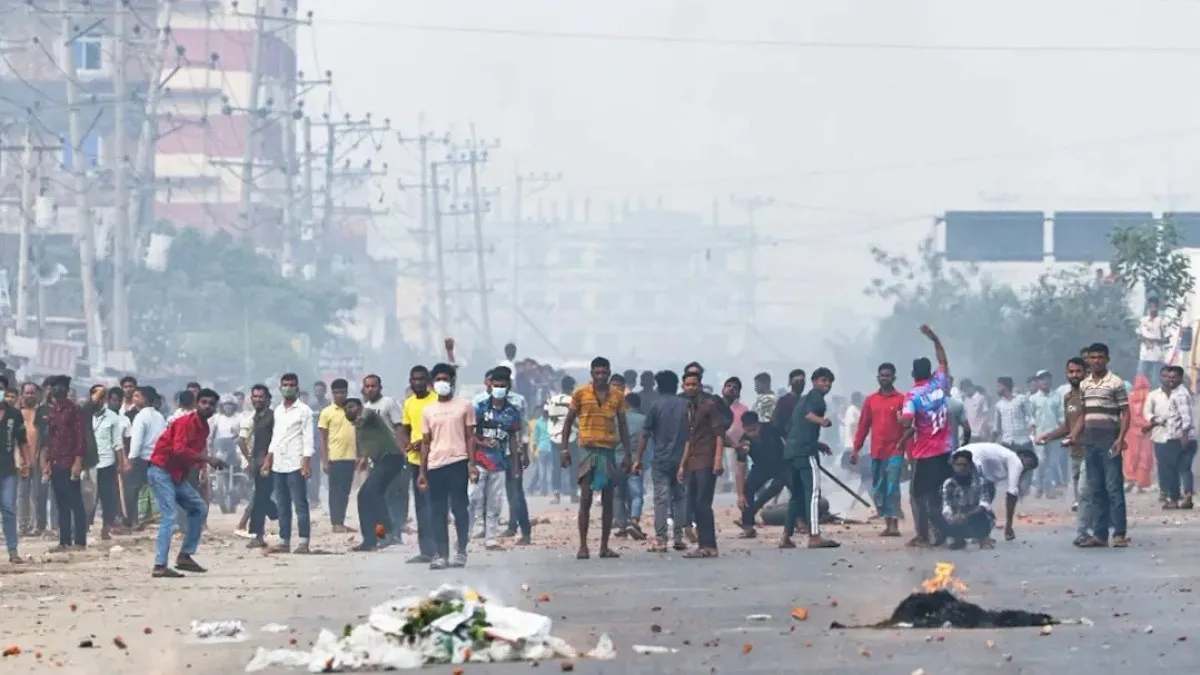
Photo: Agamir Somoy
Fresh unrest erupted in the country’s ready-made garment industrial zones due to the postponement of the minimum wage board’s third meeting and the absence of any specific proposal from the factory owners.
The heat and pressure on the ground seem to have become the primary tool for workers to secure fair wages, rather than the discussion table. Relying on the perception that owners will not raise salaries at a respectable rate without creating an effective presence and pressure on the streets, workers took to the streets again on Tuesday.
Explaining the delay in forming the wage board and the underlying reasons behind the overall situation, Bangladesh Garments Shramik Oikya Parishad Chairman Touhidur Rahman told Agamir Somoy, “It takes at least 5-6 months to finalize the wage after forming the wage board. This time is needed to reach a consensus through discussions on the proposals submitted by workers and owners.
“For this reason, we asked the government back in August to form the wage board. But since the government was new and had no wing to work with the workers of this sector, or they could not work properly, an unorganized worker movement developed as a result. Political polarization has also joined this. Overall, the workers are angry.”
He said, “Workers have become even more enraged because the third meeting was not held and reports spread through various channels about the possibility of the owners proposing a minimum wage of Tk 15,000. However, we are repeatedly saying that disorder in the industry will not be good for any party.”
Many labor leaders also view the postponement of the wage board meeting and the silence of the owners as stalling tactics regarding the wage increase.
Regarding this, Revolutionary Garments Workers Federation President Arabindu Bepari said, “Workers are angry because the wage board meeting was not held. They feel that procrastination over raising wages has begun. Although the postponement of the meeting did not violate any law, the owners have still not held any formal meeting with all labor organizations. As a result, workers are in a state of mistrust.”
Warning about the situation, he added, “It is being heard that the owners might propose a minimum wage of Tk 15,000. If that happens, workers may become even more agitated. Under market conditions, a wage of Tk 15,000-16,000 will by no means be accepted. For these reasons, workers have taken to the streets again.”
On the other hand, urging workers to remain calm for the sake of the industry, Bangladesh Garments Shramik Shilpa Oikya President Rafiqul Islam Raja told Agamir Somoy, “The government is sincere about giving workers a respectable wage. We do not want any factory to close down in the name of agitation. If the industry shuts down, both owners and workers suffer losses.
“The wage board has been formed, where we have submitted a proposal, the owners will submit a proposal, and then a final decision will be made through discussion. Until then, I believe workers need to remain calm.”
Explaining why workers are angry despite the absence of an official proposal from the owners, he said, “Although the owners have not yet submitted a final proposal, workers are learning through various sources that they might propose Tk 15,000. That is also a reason for the workers being angry. They feel that unless they show impact on the ground, owners will not raise wages.”
The minimum wage for garment workers is Tk 12,500. In light of rising commodity prices, the workers’ representative submitted a proposal for a minimum wage of Tk 32,000 at the wage board meeting. However, the owners have not yet submitted any official proposal.
Instead, anger erupted among workers as rumors spread that during internal discussions, the majority of owners favored proposing Tk 15,000. According to the workers’ calculations, increasing the wage from Tk 12,500 to Tk 15,000 represents an increase of only Tk 2,500.
They took to the streets precisely because this minor increase is entirely unacceptable in the market situation.
Centering around this movement on the ground, incidents of factory vandalism and violence are occurring in some areas of the industrial zones. However, labor leaders explicitly claim that genuine and general workers are never involved in destroying their own workplaces.
In this regard, Rafiqul said, “We believe that genuine workers cannot be involved in any kind of disorder.”
Echoing the same sentiment, Arabindu Bepari expressed concern over the infiltration of outsiders into the movement, saying, “Disorder is higher in some areas, where a third party has entered. The government must quickly identify them and take action.”
According to them, identifying the third party causing disorder, alongside owners quickly sitting down for discussions with all labor organizations and presenting an acceptable wage proposal, can resolve the ongoing instability in the industrial sector.
